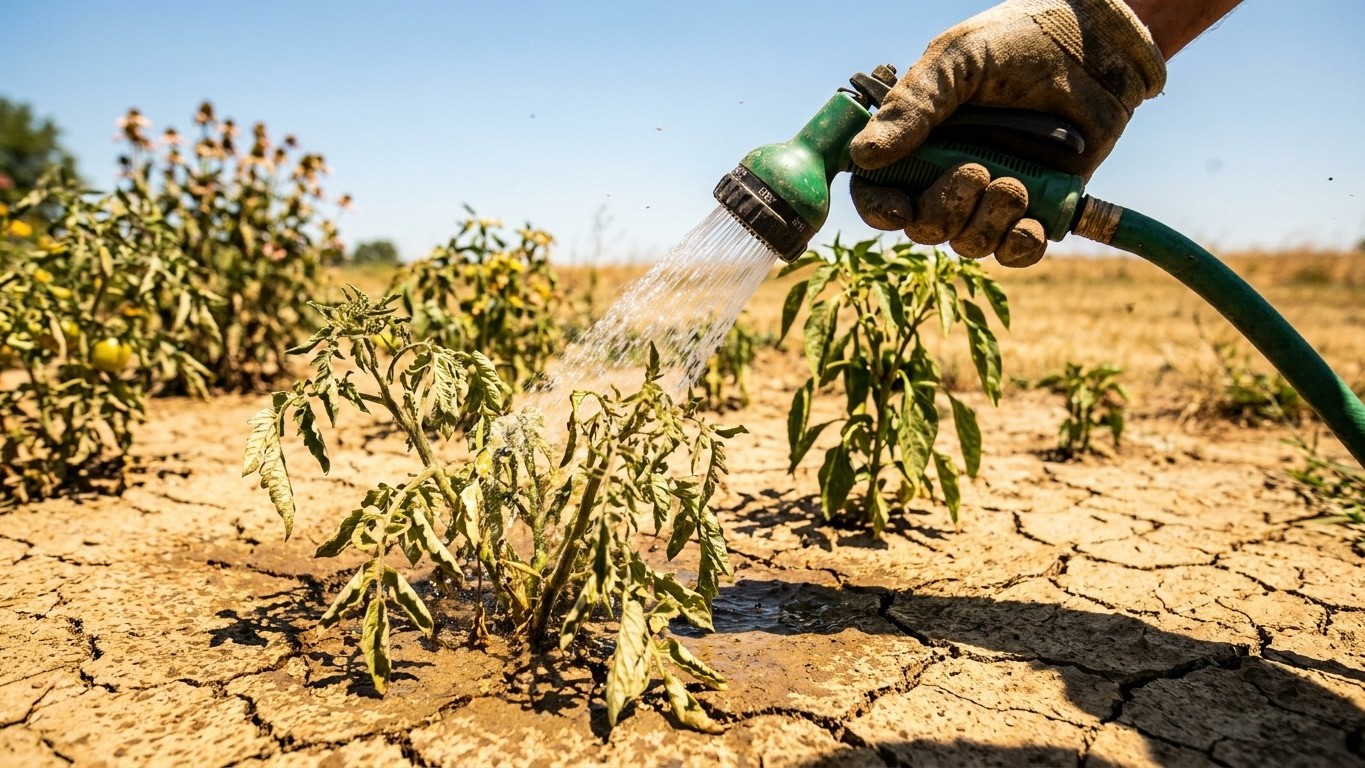

July delivers 3.71 inches of rain across the month here, and the year brings 14.0 days that hit 90 degrees or hotter. Those two numbers together mean the driest stretch of summer lands right when heat is pulling the most moisture out of the soil, so a garden that looked fine in June can wilt fast once both trends overlap.
What changes here
Start with the numbers as they stand: 3.71 inches of rain in July, the driest of the three summer months, and 14.0 days a year reaching 90 degrees or above. June brings 4.1 inches, August 4.25, so July is the low point in an otherwise fairly generous summer total of about 12.1 inches. Put side by side, those two figures tell a gardener something specific: the month with the least rain is also sitting inside the stretch of the year with the heaviest heat load, which is exactly when a bed needs the most water and gets the least of it from the sky.
Run the arithmetic. A vegetable bed or a young perennial border wants roughly an inch of water a week to keep growing without stress. Spread July’s 3.71 inches evenly across the month’s four-plus weeks, and the sky is supplying about 0.84 inch a week on average. That leaves the gardener carrying the remaining sliver, somewhere around 0.15 to 0.2 inch a week, just to hit the target. It sounds small until you remember that average is not reality: July rain in this part of the country tends to arrive as a thunderstorm rather than a steady drizzle, dumping half an inch in twenty minutes and then leaving the ground dry for ten days. The monthly total can look adequate on paper while a bed goes bone-dry in the gaps between storms.
Soil texture decides how far that inch actually reaches. A sandy bed lets water pass through within hours, so even a generous storm does little for a plant’s roots three days later. Heavy clay holds water for a week or more, which sounds like an advantage until a second storm arrives on top of ground that never drained, drowning roots that need air as much as moisture. Without knowing the exact soil profile under a given yard, the safest approach is to test it directly rather than assume: dig down a few inches after a rain and see how long the ground stays damp. That tells you more than any regional average ever will.
How to water when it matters
The method that works on this ground is the same one that works almost everywhere, but the reasons behind it matter more here than in a milder climate. Deep watering pushes moisture down where roots actually live, training them to grow downward instead of clustering near a surface that bakes hard the moment a 90-degree day hits. Frequent shallow watering does the opposite: it keeps roots shallow and vulnerable, which is a bigger risk here given how many days a year reach that heat threshold. Watering at the base rather than overhead means the moisture goes where it’s needed instead of evaporating off leaves before it ever reaches soil, and morning watering gives plants a full day to take up what they need before the afternoon heat arrives to pull it right back out.
Checking soil moisture at root depth, not just at the surface, is the habit that separates a garden that survives July from one that struggles. A finger pushed two inches down, or a trowel turned to check the same depth, tells you whether the ground is actually dry where it counts. Surface soil can look pale and cracked while two inches down it’s still holding moisture from last week’s storm, and watering on top of that just invites the drowning problem clay soils are prone to.
Here’s a practical sequence to start from, adjusted against whatever your own soil turns out to be:
- Check soil moisture two inches down with a finger or trowel before watering at all, rather than watering on a fixed schedule.
- Water at the base of the plant, early in the morning, aiming for about 1 inch total per week as a starting point.
- On sandy ground, split that inch into two or three shorter soakings a week rather than one large one, since sand won’t hold a full inch long enough to matter.
- On heavy clay, water less often but more slowly, letting the ground dry partway between sessions to avoid waterlogging roots.
- During any stretch of days at or above 90 degrees, recheck soil moisture every two to three days instead of waiting for the next scheduled watering.
That one-inch figure is a starting point, not a rule. The only way to know if it’s enough for a particular bed is to keep checking the soil directly and adjust from there.
What goes wrong
Watering a little every day
A daily sprinkle feels responsible, but it wets only the top inch or so of soil and never encourages roots to grow deeper. Those shallow roots then sit right in the zone that heats up fastest on any of the 14.0 days a year that reach 90 degrees, and the plant stresses out exactly when it can least afford to.
Watering leaves in the evening
Wetting foliage after dinner leaves moisture sitting on leaves overnight with no sun or breeze to dry it off. That damp surface is an open invitation for fungal disease, which spreads faster in a climate that swings between hot, dry stretches and sudden downpours the way this one does.
Trusting a rain shower that barely wet the surface
A quick summer storm can look convincing from a window and still only soak the top half-inch of soil. Given that July rain here tends to fall as sharp thunderstorms rather than steady rain, this is probably the costliest mistake in this climate: skipping a watering because it “rained” when the ground two inches down never got touched. Check with a finger before assuming the sky did the job.
Skipping mulch
Bare soil gives back what was just watered into it, since direct sun on exposed dirt speeds up evaporation. A two- to three-inch layer of mulch slows that loss and keeps soil temperature more even, which matters most during the stretch of days that hit 90 degrees or higher.
Local help
The University of Illinois Extension offers region-specific guidance for gardeners working with local soil and climate conditions. Watering restrictions vary by municipality and water provider and can change during dry spells, so check with your own water utility or local government for current rules before setting up an irrigation schedule.
Common questions
How much rain does this area get in a typical summer?
About 12.1 inches across June, July and August combined, with July the driest of the three at 3.71 inches.
How many days a year get hot enough to stress a garden?
The reference station records 14.0 days a year at or above 90 degrees, the main driver of extra water demand in summer.
Is a weekly rain total enough to skip watering?
Not reliably. A single thunderstorm can add up to a decent weekly total on paper while only wetting the top half-inch of soil. Check moisture two inches down before deciding.
Does soil type really change how often I should water?
Yes. Sandy soil drains fast and needs shorter, more frequent watering, while clay holds moisture longer but can drown roots if watered again before it dries out.