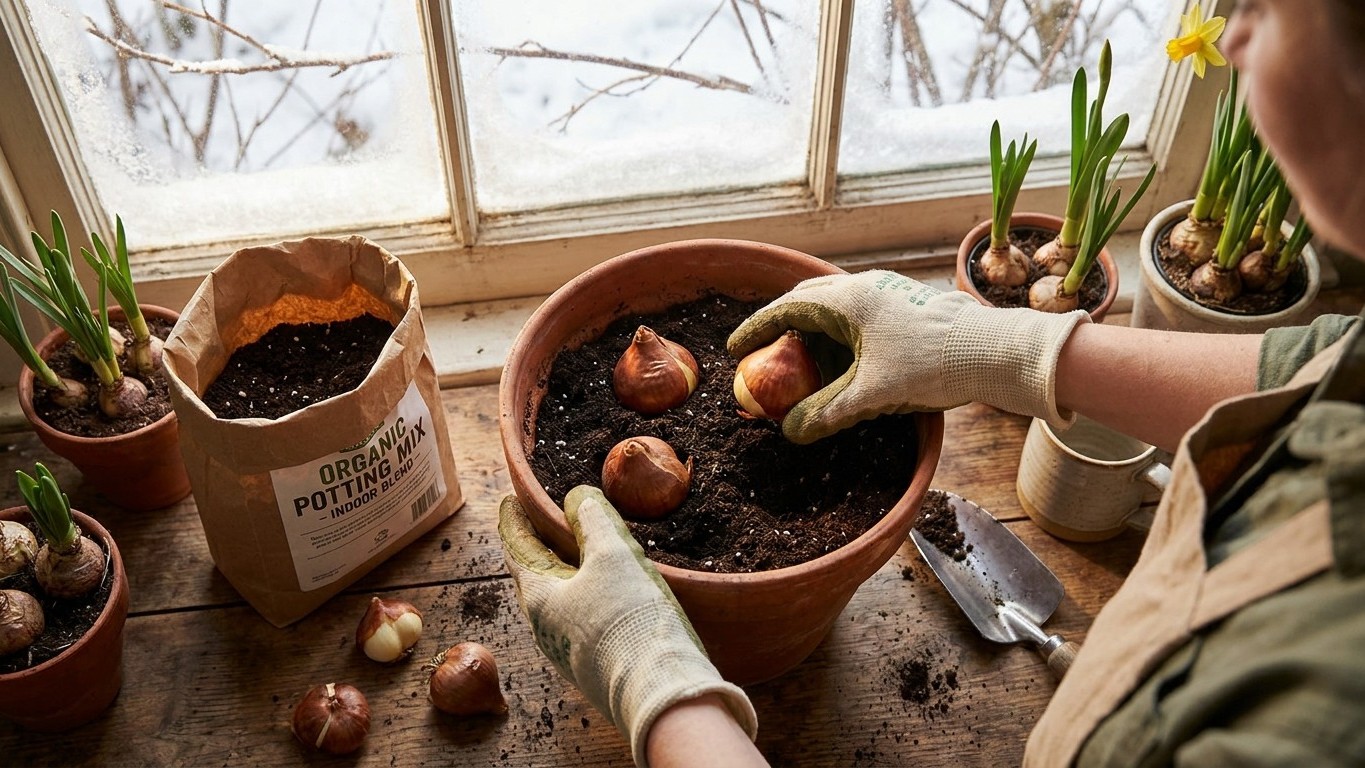

Forcing works for any Indiana gardener willing to fake a winter indoors: pot the bulbs, chill them for the weeks each species demands, then bring them into warmth and light. The trick here isn’t a shortage of cold outdoors (Indiana has plenty), it’s timing the artificial cold correctly and, if you’re using containers, protecting them from a freeze the ground never sees.
Why this matters in Indiana

The coldest month here runs a mean daily minimum of 20.9°F, based on NOAA NCEI Climate Normals for 1991-2020 measured at the Indianapolis reference station. Pair that with a hardiness range of 5b-7a on the USDA Plant Hardiness Zone Map (2023 edition, built on 1991-2020 averages), and one thing becomes clear: this is not a territory short on winter. Ground here freezes hard enough, long enough, to give spring bulbs every bit of the chilling they evolved to expect.
That matters because forcing exists for two different reasons, and only one of them applies in Indiana. In places where winter never gets cold enough or long enough, gardeners force bulbs to supply artificially what the climate withholds naturally, running the fridge or an unheated space as a stand-in for a season that won’t cooperate. That’s not the Indiana story. With a 20.9°F average minimum in the coldest month, outdoor beds here deliver the twelve to fourteen weeks below 45°F that tulips and daffodils need without any help. Gardeners who plant bulbs directly in the ground don’t need to force anything; the ground does the work for free.
The real reason to force bulbs indoors in Indiana is timing, not necessity. It lets you have hyacinths or crocus blooming on a windowsill in January or February, months before anything pokes through outdoor soil. That’s a choice, not a climate workaround.
The container problem is a separate matter, and it’s the one that actually bites here. A bulb planted in a garden bed sits below the frost line, insulated by the soil mass around it, so a hardiness zone rating of 5b or 6a tells you something real about its survival odds. A bulb in a pot has no such protection. An unprotected container left outdoors through a stretch near that 20.9°F average minimum can freeze solid, roots and all, killing a bulb that would have sailed through the same night in open ground. That’s the situation Indiana gardeners actually need to plan around: not a lack of cold, but a pot that can’t buffer the cold it gets.
How to do it here
The process is the same sequence anywhere, but the details, especially where you park the pots for chilling, need to fit Indiana’s actual winter numbers rather than a national average.
- Buy bulbs suited to forcing and check the chilling weeks listed for each type before you commit a fridge shelf or garage corner to them for months.
- Pot them in early to mid fall in shallow containers with drainage holes, using a standard well-draining potting mix, bulbs set close together with the pointed end up and just the tip showing above the soil line.
- Water thoroughly right after potting, then let the excess drain completely before moving the container anywhere.
- Find a cold spot that stays consistently above freezing: an unheated garage often works, but check it with an actual thermometer rather than assuming. Given that Indiana’s coldest month averages a 20.9°F minimum, a detached or poorly insulated garage can dip below freezing on the coldest nights even though it feels “unheated but mild.”
- If the garage runs too cold or too unpredictable, use a refrigerator instead, in a drawer or shelf kept well away from any ripening fruit. Fruit gives off ethylene gas, and ethylene will kill the flower bud inside a chilling bulb before it ever has a chance to open.
- Leave the pots undisturbed for the full chilling period required by that species, checking the soil every few weeks so it stays lightly moist, never soggy, never bone dry.
- Look for roots showing through the drainage holes and a pale shoot emerging from the soil before you consider the chilling period complete. Weeks on a calendar are a guide, not a guarantee.
- Move the pot to a cool, bright spot indoors, somewhere in the 60-65°F range, for a week or two before shifting it to normal room temperature and full light.
- If you’re chilling Bulbs in Containers left outdoors rather than in a garage or fridge, sink the pot into a garden bed up to its rim or bank mulch and leaves around its sides. Because that 20.9°F average minimum will freeze an exposed pot straight through, the container effectively needs to behave two hardiness zones tougher than the bulb inside it, or it needs that insulation to survive the winter at all.
Which bulbs are worth it
Chilling requirements vary widely between species, and that variation decides which bulbs reward the effort and which ones just tie up shelf space. A short cold requirement means a shorter wait and less risk of something going wrong along the way. A tall, top-heavy bloom means a floppy mess once it’s finally indoors in a lightweight pot. And for bulbs that were never going to survive an Indiana winter outdoors or rebloom next year regardless, forcing costs nothing extra in the long run since the bulb was a one-season purchase either way.
- Paperwhite narcissus: needs no chilling at all, blooms in three to four weeks from potting, and since it won’t survive outdoors here or rebloom next year, forcing is the only use for it anyway.
- Crocus: short chill requirement, roughly eight to fifteen weeks, low growth habit that never topples in a shallow pot.
- Hyacinth: chills in about eight to thirteen weeks and produces a sturdy, self-supporting stem.
- Grape hyacinth (muscari): short chill period, compact habit, forgiving of minor timing errors.
- Amaryllis: no cold period required whatsoever, a different category from hardy spring bulbs, but reliable and fast for indoor bloom.
- Standard tall tulips: need fourteen to sixteen weeks of chilling, tying up space for months, and the tall stem often flops in a lightweight indoor pot.
- Large trumpet daffodils: long chill requirement similar to tulips, with the same top-heavy stem problem once indoors.
- Fritillaria: chilling response is uneven and unreliable, making failure more common than success.
- Allium: chill period is long and the mature stem height makes indoor display impractical.
What goes wrong, and when you can still fix it
Leaves but no flower
Green growth with nothing to show for it means the chilling period ran short. The bulb needs a set number of weeks below 45°F to complete the internal process that forms the flower bud, and cutting that period short leaves you with foliage only. This year’s pot won’t produce a bloom no matter how long you wait afterward. The bulb itself, if it’s a perennial type like crocus or hyacinth, can often be planted outdoors once the ground thaws and may recover to bloom on its own next spring, just not on the forced schedule you wanted.
Flower buried low in the leaves
A bloom that opens on a stem too short to see above the foliage was warmed up too early, before it had time in that cool, dim transition spot to elongate the stem properly. Once it’s happened, there’s no bringing that stem back up this season. The fix belongs to the next attempt: give the pot its full one to two weeks in a cool, bright spot before moving it into warm room conditions.
Rot in the pot
A soft, mushy bulb base usually traces back to a container without adequate drainage, or soil that stayed soggy for too long during chilling. Once rot sets in, the bulb is lost for this season and there’s no reviving it. Prevention is the only real answer: drainage holes in every pot, a mix that drains freely, and watering that keeps soil lightly moist rather than saturated throughout the chilling weeks.
Related guides
- Growing Spring Bulbs in Containers in Indiana
- Forcing Spring Bulbs Indoors in Iowa