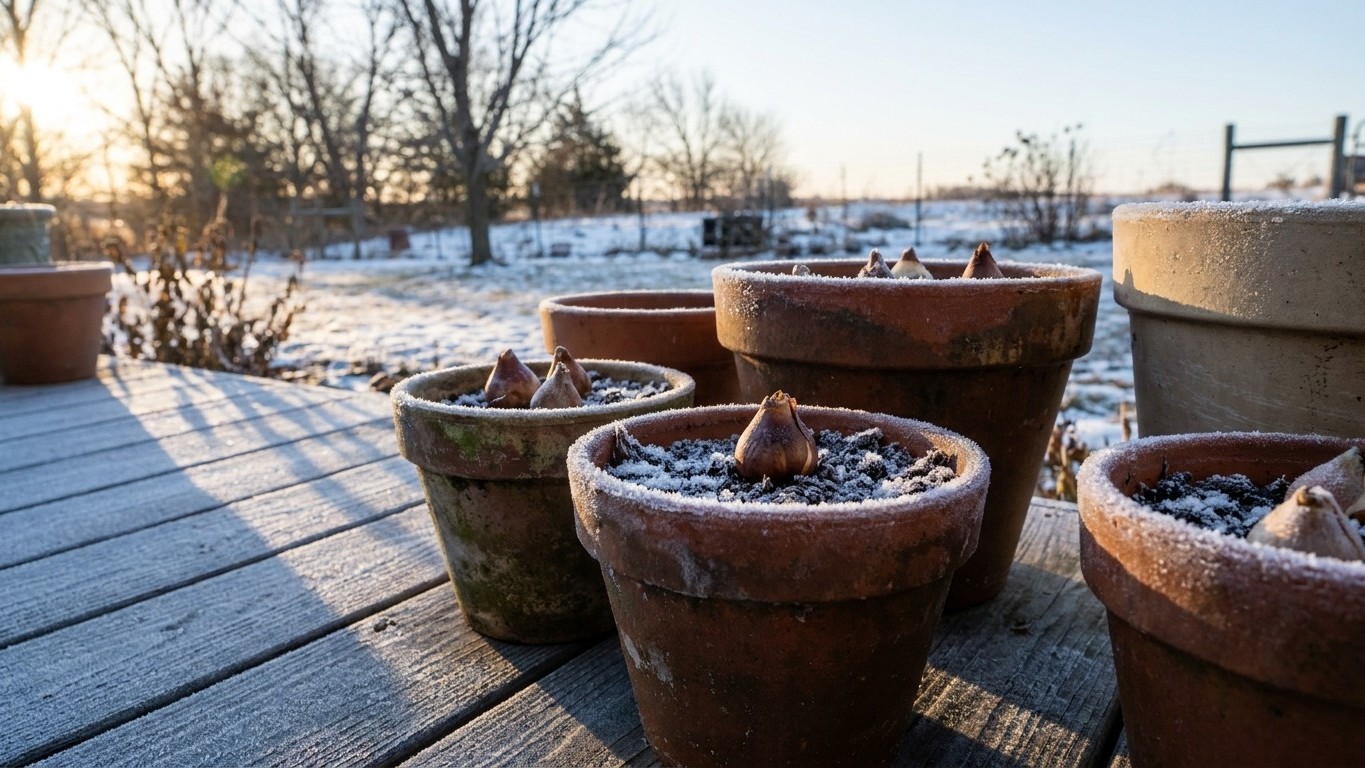

Spring bulbs do fine in containers here, but the pot changes the rules. Iowa’s ground cold is more than enough for tulips, crocus, and daffodils to bloom on schedule outdoors. The container is a separate calculation: it freezes solid in a way garden soil never does, and that single fact decides whether a potted bulb survives the winter or not.
Why this matters in Iowa

The coldest month here has a mean daily minimum of 13.8°F, measured at the Des Moines reference station over the 1991-2020 period (NOAA NCEI Climate Normals). That number sits far below the 45°F threshold a spring bulb needs to sit under for twelve to fourteen weeks to bloom. So the natural chilling that forcing exists to replace isn’t missing in Iowa. Bulbs planted in the ground here get their winter dose without any help from a gardener.
The problem shows up somewhere else. The USDA Plant Hardiness Zone Map (2023 edition, built on 1991-2020 average annual extreme minimum temperatures) places this territory across zones 4b to 6a, with Des Moines as the reference city for that range. That zone rating describes a bulb sitting in the ground, insulated by soil mass below the frost line even when the surface freezes hard. A container doesn’t have that insulation. Exposed on every side above grade, a pot’s entire root mass can freeze through, roots and all, at temperatures a garden bed would shrug off.
That’s the gap a container gardener in this territory has to close. A tulip bulb rated hardy to zone 5 will winter over without complaint in a Des Moines flower bed. The same bulb, in a terra cotta or plastic pot left on a deck all winter, is exposed to something closer to zone 3 conditions once the whole container freezes solid. The hardiness rating on the bag doesn’t change. What changes is how much of that cold actually reaches the bulb, and a pot delivers all of it, from every direction, with nothing left insulated.
Forcing, by contrast, is something Iowa gardeners choose to do, not something the climate forces on them. Potting bulbs and giving them a controlled cold period, then bringing them into a warm room, lets a gardener move a hyacinth or crocus bloom weeks ahead of when it would open outside. The cold for that process comes from the same abundant winter this territory already has. It just gets delivered in a garage or a refrigerator instead of a flower bed.
How to do it here
Whether the goal is an indoor bloom ahead of schedule or a container left outdoors through the season, the sequence below covers both, since the two techniques share the same cold requirement and diverge only at the point of where that cold gets delivered.
- Pick bulbs suited to the container size, using a well-draining potting mix and a pot with an actual drainage hole. Skip anything without one; standing water in a closed container is the single most common way a forced bulb rots before it ever blooms.
- Plant in fall at the depth listed for that species, water once to settle the soil, then move the potted bulbs into cold storage. An unheated garage that stays reliably above freezing works, provided the reader checks it with a thermometer rather than guessing.
- A refrigerator drawer works as an alternative, kept away from ripening fruit. Apples and other fruit release ethylene gas, and ethylene damages the flower bud forming inside the bulb before it ever gets the chance to open.
- Hold the pots in that cold spot for twelve to fourteen weeks below 45°F. Check for roots showing at the drainage hole near the end of that window; that’s the sign the bulb has done its underground work and is ready to grow.
- For containers meant to stay outdoors all winter rather than forced indoors, treat the pot as needing to be rated at least two USDA zones hardier than the bulb inside it. In a Des Moines-area zone 5 planting, that means either buying a bulb hardy to zone 3, or protecting the container itself.
- Protection means moving the pot into an unheated garage or shed for the winter, sinking it into the ground and mulching heavily over the rim, or clustering several containers together against a foundation wall where they trap and share warmth.
- Once a forced pot has finished its cold period, bring it into a cool, bright room first rather than straight into full household warmth. Move it to a warmer spot only once the flower bud shows color, which keeps the stem from stretching too fast and toppling.
Which bulbs are worth it
Not every spring bulb repays the trouble of a pot. The ones with a short chilling requirement force fastest and hold up best in a container, since a shorter cold debt means less time for the potting mix to dry out or freeze unevenly. Bulbs that naturally grow a tall flower stem, on the other hand, tend to topple once that stem reaches full height in the confined root run of a pot.
- Crocus: short cold requirement, low growth habit that doesn’t need staking
- Dwarf iris (Iris reticulata): compact size suits small containers well
- Grape hyacinth (Muscari): reliable forcer, short stem stays upright
- Hyacinth: moderate cold need, sturdy stem for its size
- Paperwhite narcissus: needs no cold period at all, and since it isn’t hardy outdoors in this territory anyway, forcing it costs nothing long-term; it was never a bulb meant to come back next year
- Large trumpet daffodils: long cold requirement and a tall stem that leans in a shallow pot
- Darwin hybrid tulips: bred for height in a garden bed, which becomes a liability in a container
- Fritillaria: finicky about disturbance and root space, better suited to open ground
- Camassia: tall native bulb that needs the root run only a garden bed provides
What goes wrong, and when you can still fix it
Leaves but no flower
Green growth with no bud means the cold period ran short. The flower forms inside the bulb during those weeks below 45°F, and cutting that window early leaves the bud undeveloped even though the leaves still push up fine. There’s no fixing this season’s plant. The bulb can go into the ground to collect a full natural winter, with a better shot at flowering next year.
A flower stalk too short to see
This happens when a forced pot moves from cold storage into full warmth too fast. The stem needs a gradual transition through a cool, bright space to elongate normally; skip that step and the bud opens practically at soil level. This year’s stem length is fixed once it’s happened. Next time, hold the pot in a cooler room for a week or two before moving it somewhere warm.
Rot in the pot
Soft, mushy bulbs usually mean water sat in the container instead of draining through it. Once rot sets in, the bulb is done for the season and should be discarded rather than replanted. The fix belongs to the next planting: a pot with a real drainage hole, raised slightly off the ground on feet or blocks, and a potting mix that doesn’t compact and hold water around the bulb.