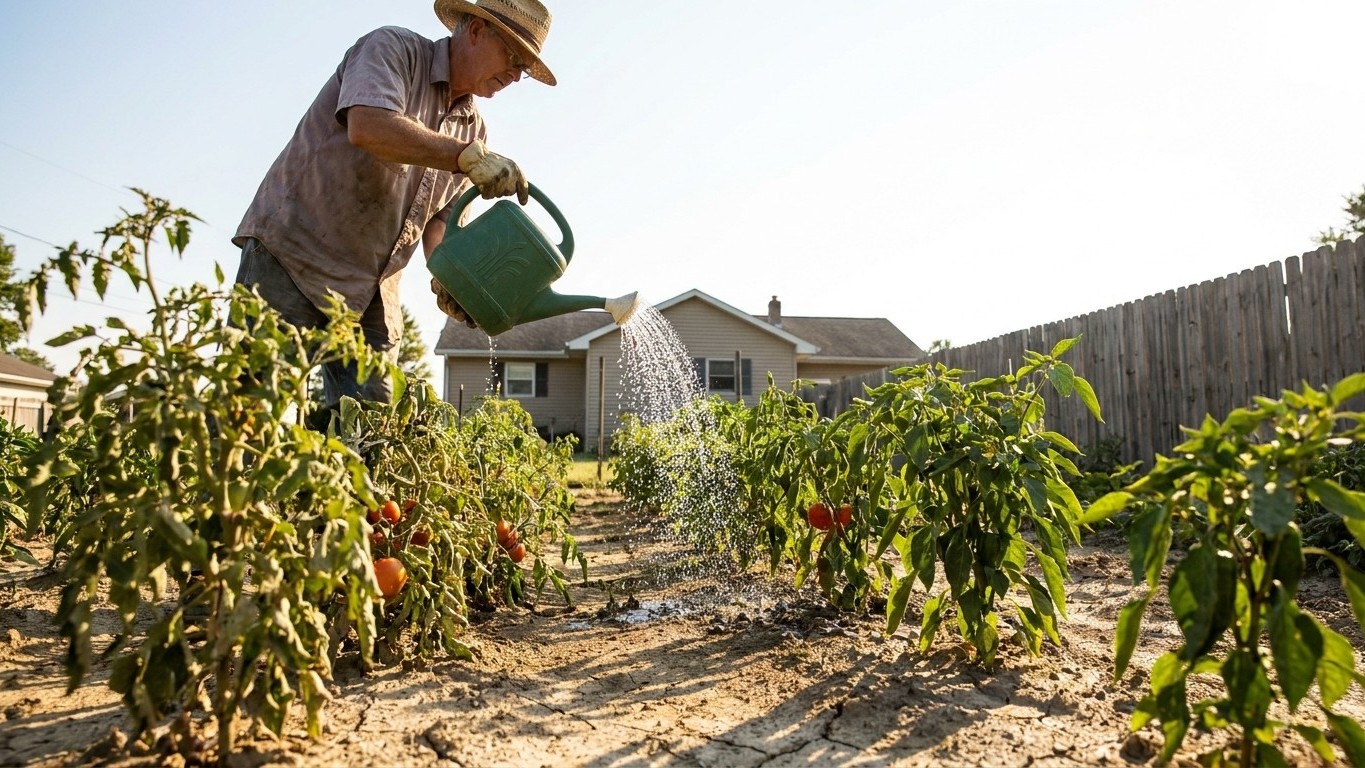

Water Indiana gardens deeply once or twice a week rather than daily, aiming for about an inch total between rainfall and irrigation. August is the driest month and the point where that math gets tight, so knowing the local rainfall and heat numbers changes how you plan the hose schedule.
What changes here

Two numbers set the terms for every Indiana garden: August, the driest summer month, averages 3.2 inches of rain, and the region sees 14.6 days a year at or above 90F. Put together, that’s a month with real but thin rainfall arriving during the stretch of the year when heat pulls the most moisture back out of the soil. June brings 4.95 inches and July 4.42, so the drop to 3.2 in August isn’t dramatic on paper, but it lands right when evaporation is running hardest.
Do the arithmetic on that 3.2 inches and the picture gets clearer. Spread evenly across an average four-and-a-third-week month, August delivers roughly 0.74 inches of rain per week. A vegetable bed or a young perennial border wants close to a full inch a week to keep growing without stress. That leaves the gardener responsible for the remaining quarter-inch or so, every single week of August, on top of whatever a normal week already covers. It sounds small. It isn’t, once you’re carrying it can by can across a hundred-foot row for six or eight weeks straight.
Soil texture decides how far that quarter-inch actually goes. Sandy soil drains fast: water that lands today is gone by tomorrow, out of reach of shallow roots by the time the sun’s had a full day at 90F to work on it. Clay holds on to that same inch for a week or more, which sounds like an advantage until the clay stays wet at the surface while drying out in cracks lower down, or until a gardener adds more water on top of what’s already there and drowns the root zone. Neither soil type gets a pass in August. Sandy ground needs the water split into smaller, more frequent doses; clay needs it delivered less often but trusted to actually reach downward before the next round.
None of this is a forecast. These are 1991-2020 normals from the reference station, and a slope, a shade line, or a spot near pavement can push a given yard well off that average in either direction. A rain gauge staked into the actual bed, checked after every storm, is what turns a regional average into a number you can use.
How to water when it matters
The method that works in Indiana’s August isn’t complicated, but the order and reasoning behind each step matter more than the schedule itself. Deep watering pushes moisture down where roots that have grown toward it can actually use it. Infrequent watering forces those roots to grow deep in the first place, instead of clustering at the surface where the next hot afternoon bakes them. Watering at the base, rather than overhead, gets the water where it’s needed without wasting a chunk of it to evaporation before it ever reaches soil. Morning watering gives the plant the whole day to draw moisture up before nightfall, and dries the leaves and soil surface before conditions turn favorable for fungal disease overnight.
Here’s a sequence to work from, adjusted to what a finger or trowel actually tells you about your own bed rather than what the calendar says:
- Push a finger or small trowel two inches into the soil near the base of the plant, not just at the surface; if it’s dry at that depth, it’s time to water, regardless of how the top half-inch looks.
- On sandy soil, water every two to three days through August, since the ground won’t hold much of what falls or gets poured on it.
- On clay soil, water once every seven to ten days, but check with the trowel first; clay that’s still damp from last week doesn’t need more yet, and adding water anyway risks rot at the root zone.
- Apply water slowly at the base of the plant, over 20 to 30 minutes for an established bed, so it has time to soak down rather than run off.
- Start from about one inch of total water per week, sky plus hose combined, and adjust up on sandy soil or down on clay based on what the finger test shows the following day.
That one-inch figure is a starting point, not a rule. A raised bed with fast drainage, a container in full sun, or a shaded corner under a mature tree will all pull away from that number in their own direction. The finger test, run consistently, is what corrects for it.
What goes wrong
The daily sprinkle
A quick pass with the hose every evening feels responsible, but it wets only the top inch or two of soil. Roots follow the water, so they stay shallow, right in the layer that dries out fastest and heats up most under a 90F afternoon. When a hot stretch hits, those shallow roots have nowhere to go, and the plant wilts even though it was “watered” the night before.
Watering the leaves at night
Overhead watering in the evening leaves foliage wet through the cool overnight hours, which is exactly the window fungal diseases like powdery mildew and blight favor. Morning watering, aimed at the base, avoids the problem entirely and still gives the plant a full day to use what it’s taken up.
Trusting the rain that just fell
A ten-minute summer thunderstorm can look like a soaking and still leave only the top half-inch of soil damp, especially on clay where water beads up and runs off before it penetrates. Checking with a finger two inches down after a storm, rather than assuming the rain gauge total means the root zone got what it needed, catches this before the plant shows stress.
Skipping the mulch
Bare soil in an Indiana August loses moisture fast under 14.6 days a year of 90-degree heat pulling water straight back out of the ground. A two-to-three-inch layer of mulch around the base of plants slows that loss and stretches every inch of water, whether it came from the sky or the hose, several days further than bare soil would.
The opposite mistake: watering ground that hasn’t dried
Because clay soil in this region can hold a week’s worth of rain, adding irrigation on a fixed schedule without checking first can waterlog roots that were never short on moisture to begin with. Given that June and July already bring close to five inches of rain each, a rigid watering calendar in early summer often does more harm than the August dry stretch it’s meant to prepare for.
Local help
Purdue’s Cooperative Extension Service publishes region-specific guidance on garden watering, soil testing, and drought management for Indiana growers, and is a solid first stop for anything beyond general practice: extension.purdue.edu. Watering restrictions during dry stretches vary by municipal water provider and change year to year, so check with your local utility directly rather than assuming statewide rules apply.
Common questions
How much should I water my garden during an Indiana dry spell?
Aim for about an inch of water a week total, combining rainfall and irrigation. In August, when average rainfall drops to 3.2 inches for the month, expect to make up roughly a quarter-inch to a third-inch of that yourself most weeks, more on sandy soil.
What time of day should I water in Indiana?
Morning is best. It gives plants the full day to take up water before evaporation peaks in the afternoon heat, and it dries leaves and soil surface before nightfall, cutting the risk of fungal disease that overnight moisture encourages.
How do I know if my soil is actually dry, not just the surface?
Push a finger or small trowel about two inches down near the base of the plant. If it’s dry at that depth, water. Surface soil can look and feel dry within hours of a good soaking, while the root zone below stays moist for days, especially on clay.
Does mulch really make a difference during hot, dry weeks?
Yes. With close to 15 days a year hitting 90F or higher, bare soil loses moisture quickly to evaporation. A few inches of mulch around plant bases slows that loss noticeably, which means less frequent watering and more consistent moisture at root depth.