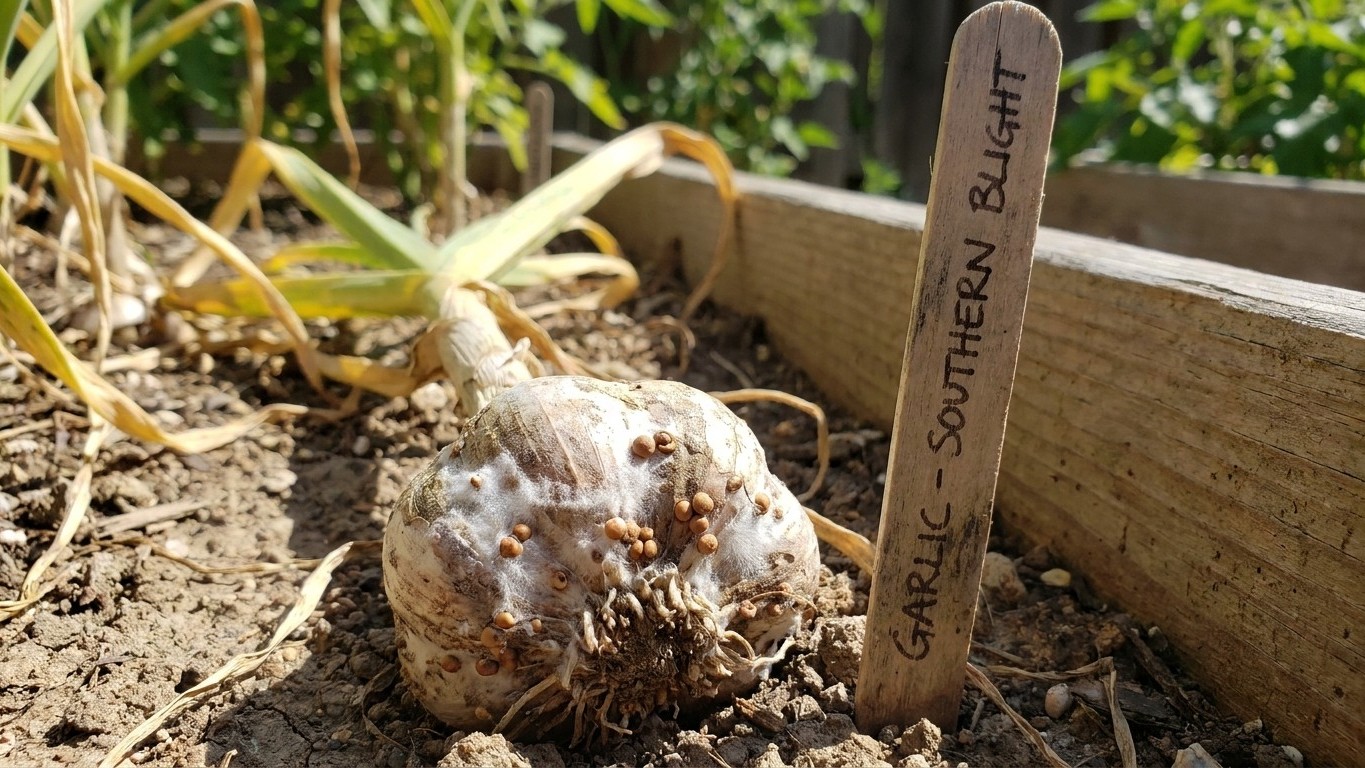

A garlic plant leaning sideways in the June heat, its outer leaves browning from the tip down, tells you almost nothing by itself. But scrape back the soil at its base and find a cottony white mat pressed flat against the bulb, dotted with tan or reddish-brown grains the size of mustard seed — that’s a different story entirely. That mat is mycelium, those grains are sclerotia, and together they mean the fungus behind Southern blight has already moved into the stem and root zone, doing its worst work exactly where you can’t see it from above.
What you are looking at

The first thing most gardeners notice is the outer leaves yellowing and wilting, starting from the tips and working inward. On its own that symptom means almost nothing, since garlic yellows for a dozen reasons in the weeks before harvest. What separates Southern blight from ordinary decline is what happens next, and where.
Pull back the soil at the base of a wilting plant and you may find a soft, wet rot at the point where the roots meet the bulb, sometimes extending up into the lower leaf sheaths. Around that rot, and often spreading a short distance into the surrounding soil, sits a layer of fine white fungal threads, the mycelium of Sclerotium rolfsii. It looks a little like a dusting of cotton or spiderweb pressed flat against the bulb surface.
Embedded in that white growth, or scattered loose in the soil around it, are the sclerotia: tiny structures roughly 0.04 to 0.08 inch across, about the size of a mustard seed, tan when young and darkening to reddish-brown as they mature. These are the fungus’s survival bodies, and their presence is the single most reliable confirmation of the disease. Symptoms typically show up as:
- Outer leaves yellowing and wilting while inner growth still looks normal
- Soft, water-soaked rot at the base of the bulb or lower stem
- A visible mat of white fungal threads on the bulb surface or adjacent soil
- Small tan to reddish-brown sclerotia, 0.04 to 0.08 inch, embedded in that white growth
Once the white threads and sclerotia are visible, the diagnosis is not in doubt. The harder cases are the ones without them yet, where a plant is wilting but the base still looks clean. That is worth checking again in a few days rather than treating as confirmed disease.
What it is not
Yellowing garlic is the norm, not the exception, in the run-up to harvest. Garlic naturally dies back from the tips as the bulb matures, and that senescence can look alarming if you have not watched a crop through to harvest before. Drought stress and nitrogen deficiency both produce similar yellowing, usually starting on the oldest, lowest leaves and moving evenly up the plant rather than collapsing one plant at a time.
| Cause | Pattern | What confirms it |
|---|---|---|
| Natural pre-harvest dieback | Even yellowing across the whole planting, timed with maturity | Bulb base is firm, no rot or mycelium |
| Drought stress | Lower leaf tips yellow and dry first | Soil is visibly dry, plant recovers after watering |
| Nitrogen deficiency | Uniform pale yellow-green across older leaves | No wilting, no rot, spreads evenly across the bed |
The discriminating detail is always at the base of the bulb, not in the leaves. If the roots and bulb base are firm, white, and free of any cottony growth, you are looking at ordinary stress or maturity, not disease. Save the alarm for plants where the base itself is soft and wet, with visible white threads or the small tan sclerotia described above. A page on garlic diseases is worth a look if you want the fuller range of what causes yellowing and wilting through the season before you settle on one cause.
Where it comes from and when it strikes
How it arrives
Sclerotium rolfsii is a soilborne fungus, and in most home gardens it arrives one of two ways: in soil that already carries sclerotia from a previous crop, or on infected planting stock brought in from elsewhere. It does not travel on wind or insects the way some garlic pathogens do. Once it is in a bed, it spreads locally through soil movement, water runoff, and contact between infected and healthy bulbs, rather than jumping between distant plantings on its own.
The temperature window
UC IPM names a clear window for disease development: soil temperatures of 86 to 95°F let the fungus grow and infect fastest. That figure is a soil temperature, not an air temperature, and the two can differ by a wide margin depending on mulch, moisture, and how much direct sun the bed gets. A warm afternoon reading on a weather app tells you almost nothing about what the soil four inches down is doing. If you want to know whether your bed is in the risk window, a soil thermometer pushed down near the root zone is the only way to find out.
At the other end of the scale, UC IPM also notes that the fungus does not survive at soil temperatures of 105 to 120°F. That is worth reading carefully: it is a lethal range, not a mere ceiling on activity. This distinction is what makes soil solarization a genuine home-garden option in warm regions, since the goal is to heat the soil past the point the fungus can survive at all, not just past its comfort zone.
What to do about it now
There is no cure once a plant shows the soft rot and white mycelium at the base. Fungicide sprays aimed at foliage do not reach a fungus that is working underground at the crown, and by the time symptoms are visible the bulb is usually already compromised for storage even if the plant limps on in the ground.
Pull affected plants as soon as you confirm the diagnosis, and take a shovelful of the surrounding soil with them rather than just the plant itself, since sclerotia sitting loose in that soil are what carries the problem forward. Bag or burn this material. Do not put it in a home compost pile. Backyard compost rarely holds a sustained temperature high enough to kill sclerotia, and a pile that never gets hot enough simply becomes a new source of infected material you spread back across the garden later.
Disinfect any tool that touched the rot, the soil around it, or your hands, before working elsewhere in the bed. If you are pulling several plants over a few days, treat each one as a fresh source rather than assuming the first removal solved the problem. Southern blight rarely stops at a single plant once soil temperatures are in the range that favors it, so check the plants immediately around each removed one over the following week.
If this is your first encounter with basal rot in garlic, it is worth ruling out the other common culprits before you settle on Southern blight for the whole bed. Fusarium basal rot produces a similar rot at the base but without the white cottony mycelium or the small tan sclerotia, and it behaves differently in storage.
Keeping it out of your garden
Start with clean stock and rotation
The most useful thing a home grower can control is what goes into the ground in the first place. Buy seed garlic from a supplier who inspects for basal rot, and reject any cloves showing soft spots, white threads, or the small tan sclerotia at the root end before planting. Since UC IPM reports that sclerotia survive at least five years in the soil, a single infected planting can leave a bed compromised for several seasons of garlic and other susceptible crops after the plants themselves are gone.
Rotation is the other tool within reach of a backyard gardener. UC IPM recommends rotating out of garlic and onion into corn, sorghum, rice, or wheat, none of which are hosts for this fungus, for a stretch of years long enough to let sclerotia numbers decline. Given the five-year persistence figure, a rotation of only a single season back to garlic is unlikely to clear a badly infected bed. Grow garlic in a different part of the garden while the original bed sits in one of those rotation crops or in an unrelated planting.
What is and is not practical at home
Some of the controls in commercial guidance are field-scale and not something a home gardener should try to replicate. Deep ploughing to bury crop residue is a tractor operation meant to move infected material well below the depth where it can reinfect a new planting. In a raised bed or small plot, digging that deep by hand usually just relocates sclerotia rather than burying them safely, and can spread them into soil that was previously clean.
Soil solarization is the one control from the commercial literature that translates well to a home garden, particularly in regions with long, hot summers. Clearing the bed, watering it well, and covering it tightly with clear plastic for several weeks during the hottest stretch of summer can push soil temperatures into the range UC IPM identifies as lethal to the fungus. Keeping bed tops as dry as possible during the growing season, by watering through subsurface drip rather than overhead sprinklers, also helps, since Southern blight thrives in wet soil at the crown far more than in soil that is merely warm.
Watch for the same rot pattern showing up in stored bulbs even after a clean-looking harvest, and compare what you find against the signs of blue mold, which develops after harvest in storage rather than in the ground and looks quite different once you know what to check for.
Common questions
Can I still eat Garlic Bulbs That had Southern blight?
Bulbs with visible soft rot, white mycelium, or sclerotia should be discarded rather than eaten or stored. The rot compromises texture and flavor quickly, and any bulb showing these signs at harvest will not keep.
Will this spread to my tomatoes or other vegetables?
Sclerotium rolfsii has a wide host range beyond alliums, so it is not a garlic-specific problem confined to one bed. If you have had confirmed Southern blight, treat nearby beds growing susceptible vegetables with the same caution around soil movement and tool sanitation.
How do I know if my soil is actually in the risk range?
Air temperature readings are not a substitute. Push a soil thermometer down near the root zone, several inches deep, since the published risk window from UC IPM refers specifically to soil temperature, not the air temperature on a given day.
Is it worth testing my soil for sclerotia before planting?
If you have had a confirmed case in a bed before, checking that soil before replanting garlic there is worth the effort given how long sclerotia persist. Contact your local extension office about sampling and testing options, since methods and availability vary by region.