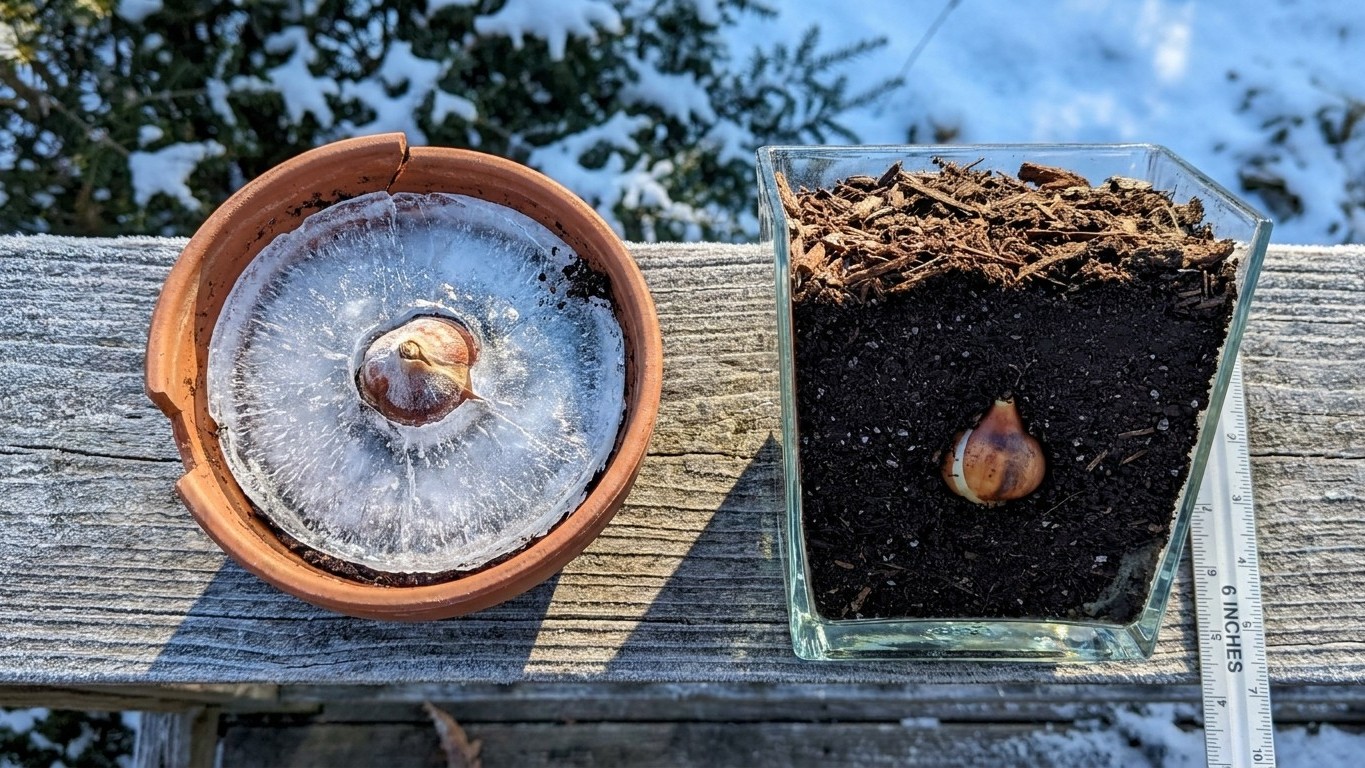

In Massachusetts, forcing bulbs indoors isn’t about outrunning a weak winter. The ground here gets plenty cold enough, on its own, to satisfy a spring bulb‘s dormancy needs. The real reason to force is the container: a pot left outside freezes solid in a way garden soil never does, and that kills the bulb before it ever gets the chance to bloom.
Why this matters in Massachusetts

The coldest month in Boston averages a daily minimum of 23.1°F, according to NOAA NCEI Climate Normals for 1991-2020. That’s a hard, sustained cold, not a mild dip. For a bulb planted in the ground, that kind of cold is exactly what it needs. Soil has mass. It holds heat at depth even while the surface freezes, so a tulip or crocus bulb sitting six inches down stays insulated while the top few inches of earth lock up hard. That’s the entire mechanism behind winter dormancy working outdoors here without any help from a gardener.
A pot doesn’t have that luxury. A container has almost no thermal mass compared to open ground, and its sides are exposed to air on every face. When the air temperature sits in the low 20s for weeks, as it regularly does across the coldest stretch of a Massachusetts winter, the soil inside a pot can freeze straight through, roots and all. That’s the opposite of what the bulb needs. A light freeze at the surface signals dormancy. A freeze that reaches the entire root ball simply kills the tissue.
This is why the state’s official hardiness range matters here in a different way than most people assume. The USDA Plant Hardiness Zone Map (2023 edition, built on 1991-2020 normals) places Massachusetts across zones 5a to 7b. That’s a wide band. Boston, on the milder end near the coast, sits at the warmer edge of that range, while the Berkshires and inland valleys run several zones colder. But the zone map measures average extreme minimum temperatures for plants rooted in the ground. It says nothing about what happens to the same bulb sitting in a glazed pot on a porch. A bulb rated hardy for Boston’s outdoor zone can still die in a container in the same yard, because the container experiences a colder, harsher version of the same winter.
So the situation here isn’t a shortage of natural chill. It’s a mismatch between where that chill is safe to receive. Forcing indoors, in this context, means giving a potted bulb its required cold period somewhere controlled, an unheated garage or a refrigerator, rather than leaving it exposed to a Massachusetts winter it isn’t built to survive in a pot.
How to do it here
The process is the same one used anywhere, but where you find the cold and how you protect the container both depend on this state’s winter behavior. Follow the sequence in order.
- Pick a bulb suited to forcing. Not every species tolerates the process well; see the next section before buying anything.
- Choose a container at least two USDA zones hardier than the bulb’s rating, or plan to move and mulch it. Since Boston and its surrounding communities span 5a to 7b, a bulb rated hardy to zone 5 outdoors should be treated as though it needs zone 3 protection once it’s in a pot, unless that pot is moved into an unheated but enclosed space for the cold period rather than left outdoors.
- Pot the bulb in well-draining soil, and water it once thoroughly. The pot needs drainage holes. A container that holds standing water will rot the bulb long before the cold period ends.
- Give it twelve to fourteen weeks of cold between roughly 35°F and 45°F. An unheated attached garage often works, but check it with a simple thermometer rather than assuming. It needs to stay above freezing consistently; a garage that dips into the low 20s for stretches, matching outdoor lows here, is no safer than leaving the pot outside.
- A refrigerator drawer works as an alternative, provided it’s kept away from apples, pears, or any ripening fruit. Ripening fruit releases ethylene gas, and ethylene will kill the flower bud forming inside the bulb before it ever emerges.
- Once the cold period is complete, move the pot to a cool room, around 60°F to 65°F, out of direct sun, and wait for shoots to appear. When shoots reach two to three inches, move the pot to a brighter, slightly warmer spot to finish blooming.
Which bulbs are worth it
Some bulbs reward the effort of forcing. Others resist it or simply aren’t built for it. The difference usually comes down to how much cold the species needs and how tall and top-heavy the flower stem grows once it’s indoors, away from wind and gravity cues it would get outside.
- Paperwhite narcissus (needs no cold period at all, making it the simplest starting point)
- Crocus (short stem, stable in a small pot)
- Hyacinth (reliable bloomer, strong fragrance, widely sold pre-chilled)
- Grape hyacinth (muscari) (compact and forgiving)
- Standard daffodil varieties (dependable once the cold requirement is met)
Since most of these are sold as garden annuals when purchased for forcing anyway, the trade-off costs nothing in the long run. A hybrid tulip or paperwhite forced indoors was rarely going to return to bloom in a Massachusetts garden bed the following spring regardless, so there’s no loss in treating it as a one-season display.
- Fritillaria (sensitive to handling and inconsistent once potted)
- Large trumpet daffodils (tall stems that topple in a lightweight indoor pot)
- Allium (long cold requirement combined with height that doesn’t suit a windowsill)
- Late-season tulip varieties (extended chill needs and stems that stretch too far indoors)
A gardener scanning a bulb catalog can use this as a quick check before buying anything specifically for indoor forcing rather than the garden bed.
What goes wrong, and when you can still fix it
Leaves, but no flower
This means the cold period was too short. The bulb had enough energy to push foliage but never received the full stretch of chill needed to trigger a flower bud. There’s no fix this season. The bulb can be planted in the garden afterward, where it may recover naturally over a full winter outdoors, but it won’t bloom indoors this cycle.
A flower low on the stem, tucked among the leaves
This happens when the pot was brought into warmth too early, before the stem had time to elongate normally. The flower forms, but the stem stays short and the bloom sits low and hidden. This can’t be corrected once it’s underway; the stem won’t stretch further after the fact. It’s a sign to extend the transition period next time.
Rot in the pot
Soft, mushy bulb tissue or a sour smell in the soil points to standing water, almost always from a container without adequate drainage. Once rot sets in, the bulb is finished for this attempt. The only fix is prevention on the next round: drainage holes, a well-draining mix, and watering just enough to moisten the soil without saturating it.
Related guides
- Growing Spring Bulbs in Containers in Massachusetts
- Forcing Spring Bulbs Indoors in Michigan