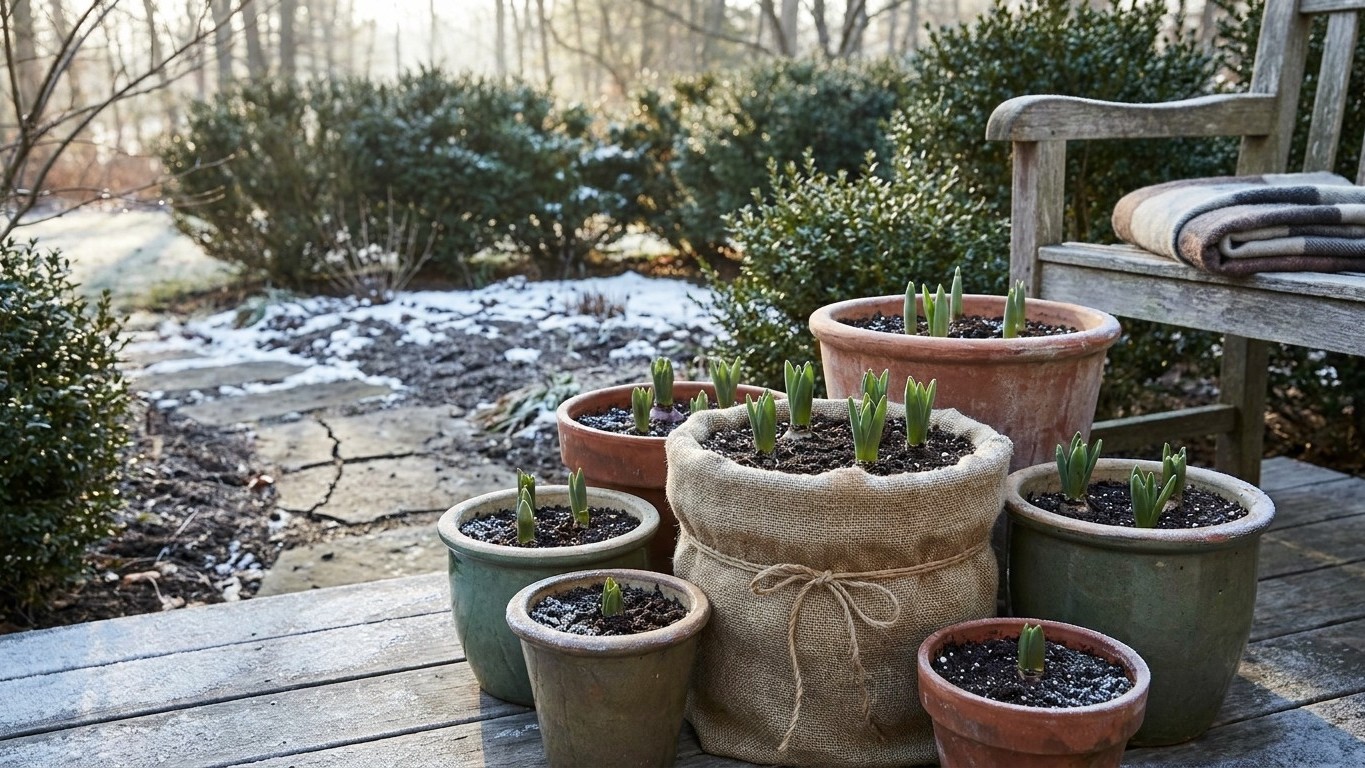

Container-grown Spring Bulbs in Massachusetts face a different threat than bulbs planted straight into a garden bed: a pot freezes clear through, roots and all, while soil in the ground only crusts on top. Forcing bulbs into early bloom indoors is a separate, optional technique here, not a fix for a weak winter. The practical answer is that containers need extra hardiness, not extra cold.
Why this matters in Massachusetts

The mean daily minimum temperature during the state’s coldest month, measured at the Boston reference station, is 23.1°F, according to NOAA NCEI’s 1991-2020 climate normals. That’s well under the 45°F ceiling a tulip or daffodil bulb needs to sit below before it will bloom, and it holds for weeks at a stretch through an ordinary New England winter. Bulbs planted in a garden bed here get their twelve to fourteen weeks of chill without any help from the gardener. The state is simply cold enough, for long enough, on its own.
That’s why forcing, in the strict sense of substituting a refrigerator or an unheated garage for winter, isn’t something Massachusetts gardeners need to make bulbs bloom outdoors. Forcing here is a choice, useful for pulling bloom indoors ahead of the calendar in January or February, not a workaround for a climate that comes up short on cold.
Containers flip that logic. USDA’s Plant Hardiness Zone Map (2023 edition, built on 1991-2020 normals) places Massachusetts across a 5a to 7b range, a wide span that covers the milder coast near Cape Cod at one edge and the colder Berkshires at the other. That range describes ground temperatures, where soil mass buffers the cold and roots a few inches down rarely feel the air’s extremes. A container has none of that mass. A pot sitting on a deck or a stoop tracks the air temperature almost directly, and once the soil inside freezes, it freezes solid, with no surrounding earth to slow it down.
That gap between a bed and a pot is the real hazard in this state, more than any shortage of cold. A daffodil bulb rated hardy to zone 5 in the ground can still die in a container left out through a Massachusetts winter, because the pot’s effective exposure runs closer to zone 3. Boston is the reference point for that number, and it will read colder in the Berkshires and milder on the Cape, so treat any single zone figure as a starting point for a specific yard, not a guarantee.
How to do it here
The method below works whether the goal is a pot of hyacinths blooming on a windowsill in February or a container of daffodils meant to stay outdoors all winter and open in April. The two paths split at the cold-storage step.
- Pick bulbs suited to the goal. Short-cold-requirement bulbs (crocus, muscari) force fastest indoors; taller, longer-chill bulbs (most tulips) are harder to manage in a pot either way.
- Pot them close together. Use a container with drainage holes, ordinary potting mix, and set bulbs shoulder to shoulder with the tips just below the surface. Crowding is fine; bulbs in pots don’t need the spacing they’d get in a bed.
- Give them twelve to fourteen weeks below 45°F. An unheated garage that stays above freezing but under that mark works, as does an unheated basement stairwell, checked with an ordinary thermometer rather than guessed at. A refrigerator’s crisper drawer works too, provided nobody checks the temperature by feel alone.
- Keep the fridge drawer away from ripening fruit. Apples and pears give off ethylene gas as they ripen, and ethylene kills the flower bud forming inside a chilling bulb before it ever shows.
- For forced pots, bring them into a cool, bright room once the chill period is done. Aim for 60-65°F rather than a warm living room, so the stem has time to elongate before the flower opens.
- For pots meant to overwinter outdoors, treat the container as two zones less hardy than the ground. Sink the pot into a garden bed and mulch heavily over the rim, or move it into an unheated garage or shed for the coldest months, or simply choose bulbs rated hardy well past what the ground zone requires.
None of these steps depends on guesswork. A thermometer confirms the garage or fridge is in range, and the pot itself will tell you by spring whether the mulch or the move indoors did its job.
Which bulbs are worth it
Not every bulb repays the trouble of a container. Short bulbs with a shorter cold requirement force faster and stay upright in a pot; tall bulbs with a long chill requirement take longer, and a top-heavy stem in a small pot of soil topples in the first stiff breeze or under the weight of its own flower.
- Crocus: short cold requirement, low stem, rarely tips over
- Grape hyacinth (muscari): compact, forces reliably, forgiving of a shorter chill
- Hyacinth: forces well and holds its shape in a pot despite a heavier flower head
- Daffodil (most narcissus cultivars): dependable bloom, sturdy stem relative to its size
- Paperwhite narcissus: needs no cold period at all, which makes it the simplest indoor pot bulb there is
- Tall tulips: long cold requirement and a stem that leans or falls once the flower opens in a shallow pot
- Fritillaria: finicky about both cold duration and drainage, unreliable in a container
- Large ornamental alliums: long chill needed and a flower head too heavy for most pot-sized root systems
Paperwhites are worth singling out. They’re grown from a bulb that won’t survive a Massachusetts winter outdoors and won’t rebloom next year regardless of how it’s treated, so forcing them costs nothing in the long run. The bulb was a one-season purchase from the moment it left the shelf.
What goes wrong, and when you can still fix it
Leaves come up, but no flower
This means the cold period ran short, whether in a fridge, a garage, or an outdoor pot that got moved indoors too soon. The bulb built leaves because it had enough energy for that, but never crossed the temperature-and-time threshold that triggers a flower bud to form. There’s no fixing it this season. The bulb needs a full twelve to fourteen weeks below 45°F next winter before it will try again.
The flower opens low, almost hidden in the foliage
This happens when a chilled bulb is warmed too fast, moved from a cold garage straight into a warm room instead of a cool, bright one first. The flower bud was ready, but the stem never got the gradual rise in temperature it needs to elongate before opening. Once the bloom has already opened low, nothing brings the stem up. Keeping future pots at 60-65°F rather than full room temperature after chilling is the only real prevention.
The bulb turns soft or rots in the pot
Rot points to standing water, either from a pot with no drainage hole or one sitting in a saucer that never dries out between waterings. A soft, mushy bulb won’t recover this season; it’s finished. The fix applies to the next planting: drainage holes, a saucer that gets emptied, and potting mix that doesn’t stay saturated for days at a stretch.