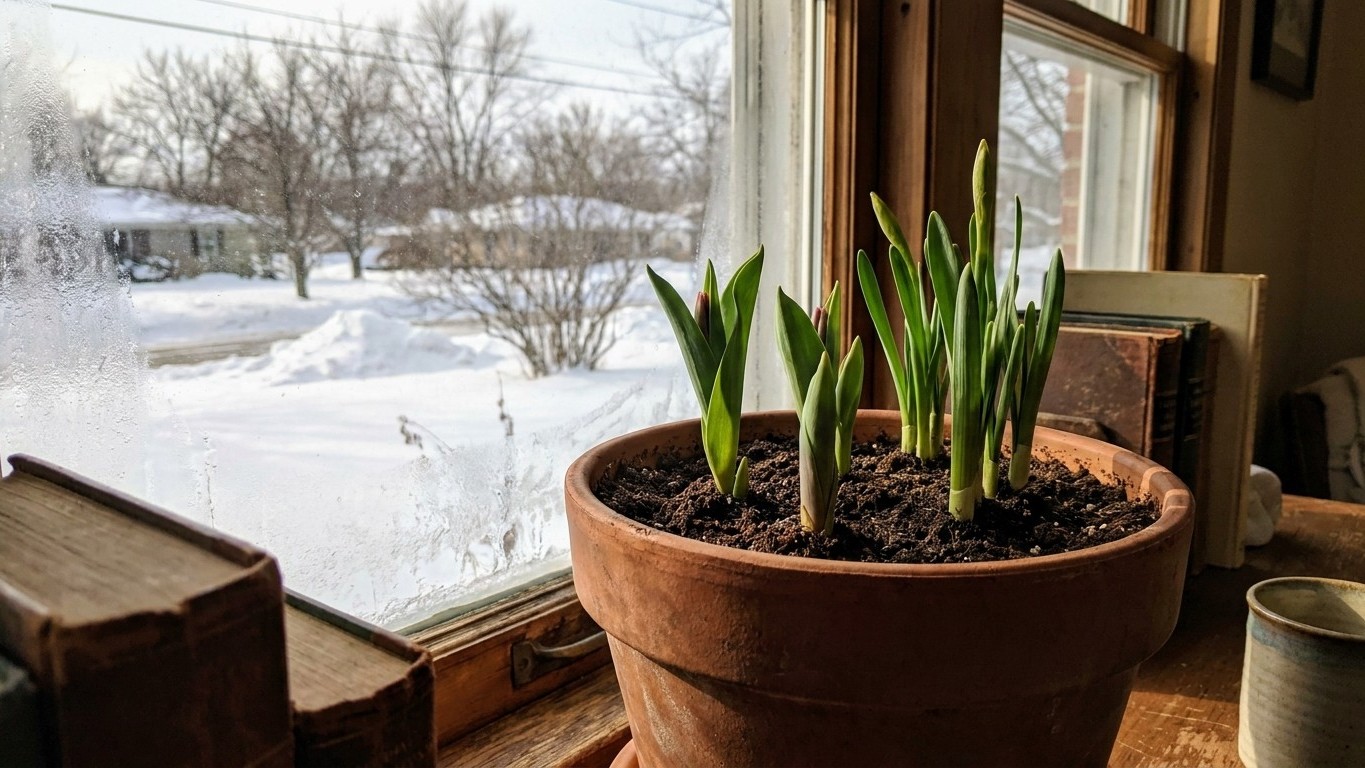

Forcing Spring Bulbs Indoors works in Minnesota because it sidesteps the state’s real limitation: a winter too extreme for a container to survive outdoors, and a house too warm to give a bulb the cold it needs on its own. The fix is a controlled cold space, not the porch or the yard.
Why this matters in Minnesota

The mean daily minimum for the coldest month in Minnesota runs 8.8°F, based on NOAA NCEI Climate Normals for 1991-2020 at the Minneapolis reference station. That number matters here for a reason most guides skip: a spring bulb needs roughly twelve to fourteen weeks in a steady 35°F to 45°F range to root properly before it flowers. Minnesota’s outdoor winter doesn’t sit in that band. It swings from a warm house interior straight down toward a mean minimum near 9°F, with stretches far colder than that on any given night. There’s no reliable window outside where a potted bulb just sits at 40°F for three months.
That’s the forcing problem. The container problem is separate, and more dangerous for anyone who assumes a pot behaves like garden soil. USDA hardiness zones for Minnesota, per the 2023 Plant Hardiness Zone Map built on the 1991-2020 normals, range from 3a in the north to 5a in the south. Those zone numbers describe soil in the ground, where the earth insulates roots and only the top few inches truly freeze hard. A pot has no such insulation. Sitting outside, a container freezes all the way through, roots and all, exposing the bulb to temperatures far colder than the same bulb would ever feel buried in a garden bed rated for its zone. A tulip that’s perfectly hardy in a Minneapolis flower bed can die in an unprotected pot on a Minneapolis deck the same winter.
So Minnesota gardeners forcing bulbs indoors are dealing with both issues at once. The house is too warm to supply the cold period naturally. The outdoors, left unmanaged, is too cold and too unbuffered for a container. Neither extreme gives the bulb what it needs, which is why the cold has to be manufactured somewhere in between, in a space the gardener controls and can check with a thermometer.
How to do it here
The sequence below is built around what a Minnesota home or garage can actually provide, not an idealized greenhouse setup.
- Choose firm, disease-free bulbs sized for forcing (this is covered in more detail in the varieties section below), and pot them in fall while they’re still available at local nurseries.
- Plant in a well-draining container with drainage holes, setting bulbs shoulder to shoulder with their tips just at or above the soil surface. Water once, thoroughly, right after potting.
- Move the pot to a space that holds a steady 35°F to 45°F for twelve to fourteen weeks. A refrigerator crisper drawer works, but keep it away from any ripening fruit, since the ethylene gas fruit gives off will kill the flower bud developing inside the bulb before you ever see it. An unheated attached garage can also work, but only if it reliably stays above freezing all winter; Minnesota’s coldest-month mean minimum of 8.8°F means a detached, uninsulated garage can easily drop well below the range a bulb needs. Check it with a min-max thermometer rather than guessing.
- Check the soil every couple of weeks and water lightly if it’s dried out. The goal is barely moist, never soggy, for the entire cold period.
- If any part of that cold period happens in an outdoor or unheated space, the pot itself needs protection. A container should be rated at least two USDA zones hardier than the bulb it holds, or it needs to be moved indoors or buried in a mulch pile that buffers the temperature swings a bare pot can’t handle on its own.
- Once shoots reach one to two inches, bring the pot into bright, indirect light at a cool room temperature, around 60°F to 65°F, rather than a warm, sunny window right away. Rotate it every few days for even growth.
- Expect bloom within two to four weeks of that final move indoors, depending on the species.
Which bulbs are worth it
Some bulbs reward the twelve-week wait. Others sulk, flop, or simply aren’t built for a pot, no matter how carefully the cold period is managed. The difference usually comes down to how long a cold requirement the bulb has and how tall it grows once it’s blooming.
- Crocus — short cold requirement, compact form, one of the fastest and most forgiving bulbs to force.
- Grape hyacinth (muscari) — short stems that never need staking, reliable bloom.
- Hyacinths — strong, predictable bloom and fragrance, widely sold pre-treated for forcing.
- Daffodils, especially smaller cultivars, dependable, sturdy enough for a pot.
- Paperwhite narcissus — need no cold period at all, forced straight in water and pebbles, which makes them the fastest option of the group.
- Tall hybrid tulips (Darwin types and similar), a long cold requirement and a stem that regularly topples in a lightweight pot.
- Alliums — need an extended cold period and grow tall enough to flop without staking, which defeats the point of a tidy indoor display.
- Fritillaria — finicky about temperature consistency and prone to uneven, disappointing bloom.
- Large trumpet daffodils — can grow leggy and thin-stemmed under indoor light conditions.
Since paperwhites and most forced hyacinths and tulips aren’t reliably hardy across Minnesota’s 3a-5a range anyway, or won’t rebloom well after the energy a forced bloom takes out of them, treating them as a one-season purchase costs nothing extra. They were never going to come back regardless.
What goes wrong, and when you can still fix it
Leaves but no flower
This means the cold period was cut short. The bulb put energy into greenery because it never fully broke dormancy before it was warmed. There’s no fix for the bulb this season; the flower bud simply didn’t form. Note the shortfall and give the next batch the full twelve to fourteen weeks.
A flower buried low in the foliage, on a stem too short to see
This usually means the pot was warmed too fast, or moved into bright, hot light straight out of cold storage. The stem never had the gradual temperature rise it needed to stretch normally. This bloom is what it is this season; there’s no way to lengthen a stem after the fact. Next time, move the pot to a cool room first before it goes anywhere near a warm, sunny window.
Rot at the base of the bulb
This points to standing water, almost always from a container without adequate drainage holes or soil that stayed soggy through the cold period. A rotted bulb is not salvageable this season. Discard it, and switch to a pot with real drainage and a lighter watering hand for the next round.