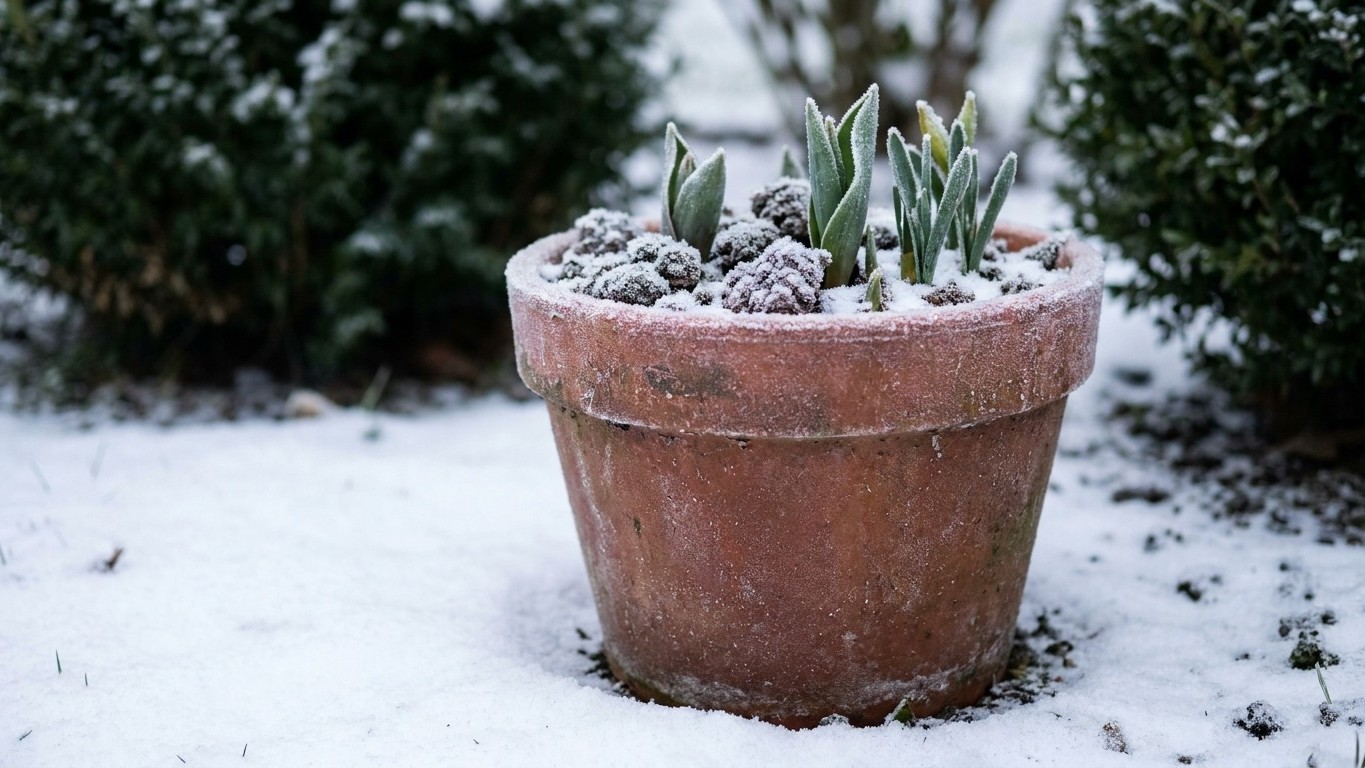

Spring bulbs will grow in containers in Minnesota, but the pot changes the rules that apply in a garden bed. A container freezes solid, roots and all, while the ground beneath a lawn stays insulated even in the coldest weeks. That means a bulb hardy enough for a Minnesota flower bed can still die in the same-rated pot unless the gardener treats the container as colder than the ground and protects it accordingly.
Why this matters in Minnesota

The average daily low during the coldest month here, measured at the Minneapolis reference station, is 8.8°F (NOAA NCEI Climate Normals, 1991-2020). That number settles the first question before anyone reaches for a trowel: does this state need to manufacture winter for its spring bulbs, or does it already have more than enough? At 8.8°F, Minnesota delivers the twelve to fourteen weeks below 45°F that a tulip or daffodil needs to set its flower bud, several times over. Forcing, the practice of substituting a refrigerator or a cold garage for a winter that never gets cold enough, isn’t the problem here. It’s a fix built for gardeners in warmer zones, where the ground barely dips below 50°F all season.
The problem in Minnesota runs the other direction. USDA places the state across hardiness zones 3a to 5a (USDA Plant Hardiness Zone Map, 2023 update, based on 1991-2020 normals), a range built on one variable: the average annual extreme minimum temperature. That rating tells a gardener what survives in the ground. It says almost nothing about what survives in a pot. Soil in a garden bed is insulated by the earth around it; even when the surface freezes hard, six or eight inches down the ground rarely drops to the same extreme. A container has no such buffer. Sitting on a deck or a porch, exposed on every side, a pot’s soil tracks the air temperature almost exactly, and it freezes clear through, bulb and roots together.
That difference is why a daffodil rated hardy for a Minnesota yard can turn to mush in a terra-cotta pot two feet away. The bulb itself never faced a temperature it couldn’t handle in the ground. In the container, it faced one it never had to survive before. Growers who work with a rule that a potted bulb needs two hardiness zones colder of protection than its garden-bed rating aren’t padding the number out of caution; they’re accounting for the fact that a pot has no soil mass to slow the freeze down. In a state that reaches 8.8°F on an average night in its coldest month, that gap between bed and pot decides whether the bulb makes it to spring.
How to do it here
Once the pot itself is accounted for, the sequence for Growing Spring Bulbs in Containers in Minnesota is the same one gardeners have used for generations, applied to a smaller volume of soil that needs more help holding a stable temperature. Every bulb still needs its twelve to fourteen weeks below 45°F; the only question is where that cold comes from and how the container survives it.
- Pick a pot with a real drainage hole at the bottom; a container that holds water against the bulb through freeze-thaw cycles kills faster than cold ever does.
- Plant at the depth listed for the species, in a well-draining potting mix rather than garden soil, which compacts once it’s confined to a container.
- Give the bulb its full stretch below 45°F, tracked from a clear start date to a clear end date, whether that happens outdoors or indoors.
- An unheated garage that stays above freezing works well, and so does an unheated porch, as long as neither climbs above 45°F on a warm afternoon, which resets the clock.
- A refrigerator drawer works too, kept away from ripening fruit: apples, pears, and other fruit release ethylene gas as they ripen, and ethylene kills the flower bud inside a chilling bulb before it ever opens.
- If the pot stays outdoors instead, treat it as roughly two hardiness zones colder than the ground it’s sitting on; a bulb rated for a Minnesota bed needs to hold up like a bulb from a colder zone once it’s isolated in a container.
- Sink the pot into a garden bed or a mound of mulch, burying it up to its rim, so the surrounding earth does for the container what it already does for an in-ground planting.
- If sinking the pot isn’t practical, move it into an unheated garage or shed for the coldest stretch, checking that the space doesn’t track outdoor temperatures exactly, since an uninsulated structure offers little more protection than open air.
- Once the chilling period is complete, bring the container into a bright room no warmer than the low 60s, and let the shoots green up gradually before moving it into direct light.
Every step here is something a gardener can check without special equipment: a thermometer in the garage, a calendar for the weeks of chilling, a look at the pot’s bottom for a drainage hole. None of it depends on a forecast or a date on the calendar, because the requirement is a number of cold weeks, not a specific month.
Which bulbs are worth it
Not every spring bulb is suited to a container, and the difference comes down to two things: how long the bulb needs its cold spell, and how tall it stands once it blooms. A short cold requirement means less time managing a garage or a fridge drawer. A short, sturdy stem means the pot doesn’t tip over the first time a house cat brushes past it.
Bulbs that force reliably tend to be the smaller, earlier-blooming species. That works in the container grower’s favor twice over: the plant is proportioned for a pot to begin with, and it needs less total chilling time before it’s ready to bloom.
- Crocus, low and compact, among the fastest to respond once brought into warmth
- Hyacinth, sturdy stem and heavy scent, holds up well in a pot indoors
- Grape hyacinth (muscari), small enough that several bulbs share one pot without crowding
- Dwarf iris (reticulata types), very short, rarely needs staking
- Miniature daffodils, shorter cultivars that stand up in a container where full-size trumpet types lean
Other bulbs sulk in a pot, either because they demand a longer stretch of cold than most gardeners want to manage in a refrigerator drawer, or because their mature height works against a container’s narrow base.
- Tall single and double tulips, top-heavy once in full bloom, prone to tipping a lightweight pot
- Large trumpet daffodils, the same leaning problem as tall tulips, worse in a small container
- Alliums, some of the tallest spring bulbs, built for a garden bed’s stability rather than a pot’s
- Fritillaria, a longer and more exacting chill requirement than most container growers want to track
Tulips deserve a separate note, because in most home gardens a containerized tulip is a one-season purchase either way; the bulb rarely rebuilds enough energy in a pot to repeat its show the following spring. That changes the math. If the bulb was never going to come back regardless of how it’s grown, using it for one good season of bloom in a pot costs nothing that a garden bed would have saved.
What goes wrong, and when you can still fix it
Three problems show up more than any others in containers, and each one points to a different stage where the process broke down.
Leaves, but no flower
A bulb that pushes up healthy green leaves and then stops, with no bud at all, almost always didn’t get its full stretch of cold. Cut the chilling period short by even a few weeks and the plant has enough stored energy for foliage but not enough of the trigger for a flower. There’s no fix for the bulb that’s already up and leafing. The next attempt needs a longer, uninterrupted chilling period, tracked from a clear start to a clear end.
A flower on a stem too short to see
When the bloom opens practically at soil level, buried in the leaves instead of standing above them, the bulb was moved into warmth before it had finished its cold period, or it was warmed too fast once the chilling ended. The stem needs a gradual transition from cold to a cool bright room before it stretches properly; skip that step and the flower forms on a stem that never got the signal to elongate. This season’s bloom is what it is. Next time, move the pot to an intermediate, cool space for a week or two before the final push into a warm room.
Rot in the pot
Soft, mushy bulbs, sometimes with a sour smell, mean water sat against them through repeated freeze-thaw cycles, almost always because the container had no drainage hole or the mix was too dense to let water pass through. There’s no reviving a bulb that’s already rotted. The pot itself can be reused, but it needs a real drainage hole and a looser, well-draining mix before it holds a bulb again.