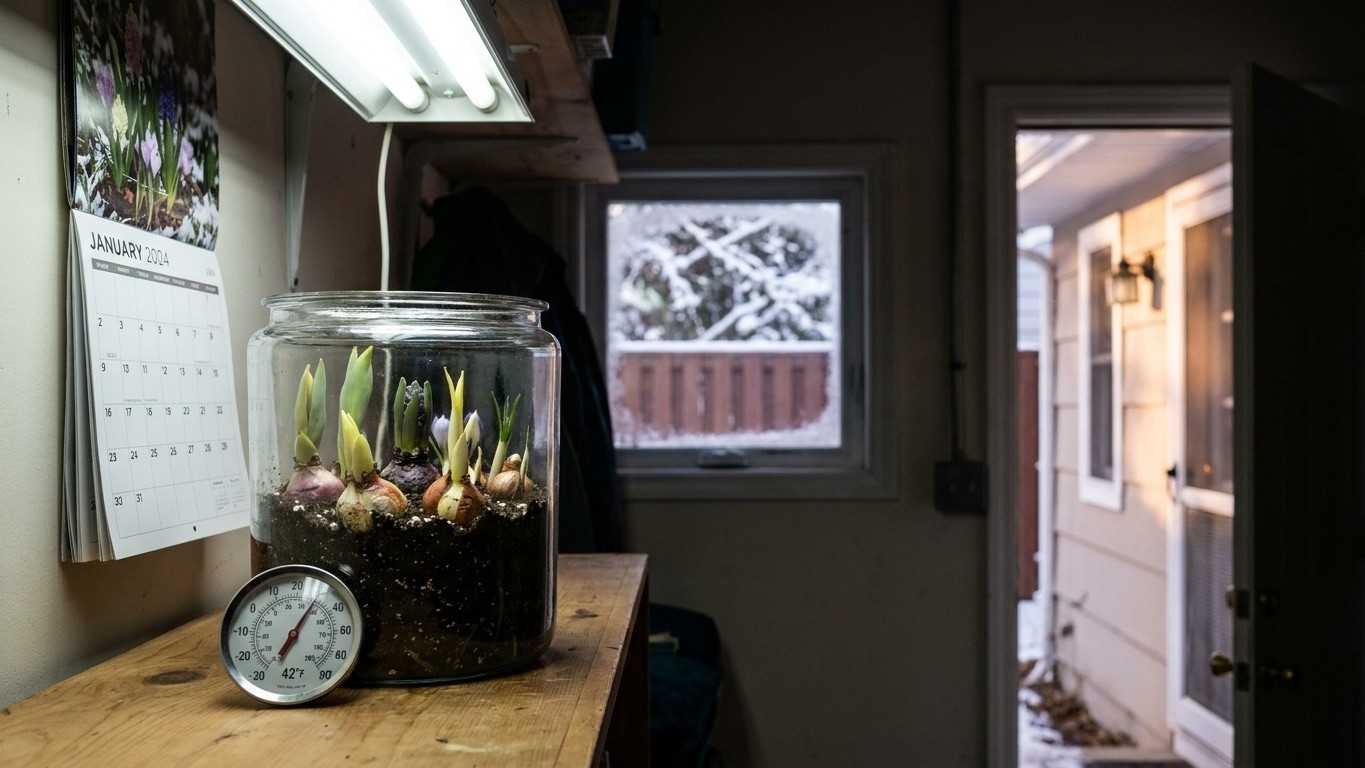

Mississippi’s mild winters rarely deliver the sustained chill that tulips, hyacinths, and crocus need to bloom. Forcing solves that by moving the chilling indoors, into a refrigerator or a cold garage, so the bulb experiences the cold spell the ground here won’t reliably provide.
Why this matters in Mississippi

The mean daily minimum for the coldest month in Jackson runs 36.6°F, according to NOAA NCEI’s 1991-2020 climate normals. That number matters more than any record low, because it’s the temperature a bulb actually experiences on an average night during the coldest stretch of the year, not the occasional hard freeze that makes the news.
A spring bulb like a tulip or hyacinth needs somewhere between twelve and fourteen weeks of temperatures below 45°F to complete the internal chemistry that produces a flower stalk. Mississippi’s winter, especially across the Gulf Coast half of the state sitting in USDA zone 9a, simply doesn’t hold below that threshold long enough or consistently enough. Even in the cooler 7b pockets near the Tennessee line, a run of 60-degree afternoons in January can interrupt the chilling clock a bulb needs to keep running without a break.
That’s the situation this territory falls into: not enough natural cold, not a container-freezing problem. The ground here almost never freezes deep enough to threaten a planted bulb’s roots, so the usual container-versus-ground-freeze concern that dominates colder states doesn’t apply the same way in Mississippi. The real issue is the opposite one: winter ends before the bulb has banked enough chill hours to flower reliably, whether it’s in the ground or a pot on the porch.
That’s exactly why forcing exists as a technique here. Instead of hoping a Mississippi winter cooperates, the gardener manufactures the missing weeks of cold in a refrigerator crisper drawer or an unheated garage, then brings the bulb out once it’s had its full chilling requirement. It’s a workaround for a climate gap, not a hedge against frost damage.
There’s a secondary wrinkle worth naming honestly. Bulbs already in Containers outdoors during a rare hard freeze can still take a hit, since a pot’s soil mass is smaller than the surrounding ground and cools faster during a sudden cold snap. But that’s a minor, occasional risk in Mississippi’s zone 7b-9a range, not the driving reason gardeners here force bulbs indoors. The driving reason is the 36.6°F figure itself: not cold enough, not long enough, most winters.
How to do it here
Because Jackson’s winters hover in that 36.6°F range for the coldest month rather than dropping consistently below 45°F for three-plus months, an unheated garage is a gamble in most of Mississippi. It might stay cold enough in December and January, then warm up too early in a mild February, cutting the chilling period short before the bulb is ready. A refrigerator drawer gives a controllable, checkable alternative that doesn’t depend on the weather cooperating.
- Buy dormant, pre-cooled bulbs where available, or plan to chill them yourself starting in early fall. Pot them in a well-draining mix in containers with drainage holes, then water once thoroughly.
- Place the potted bulbs in a refrigerator crisper drawer set between 35°F and 45°F. Keep them away from any ripening fruit stored in the same fridge, since the ethylene gas fruit gives off can damage the flower bud forming inside the bulb before it ever emerges.
- If using an unheated garage instead, verify with a min-max thermometer that it holds reliably above freezing and below 45°F for the full period. In much of Mississippi’s milder zone, this is harder to guarantee than a refrigerator, so check rather than assume.
- Leave the bulbs undisturbed for the species-specific chilling window, generally twelve to fourteen weeks for tulips and hyacinths, shorter for crocus. Check the soil every couple of weeks and add a little water if it’s gone bone-dry.
- Watch for pale shoots emerging from the soil surface. That’s the signal the chilling period is complete and the bulb is ready to be warmed.
- Move the pot to a cool, bright room, out of direct heat vents, and let it green up for several days before moving it into fuller light to bloom.
- If any bulbs are potted and left outdoors rather than forced indoors, mulch the container heavily or move it against a sheltered wall during any forecast hard freeze, since a small pot cools faster than garden soil.
Which bulbs are worth it
Not every spring bulb rewards the extra refrigerator space. Bulbs with a short chilling requirement and a compact flower stalk force cleanly and hold up in a pot. Bulbs bred for tall, dramatic garden display tend to topple or bloom unevenly once forced, because the same genetics that make them showy outdoors make them top-heavy indoors.
Bulbs that force reliably here
- Paperwhite narcissus: needs no chilling period at all, the easiest option for Mississippi gardeners who want to skip the refrigerator step entirely.
- Crocus: short chilling requirement and a low, sturdy stem that doesn’t flop.
- Hyacinths: fragrant, compact, and forgiving of the twelve-week minimum.
- Tulips: reliable once the full fourteen-week chill is met, though they need staking help in a shallow pot.
- Muscari (grape hyacinth): short stem, short chill, blooms cleanly indoors.
Bulbs that sulk
- Large trumpet daffodils: uneven forcing results and a tall stem that leans in a container.
- Tall alliums: top-heavy once the flower head opens, prone to tipping the pot.
- Fritillaria: fussy about chilling consistency, unreliable indoors.
- Amaryllis: a different category of bulb entirely, it doesn’t need a cold period and shouldn’t be lumped in with true forced spring bulbs.
Worth saying plainly: in Mississippi, tulips planted in the ground rarely get the sustained chill needed to rebloom the following year anyway, so they’re already a one-season purchase here. Forcing them indoors costs nothing extra in the long run, since the bulb was never going to naturalize outdoors in this climate.
What goes wrong, and when you can still fix it
Leaves come up, but no flower
This means the chilling period was cut short, either an early warm spell interrupted a garage-stored bulb or the fridge time ran a few weeks under the twelve-to-fourteen-week minimum. There’s no fix this season. The bulb has spent its stored energy on foliage instead of a flower bud. Compost it or plant it in the garden where it may eventually recover enough reserves to flower in a future year, and note the shortfall for next season’s timing.
The flower opens on a very short stem
This happens when the bulb was moved from cold storage into warmth and bright light too abruptly, before the stem had time to elongate. It’s a cosmetic problem, not a fatal one. The flower will still open and can still be enjoyed at that shorter height. Next time, give the bulb a few extra days in cool, dim conditions after the chilling period before moving it into full light and warmth.
Rot at the base, soil smells sour
This is a drainage failure, almost always a pot without adequate drainage holes or a mix that held too much water during the long chilling weeks. There’s no saving that bulb this season. Discard it, clean the pot, and switch to a mix with more perlite or coarse sand next time, along with a pot that actually drains.