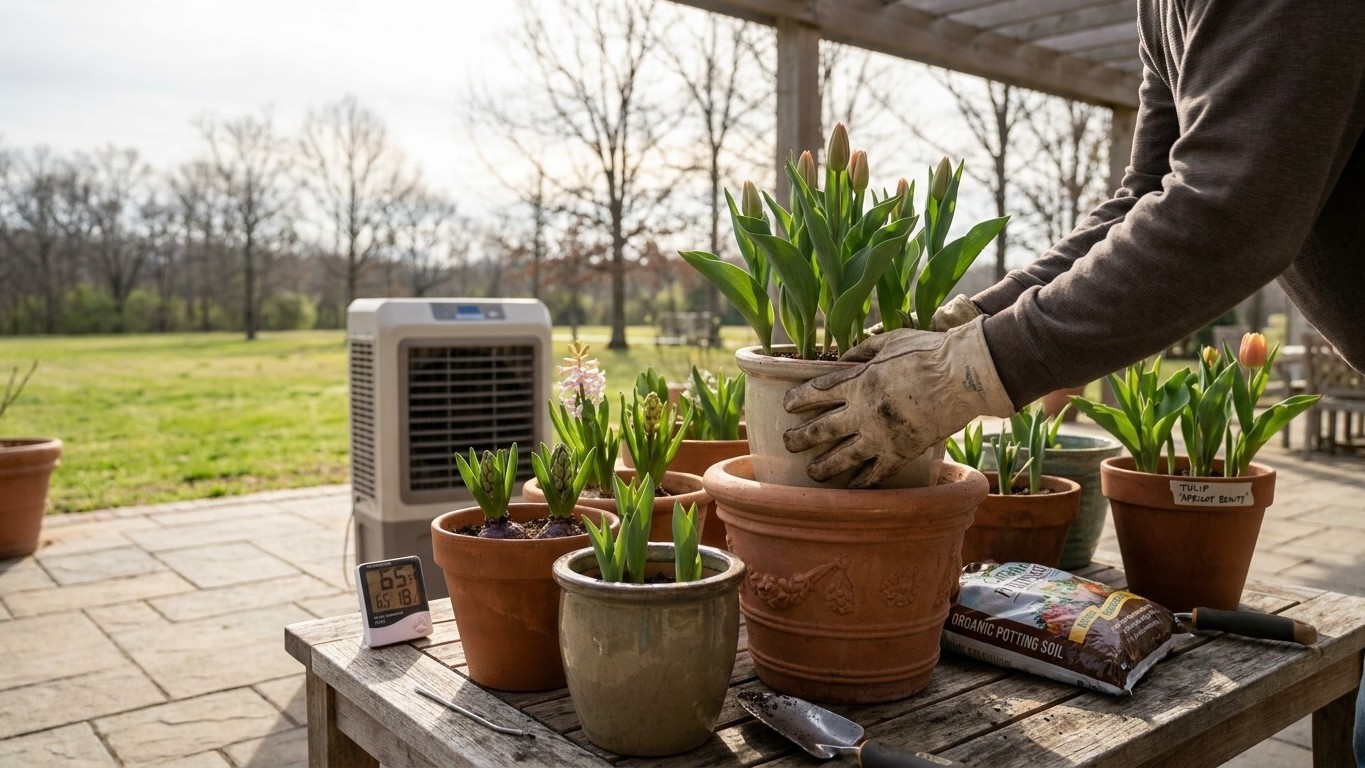

In Containers, bulbs in Mississippi almost always need help from the gardener rather than help from the calendar. The state’s winters rarely stay cold enough, long enough, to trigger a spring bloom on their own, so forcing (deliberately chilling the bulb yourself) is the practical answer here, and container growing adds its own set of rules on top of that.
Why this matters in Mississippi

The number that decides this is 36.6°F, the mean daily minimum of the coldest month at the Jackson reference station, per NOAA NCEI’s 1991-2020 climate normals. That is an average low, not a record low, and it sits close to the 45°F ceiling that spring bulbs need to stay under for roughly twelve to fourteen weeks straight before they’ll flower properly. An average that close to the threshold means a lot of nights climb well above it, and daytime highs in the coldest month routinely push past 45°F across most of the state. The sustained, weeks-long stretch of chilly air that a tulip or hyacinth is built for just doesn’t show up reliably.
That puts Mississippi in the forcing camp, not the freeze-through camp. In colder parts of the country, the problem with containers is a pot that freezes solid, roots and all, when the same bulb would have been fine bedded in ground that only freezes at the surface. That’s a real risk in a zone 5 or 6 climate. Here, with the state spanning USDA hardiness zone 7b to 9a on the 2023 map (built from that same 1991-2020 window), the ground almost never freezes hard enough for that scenario to matter much. The bigger obstacle is the opposite one: not enough cold, not for long enough, delivered in the wrong pattern to trigger bloom.
There’s a caveat worth naming plainly. The 7b end of that range sits toward the northern part of the state, and a harder freeze night there can still chill a container faster than it would chill a bed, because a pot has less soil mass and more exposed surface. So container growers in the cooler third of Mississippi shouldn’t ignore cold snaps entirely. But the dominant fact for the state as a whole is the mild coldest-month minimum, not a hard-freeze one. Plan around insufficient chilling first, and treat occasional exposure as a secondary, localized concern rather than the main event.
How to do it here
Forcing is a sequence, and skipping a step or shortcutting the timing is the most common reason it fails. Here’s the order that actually works, anchored to what a Mississippi gardener can check without special equipment.
- Pick bulbs that need real chilling. Tulips, hyacinths, and crocus require the twelve-to-fourteen-week cold period; paperwhite narcissus does not and can skip this whole process.
- Choose your cold source. An unheated garage works only if it reliably stays above freezing all winter; if it dips hard below 32°F on the coldest nights, the bulb tissue can be damaged before it ever blooms. A refrigerator crisper drawer is the more controllable option for most Mississippi homes.
- Keep the drawer away from ripening fruit. Apples, pears, and bananas release ethylene gas, and ethylene can kill the flower bud inside a chilling bulb before it ever emerges. Store bulbs in a separate drawer or a different refrigerator entirely if you can.
- Count the full twelve to fourteen weeks. Mark a start date and don’t pull bulbs early just because you’re eager; an incomplete chilling period is the single biggest cause of leaves with no flower later on.
- Match the pot to the bulb’s hardiness, or plan to move it. If bulbs will sit in the container outdoors through any part of winter rather than in a fridge, the pot needs to perform at least two USDA zones hardier than the bulb’s rated zone, since a container offers far less insulation than garden soil. If that’s not achievable, move the pot into an unheated but enclosed space, or bank mulch up around the container’s sides, during the coldest stretches.
- Plant into the container once chilling is complete, using a well-draining potting mix, and bring it into bright, cool light rather than warmth right away.
Which bulbs are worth it
Not every spring bulb pays back the effort of chilling and container growing. The ones with a shorter cold requirement force faster and more predictably, and short, sturdy stems hold up in a pot far better than tall ones that topple the moment they open. Worth noting too: in a climate like Mississippi’s, many of these bulbs were never going to reliably return and rebloom in the ground anyway, since the same mild-winter chilling shortfall applies outdoors. That means treating them as a one-season purchase for forcing costs nothing in the long run.
- Crocus, chilled and dependable
- Hyacinths, fast to flower and heavily scented
- Tulips, especially shorter-stemmed varieties bred for pots
- Paperwhite narcissus, which need no chilling period at all
- Grape hyacinth (muscari), compact and low-toppling
- Tall alliums, prone to toppling in a lightweight container
- Fritillaria, fussy about drainage and inconsistent when forced
- Large trumpet daffodils on tall stems, better suited to garden beds than pots
What goes wrong, and when you can still fix it
Leaves but no flower
This means the chilling period ran short, whether the bulb spent nine weeks in the drawer instead of twelve to fourteen, or the garage never got consistently cold enough. There’s no fix for the plant this season; the flower bud simply never fully formed inside the bulb. The bulb can go back through a full, uninterrupted chilling cycle next year.
A flower on a stem too short to see
Here the chilling was fine, but the bulb got warmed up too fast afterward, often by moving straight from a cold drawer into a warm, sunny windowsill. The stem doesn’t have time to elongate before the flower opens. Once it’s happened, there’s no rescue for that bloom, but the bulb itself is otherwise undamaged. Next time, move chilled bulbs into a cool, bright spot first and only into full warmth once growth is well underway.
Rot in the pot
Soft, mushy bulbs or a sour smell in the soil point to standing water, almost always because the container never drained. This one is not fixable for the current bulb; rot at the base spreads quickly and doesn’t reverse. It is fixable for next season by choosing a container with an actual drainage hole and a coarse, fast-draining mix rather than dense garden soil.