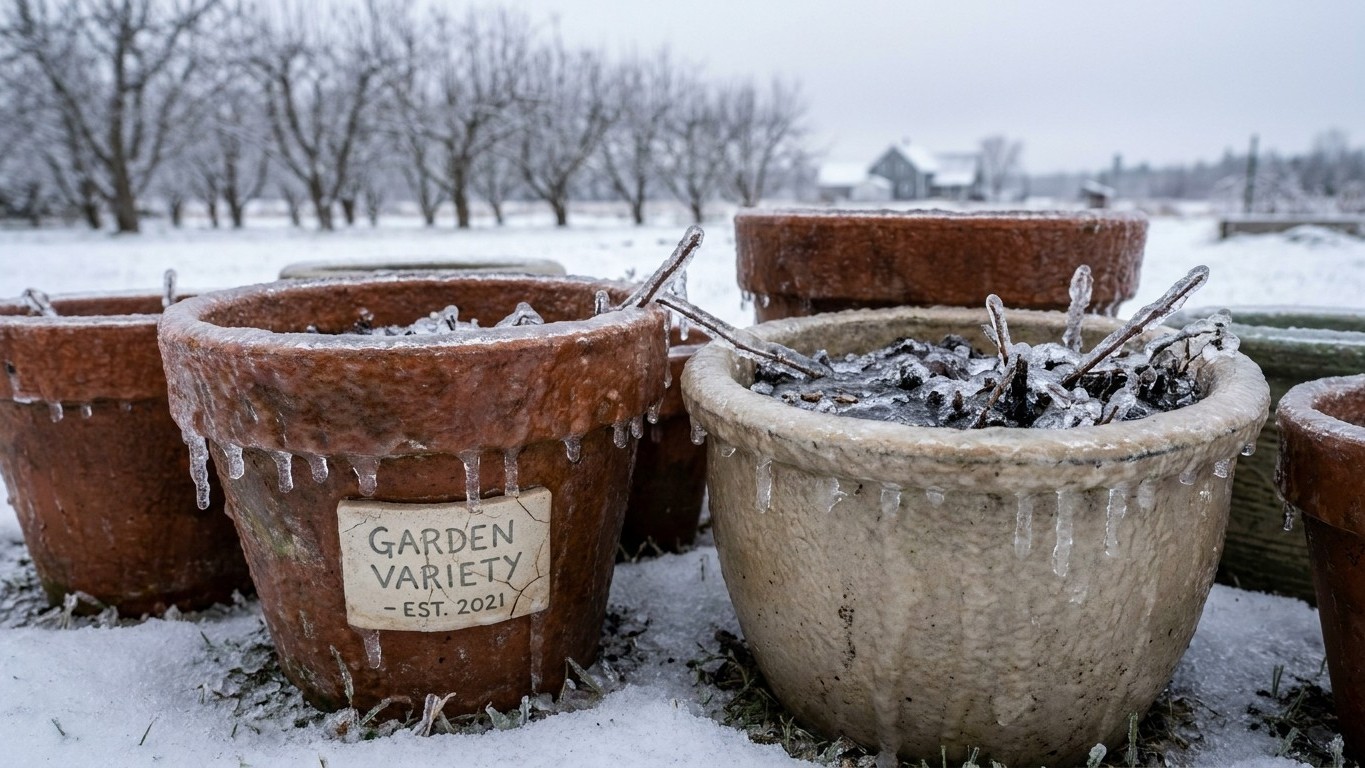

Forcing spring bulbs indoors works well in New Brunswick, but the reason has nothing to do with a shortage of winter cold. The province has plenty of that. The real obstacle is containers: a pot left outdoors here freezes solid, roots and all, in a way garden soil never does.
Why this matters in New Brunswick

The mean daily minimum for the coldest month at the Moncton reference station sits at 6.9°F, according to Environment and Climate Change Canada’s 1981-2010 Climate Normals. That number matters more than any record low, because it describes the cold a bulb actually sits through, night after night, for weeks at a stretch. Moncton’s hardiness rating, using the Canadian system built by Natural Resources Canada from the 1991-2020 normals, comes out to zone 5a. That’s a system built on seven climate variables, not the single-variable USDA scale used elsewhere, so the number can’t be swapped for a US zone rating on a seed catalog.
A spring bulb needs roughly 12 to 14 weeks below 45°F before it can break dormancy and bloom. In a New Brunswick garden bed, the ground delivers that without any help. Nobody here needs to manufacture missing chill hours. The problem shows up somewhere else entirely: a pot.
Garden soil freezes from the top down, and even in a hard winter the frost line rarely reaches the depth where a planted bulb sits. A container has no such buffer. Soil in a pot is exposed on all sides, so at 6.9°F average lows it freezes clean through, bulb and roots together, and repeated freeze-thaw cycles rupture plant cells that would have survived fine six inches under open ground. A hardiness rating printed on a bulb bag assumes an in-ground planting. It says nothing about what happens to the same bulb sitting in a plastic nursery pot on a porch in January.
That’s the situation this territory is actually in. Forcing indoors here isn’t about supplementing cold that winter fails to deliver. It’s about capturing a controlled slice of that cold, in a garage or a refrigerator, so the bulb gets its chill requirement without the container being destroyed by direct exposure to a zone 5a winter.
How to do it here
The sequence stays the same whether the bulb is a hyacinth destined for a windowsill or a batch of crocus meant for a kitchen table. What changes in New Brunswick is where the cold period happens, and how closely it needs watching.
- Pot the bulbs in fall, using a well-draining mix in a container with drainage holes, bulb noses pointed up and barely covered.
- Water once, thoroughly, right after potting. The soil should be damp through the cold period, never soggy.
- Move the pots to an unheated garage that reliably stays above freezing rather than leaving them outdoors. This is the step that replaces the ground’s natural insulation.
- Track the weeks. Most spring bulbs need 12 to 14 weeks below 45°F before the flower inside the bulb has finished developing.
- Check the garage’s actual temperature swing against the outdoor figure. If it tracks close to the region’s 6.9°F coldest-month average, the space is too cold for a pot and the bulbs should move to a refrigerator drawer instead.
- If using a refrigerator, keep the pots away from ripening fruit. Fruit gives off ethylene gas, and ethylene kills the flower bud forming inside the bulb before it ever gets the chance to open.
- After the full cold period, check for a shoot tip an inch or two long and visible root growth through the drainage holes. That’s the signal the bulb is ready, not a date on a calendar.
- Bring the pot into a cool room with indirect light for about a week before moving it somewhere brighter and warmer. Jumping straight from cold storage to a sunny, heated room is the single most common cause of a disappointing bloom.
- If the plan is to keep the container outdoors after forcing, remember it needs to rate at least two zones hardier than the bulb itself, or be moved to shelter and heavily mulched, because zone 5a cold will freeze an unprotected pot solid regardless of what the bulb’s own rating claims.
Which bulbs are worth it
Not every bulb rewards the effort of a cold chamber and a watched calendar. The ones that force well tend to share a short chill requirement or a compact growth habit; the ones that disappoint usually need a long cold spell, grow tall enough to flop in a lightweight pot, or simply don’t respond to the shortcut at all.
- Paperwhite narcissus — needs no cold period at all, blooms in about four to six weeks from potting, and since it isn’t hardy outdoors in this zone anyway, forcing it costs nothing long-term. It was never going to survive a New Brunswick winter in the ground.
- Hyacinths — a shorter chill requirement than tulips and a compact stem that holds up well in a small pot.
- Crocus — small, fast, and forgiving of a slightly shortened cold period compared with larger bulbs.
- Muscari (grape hyacinth) — reliable bloomer indoors, low growth habit that rarely topples.
- Early single-flowering tulip varieties — shorter stems than the late doubles, better balance in a pot.
- Large trumpet daffodils — tall stems that lean or snap once the flower opens indoors, away from the wind resistance they’d get outdoors.
- Late double tulips — heavy flower heads on stems that a small pot’s soil volume can’t anchor well.
- Alliums — a long cold requirement combined with a tall flower stalk makes them poor candidates for indoor forcing.
- Fritillaria — finicky about both cold duration and moisture, with a low success rate outside a garden bed.
What goes wrong, and when you can still fix it
Leaves but no flower
Green growth appears right on schedule, but no bud ever shows. The mechanism is a shortened cold period: leaf growth can proceed on partial chilling, but the flower embryo inside the bulb only finishes developing after the full 12 to 14 weeks below 45°F. If the pot is still in its cold spell, returning it to cold storage for the missing weeks can still save the bloom. Once it’s already been warmed and pushed leaves for several weeks, the flower for this season is gone; the bulb can go into a garden bed to try again next year if it’s a hardy species.
Flower on a stem too short to see
The bud opens, but it’s buried at soil level instead of standing up on a visible stalk. This comes from warming the bulb too fast, jumping straight from a cold garage or fridge into a hot, bright window. The stem never gets the gradual temperature rise it needs to elongate. There’s no fix once the stem has already set at that height; the lesson carries to next season’s timing, not this one.
Rot in the pot
The bulb turns soft and dark instead of sprouting. This is almost always a drainage failure, either a pot without enough holes or soil that stayed waterlogged through the cold period. A rotted bulb is not salvageable. The only fix is prevention next time: a pot that drains freely and watering that keeps the soil damp, not wet, through the entire chilling stretch.