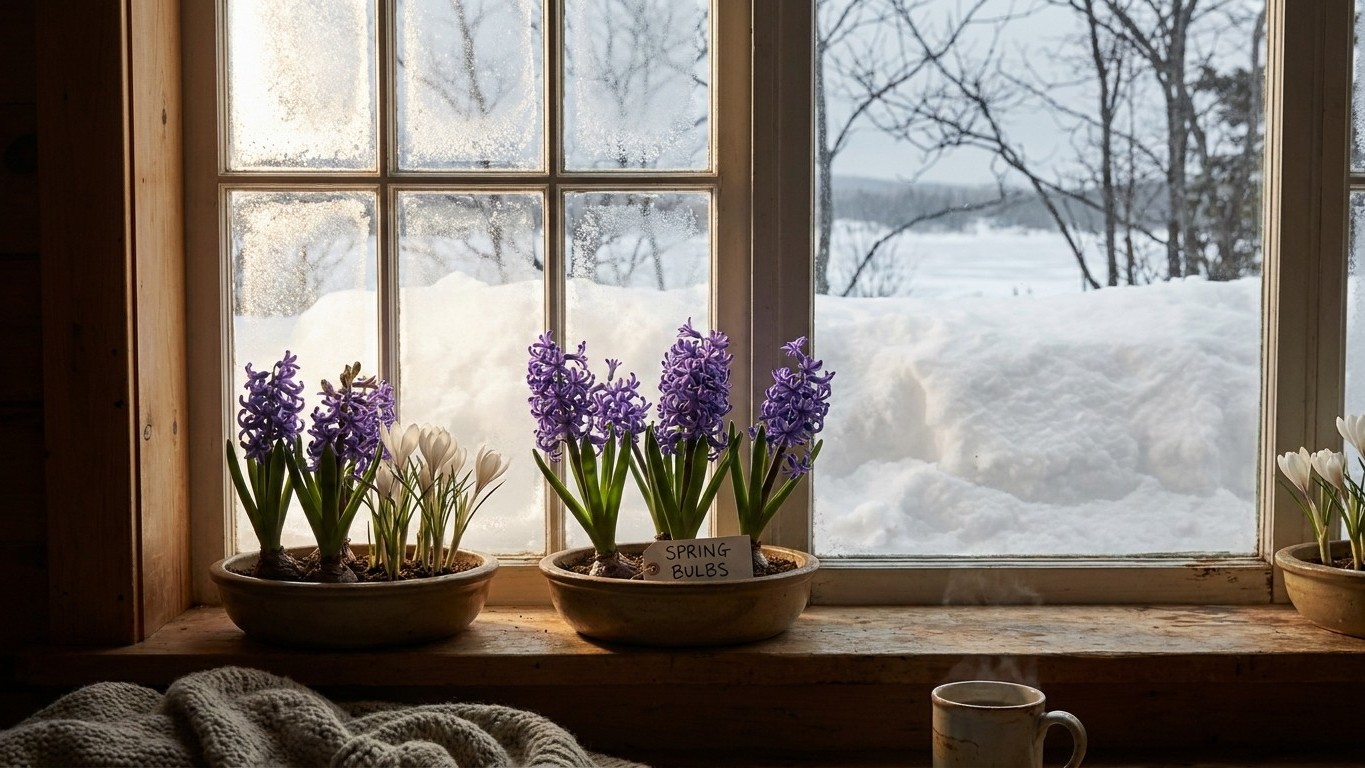

Forcing spring bulbs indoors here isn’t about supplying cold the winter withholds. Newfoundland and Labrador already has more of that than most bulbs need. It’s about pulling the bloom forward into January or February, weeks before the snow outside even thinks about melting. Chill the bulbs yourself, on your own schedule, and a hyacinth or a crocus can flower on a windowsill long before anything shows outdoors.
Why this matters in Newfoundland and Labrador

The mean daily minimum for the coldest month at St. John’s sits at 16.4°F, according to Environment and Climate Change Canada’s 1981-2010 Canadian Climate Normals. That figure is the one that decides whether a plant survives a Newfoundland winter outdoors, and it tells you plainly that this province is not short on cold. A spring bulb needs roughly twelve to fourteen weeks below 45°F before it can flower at all; St. John’s delivers that requirement and then keeps going, often for six months straight.
In a province where winters run mild, forcing exists because the ground never stays cold enough long enough, so gardeners fake that missing winter in a refrigerator. Here the opposite problem shows up. The outdoor cold arrives early, holds on late, and buries garden beds under snow long after other parts of the country see their first crocus. Forcing indoors in Newfoundland and Labrador solves a timing problem, not a shortage. You supply the same chill period yourself, starting it in the fall, so the bulb opens on a windowsill in the dead of winter instead of in a bed that won’t be worth looking at again until May.
St. John’s falls in Canadian plant hardiness zone 6a, based on Natural Resources Canada’s 1991-2020 normals. That rating is built from seven climate variables, not the single winter-low number the USDA system uses on garden tags sold south of the border, and the two scales don’t convert into each other. A bulb rated for a US zone on its packaging tells a Newfoundland gardener less than it looks like it does, and the zone number itself describes St. John’s specifically, not every corner of the province.
Containers left outdoors run into a separate problem that this page isn’t built to answer. A pot freezes solid, roots included, in conditions that only crust the top few inches of an open bed. That threshold is different from anything covered here, and it deserves to be treated as its own question rather than assumed away just because a bulb is hardy in the ground.
How to do it here
The sequence below assumes a bulb that needs a standard chill period, planted with forcing in mind rather than left to take its chances outside. Skip a step and the bulb usually tells on itself later, either with no flower or with one that opens wrong.
- Pick a bulb suited to forcing and set it in a pot with drainage holes, at the depth the packaging specifies, in ordinary potting soil rather than garden dirt.
- Water it once, thoroughly, then move the pot into a source of cold that holds steady above freezing for twelve to fourteen weeks. An unheated garage works if it stays above 32°F through the coldest stretch; check it with a thermometer rather than guessing, since an attached garage and a detached one behave very differently once temperatures drop.
- Or use a refrigerator drawer, kept well away from apples, pears, or anything else ripening nearby. Ripening fruit releases ethylene gas, and ethylene kills the flower bud inside a chilling bulb before it ever gets the chance to open.
- Check every few weeks for roots showing through the drainage holes and a pale shoot an inch or two tall. That combination means the chill requirement has been met.
- Move the pot to a cool, dim spot around 60°F for about a week before giving it full light and warmth. Skipping this transition is the single most common reason a forced bulb blooms on a stem too short to see above the leaves.
- Bring it into a bright, normally heated room once the shoot has greened up. Flowers typically follow within two to four weeks.
If containers are going to sit outdoors instead of in a garage or fridge, the pot needs to be rated at least two hardiness zones tougher than the bulb inside it, or it needs to come indoors, or into an unheated space, and get mulched heavily before the ground freezes. That’s a container question, not a forcing one, but the two get confused often enough to mention here.
Which bulbs are worth it
Not every bulb pays back the effort of chilling it on purpose. A bulb with a short cold requirement forces faster and forgives a rushed schedule; a bulb that throws up a tall, heavy stem often topples the moment it’s out of the cold and into a warm room. Where a bulb was never going to survive a Newfoundland winter outdoors anyway, forcing it costs nothing in the long run, since it was a one-season purchase either way.
Species that force reliably here
- Hyacinths, which have a shorter chill requirement and a sturdy stem that rarely flops
- Crocus, fast to chill and low enough that toppling isn’t a concern
- Grape hyacinth (muscari), compact and forgiving of a slightly short or slightly long chill period
- Smaller daffodil and narcissus types, especially the miniature varieties bred for pots rather than beds
- Single early tulips, which stay short enough in a pot to stand on their own
Bulbs that tend to sulk
- Large trumpet daffodils, whose tall stems topple easily once forced indoors
- Fritillaria, which wants a longer, more exact chill period than most home fridges or garages can guarantee
- Alliums, since their chill requirement runs long and their bulk makes a small pot impractical
- Tall late-season tulips, bred for garden height rather than a windowsill
What goes wrong, and when you can still fix it
Leaves come up, but no flower ever appears
This means the chill ran short. The flower bud sits fully formed inside the bulb before planting, but it only finishes developing after the full twelve to fourteen weeks below 45°F. Interrupt that period, or start counting from the wrong date, and the bulb puts its remaining energy into leaves instead. There’s no fix this season. The bulb has spent what it had; the only remedy is to give a fresh bulb the full chill period next time, tracked from the day it actually goes into the cold, not the day it was purchased.
The flower opens buried down in the leaves, on a stem too short to see
This is what happens when a chilled bulb moves straight from cold storage into full warmth and bright light, skipping the week-long transition through a cool, dim spot. The stem never gets the chance to elongate before the flower bud finishes opening. It can’t be lengthened after the fact, so there’s no saving that particular bloom this season. The bulb itself is usually fine for looking at, just shorter than expected; the fix belongs to the next bulb, with that cool intermediate stop restored to the sequence.
The bulb rots in the pot before it ever sprouts
Rot means the roots sat in water that had nowhere to go, usually because the pot lacked drainage holes or sat inside a decorative cachepot that trapped runoff underneath. Once a bulb has gone soft and rotted, it’s finished for the season and can’t be revived. The only action worth taking is replacing the pot with one that drains, and checking that nothing catches the water underneath, before starting the next bulb’s chill period.