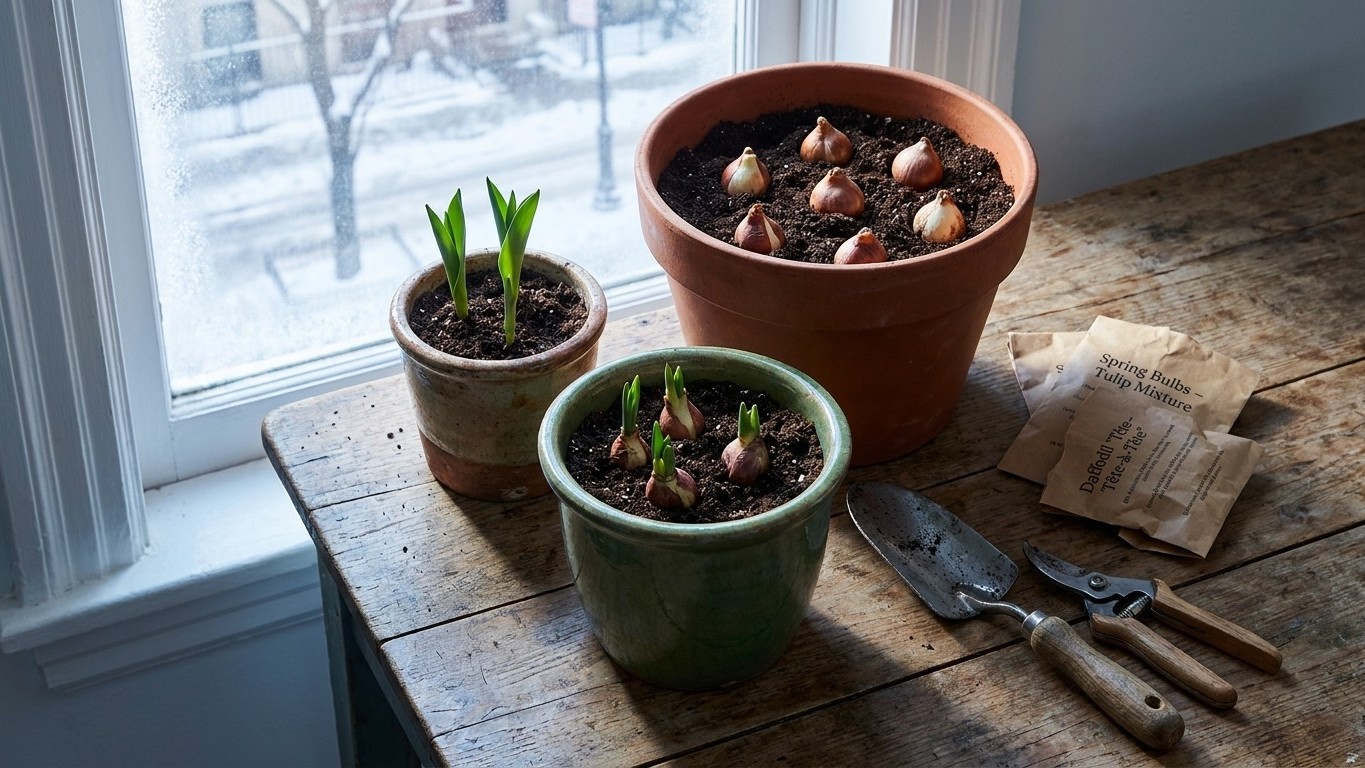

Spring bulbs grow well in containers across New York, but the plan changes with where the pot sits. New York City’s winters deliver more than enough natural cold for tulips and daffodils planted outdoors, no refrigerator required. The real risk here isn’t a shortage of chill, it’s a pot freezing solid the way a garden bed never does. Match the container to the bulb’s hardiness with a buffer, and save forcing for when you actually want blooms indoors before spring shows up outside.
Why this matters in New York

The coldest month in New York City averages a daily minimum of 27.9 degrees Fahrenheit, according to NOAA NCEI’s 1991-2020 Climate Normals for the city’s reference station. Spring bulbs need roughly twelve to fourteen weeks with temperatures staying below 45 degrees to complete the internal process that turns a dormant bulb into a flowering one. A winter that sits at 27.9 degrees on its coldest month’s average low, sustained across December, January and February, clears that threshold with room to spare. That’s the first fact worth sitting with: forcing, meaning the practice of supplying missing cold in a refrigerator or an unheated garage, isn’t something a New York gardener needs to grow bulbs outdoors. The climate already does that job. Forcing here is a choice, not a requirement, used mainly by people who want a bloom on a windowsill in February rather than in a bed in April.
The second fact changes the equation for anyone using a pot instead of a garden bed. Soil in the ground insulates roots from the air; a mass of earth several feet deep barely reflects the daily swing in outdoor temperature. A container has no such buffer. Its sides sit exposed to the air on every face, so the potting mix inside tracks the ambient temperature far more closely than garden soil does, and a hard freeze can pass all the way through the pot, bulb and roots together, in a way it never would in a bed. That means the hardiness zone printed on a bulb’s tag, which assumes ground planting, overstates how much cold a container can safely take.
New York State’s hardiness range runs from 3b to 7b, per the USDA Plant Hardiness Zone Map’s 2023 edition, built on the 1991-2020 normals. New York City sits toward the milder end of that span, while inland and upstate regions, the Adirondacks and Tug Hill among them, fall much closer to the cold end. A container gardener in the city faces a real but manageable freeze-through risk; the same pot left outdoors near the Canadian border faces a considerably harsher one. Either way, the fix is the same: treat the bulb’s stated hardiness as a ground rating, not a container rating, and plan accordingly.
How to do it here
The sequence below assumes a container left outdoors through winter, with a note on the refrigerator method for anyone chasing an earlier, indoor bloom instead.
- Pick bulbs with a shorter cold requirement if the pot will sit exposed on a porch or stoop all winter. A shorter chill period means less total time the bulb spends vulnerable to a hard freeze inside a thin-walled container.
- Check the bulb’s ground hardiness rating, then choose a pot, material and thickness that performs like a zone at least two steps colder. A bulb rated hardy to zone 5 in the ground needs container conditions closer to what zone 3 delivers, since the pot offers none of the insulation the ground provides.
- If the container can’t realistically meet that buffer, plan to move it rather than leave it exposed. An unheated garage or shed that stays reliably above freezing works well, because the goal is sustained cold, not warmth. Anywhere in the general range that keeps temperatures below 45 degrees without dropping to a hard freeze satisfies the chilling requirement.
- Where there’s no indoor unheated space available, sink the pot to its rim in mulch, straw, or a spare corner of a garden bed. This gives the container’s sides the same insulation a bed’s soil naturally provides.
- Track roughly twelve to fourteen weeks of that sub-45-degree exposure before expecting shoots to appear. Checking a thermometer left near the pot beats guessing by the calendar.
- For an indoor refrigerator method, aimed at an earlier or holiday bloom rather than at compensating for a mild climate, keep the potted bulbs in a refrigerator drawer away from ripening fruit. Fruit releases ethylene gas as it ripens, and that gas kills the flower bud forming inside the bulb before it ever gets a chance to open.
- Once the chill period is met and shoots appear, move the pot into bright, cool light gradually rather than straight into a warm room. A fast jump to warmth is what produces the short, hidden stem covered further down.
Which bulbs are worth it
Not every bulb rewards the extra handling a container demands. A shorter cold requirement forces faster and tolerates the freeze-through risk of a pot better, while a tall stem that would stand fine in garden soil often topples once it’s growing in the smaller root volume and lighter weight of a container.
Forces reliably in a New York container
- Crocus, whose short cold requirement and low, ground-hugging profile keep it stable even when a container catches wind.
- Grape hyacinth (Muscari), sharing crocus’s short chill window and readily multiplying in the same pot year after year.
- Species and botanical tulips, distinct from the tall hybrids, whose shorter stems stay upright without staking.
- Daffodils (Narcissus), both standard and miniature types, dependable repeat bloomers when the pot is left outdoors between seasons.
- Hyacinths, whose sturdy stems make them dependable forcers, though the fragrance can be strong if brought indoors early.
Sulks in a container
- Tall hybrid tulips, the Darwin and single late types, whose stem height becomes top-heavy the moment root volume shrinks to what a pot can hold, and which wind topples easily.
- Large trumpet daffodils in small decorative pots, which want more root depth than a shallow container offers and often respond with leaves and no flower.
- Fritillaria, which needs an even, undisturbed chill and reacts poorly to the faster temperature swings a container experiences compared with garden soil.
Most hybrid tulips decline sharply after their first bloom no matter where they’re planted, so using them as a one-season container purchase costs nothing extra in the long run. They were never coming back at full size in year two anyway.
What goes wrong, and when you can still fix it
Leaves but no flower
This means the cold period ran short, the bulb never reached the full twelve to fourteen weeks below 45 degrees needed to form a mature flower bud. Once foliage has emerged without a flower, that season’s bloom is gone for good. Let the foliage die back naturally so the bulb can recharge, then give it a complete, uninterrupted chill period the following winter.
A flower stem too short to see
The chill requirement was met, but the pot was warmed too fast afterward, so the stem never had time to elongate before the flower opened. Caught early, moving the pot back to cooler, bright conditions can slow things down and add a little height, but a stem that’s already opened won’t stretch further this season. A slower transition from cold to warm next time prevents it.
Rot in the pot
Soft, mushy bulbs point to a container that never drained, soil staying wet through winter while the bulb sat in it. This one isn’t salvageable this season; a rotted bulb won’t recover. For the next planting, use a container with real drainage holes and a fast-draining mix, and confirm water is actually leaving the pot rather than pooling at the bottom.