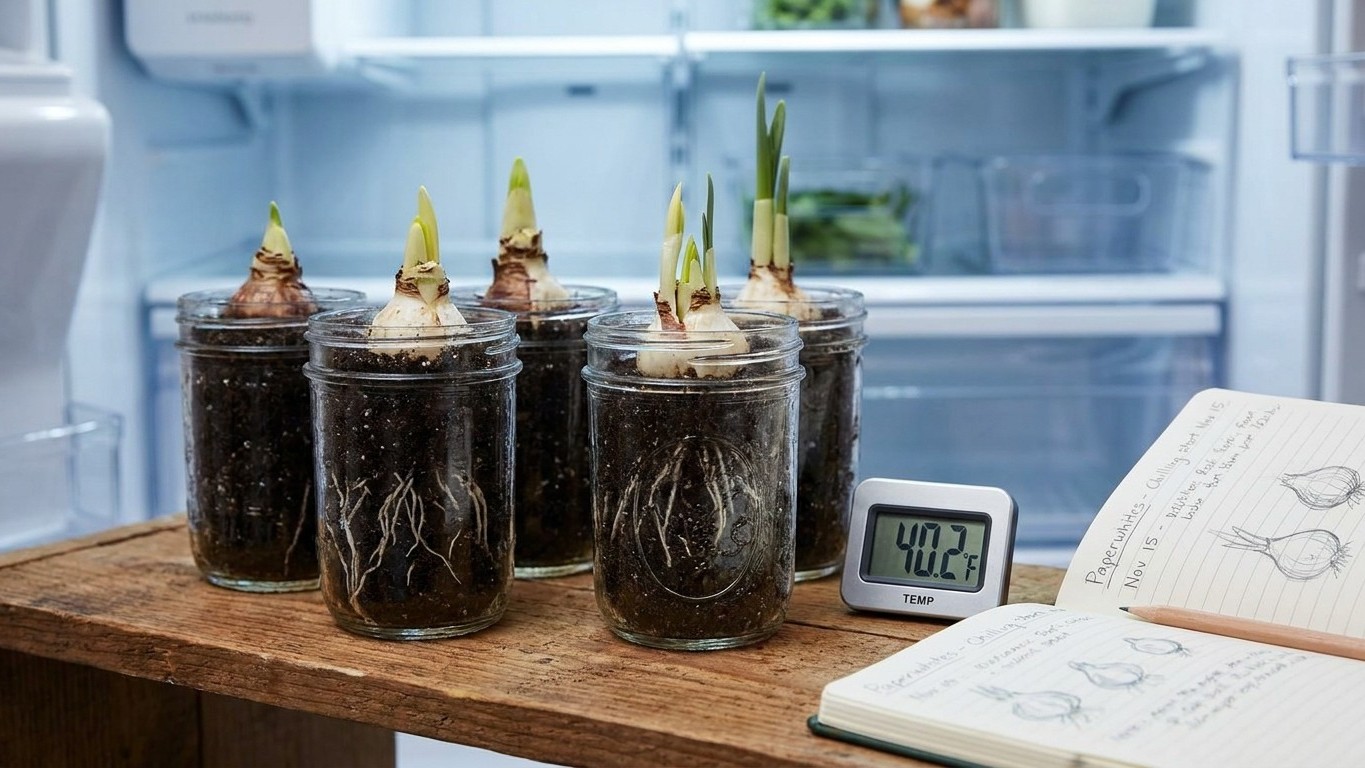

Forcing works in North Carolina because winter here doesn’t reliably deliver a steady, uninterrupted cold spell to a bulb sitting in a pot. Gardeners substitute a refrigerator drawer or an unheated garage for the 12 to 14 weeks of chill a tulip or daffodil needs, and that control matters more in a state with five hardiness zones than in most places.
Why this matters in North Carolina

In Charlotte, the reference station for the central Piedmont, the average daily minimum during the coldest month sits at 31.8°F (NOAA NCEI Climate Normals, 1991-2020). That’s well under the 45°F ceiling a spring bulb needs to trigger the biochemical process that builds a flower inside it. But that figure only describes one month’s average low. It says nothing about how many weeks in a row stay under 45°F, and it says nothing about the 55°F or 60°F afternoons that regularly interrupt a Piedmont winter between cold snaps.
That interruption is the real issue. North Carolina’s hardiness zones run from 5b in the mountains to 8b near the coast (USDA Plant Hardiness Zone Map, 1991-2020 normals), a range wide enough that a single statewide answer doesn’t hold. In the high country, ground stays cold on its own for months at a stretch; a bulb planted in a bed there gets its chill without any help. Closer to Charlotte and east toward the coast, the ground cools and warms in cycles, so a bulb counting on outdoor chill can end up with several partial cold periods instead of one continuous one, and a partial chill produces a stunted or absent bloom.
Containers face a separate problem, and it’s not about duration, it’s about depth. A hardiness rating assumes a bulb sitting in ground, where the soil below the frost line stays several degrees warmer than the air. A pot has no frost line to hide below. When outdoor air drops into the 20s, a small container of potting mix freezes solid, roots included, in a way an in-ground bed simply doesn’t. That means a bulb rated hardy for a Charlotte-area 7b or 8a bed can still die in an exposed, unmulched pot on a porch during the same cold snap.
So the answer for this state cuts two ways. Statewide, natural winter chill is inconsistent enough that a refrigerator or unheated garage gives more predictable bloom timing than trusting the ground, especially outside the mountains. And anyone growing Bulbs in Containers, in any zone from the mountains to the coast, is managing a freeze-through risk that a garden bed never has to deal with.
How to do it here
- Buy bulbs in early fall, while local nurseries still have fresh stock for the region. Bulbs that have sat on a shelf too long start losing the reserves they need to flower.
- Pick the cold location before you commit. An unheated garage works if it stays consistently above freezing but under 45°F; check it with a min-max thermometer over several nights first, since a Piedmont garage can swing more than a mountain one on a mild week.
- If you’re using a refrigerator, keep the bulbs away from ripening fruit. Apples and pears release ethylene gas, and ethylene kills the flower bud forming inside the bulb before it ever gets a chance to show.
- Pot the bulbs in moist, well-draining mix with the tip just at the surface, and write the start date on the pot. The 12-to-14-week clock only means something if you can check it later.
- Hold that cold for the full stretch. Check periodically, because an unheated garage can climb above the safe range on an unusually mild winter afternoon, and those happen even in a legitimately cold month here.
- Bring the pot into warmth gradually. A week in a cool room, somewhere around 60°F, before moving it to full light and heat keeps the stem from collapsing under sudden stress.
- For containers meant to stay outdoors year-round, use a pot rated at least two hardiness zones tougher than the bulb requires, or plan to move it into an unheated garage and bank mulch around it once the coldest weeks of winter arrive.
Which bulbs are worth it
Not every bulb rewards the effort of forcing, and the reason usually comes down to two things: how long a cold period it needs, and how tall it grows once it’s forced. A bulb with a short chill requirement finishes faster and tolerates a pot’s shallow root run better than one built for a full garden bed.
- Hyacinth needs a shorter chill, around 10 to 12 weeks, and its stem stays short and sturdy in a pot.
- Crocus chills quickly and its low profile means it never topples.
- Grape hyacinth (Muscari) forces reliably and stays compact enough for a windowsill pot.
- Paperwhite narcissus needs no cold period at all, which makes it the easiest bulb to force from a standing start.
- Amaryllis, a different type of bulb entirely, also skips the chill requirement and blooms on its own timeline indoors.
- Standard tulips need a longer chill, 14 to 16 weeks, and their tall stems tend to flop once forced indoors.
- Tall daffodil varieties, the trumpet types especially, grow top-heavy in a pot and lean or fall over.
- Large-flowered late tulips combine both problems: a long chill requirement and a stem too tall for most indoor containers.
Tulips deserve one more note specific to this state. In much of North Carolina’s Piedmont and coastal zones, tulips already struggle to come back reliably year after year, since the combination of mild winters and hot, humid summers works against the dormancy cycle tulips need. If the bulb was never going to perennialize outdoors in these zones anyway, forcing it once for an indoor bloom costs nothing extra. It was a one-season bulb regardless of what a gardener does with it.
What goes wrong, and when you can still fix it
Leaves but no flower
This means the cold period was cut short, whether from an unusually mild stretch in the garage or from pulling the pot out too soon. The flower bud never finished forming inside the bulb, so the plant puts up foliage and nothing else. There’s no fix for this season. The bulb can be planted out in a garden bed once the leaves die back, and it may eventually rebuild enough reserves to bloom outdoors in a future year, though that’s less certain in the milder eastern half of the state.
A flower on a stem too short to see
This usually happens when the pot moves from cold storage straight into full warmth and light, skipping the gradual transition. The flower opens before the stem has elongated enough to lift it above the leaves. Once it’s happened, there’s little to do this season beyond letting it finish as is. Next time, the fix is the cool-room step between cold storage and full light, giving the stem a week to catch up before the bloom pushes open.
Rot in a pot
Soft, discolored bulb tissue during the chill period almost always traces back to standing water, either from a mix that doesn’t drain or a container without enough drainage holes. Once rot sets in, the bulb isn’t salvageable this season or any other. The only real fix is prevention: fresh, well-draining mix and a pot that actually lets water pass through before the next batch goes into cold storage.