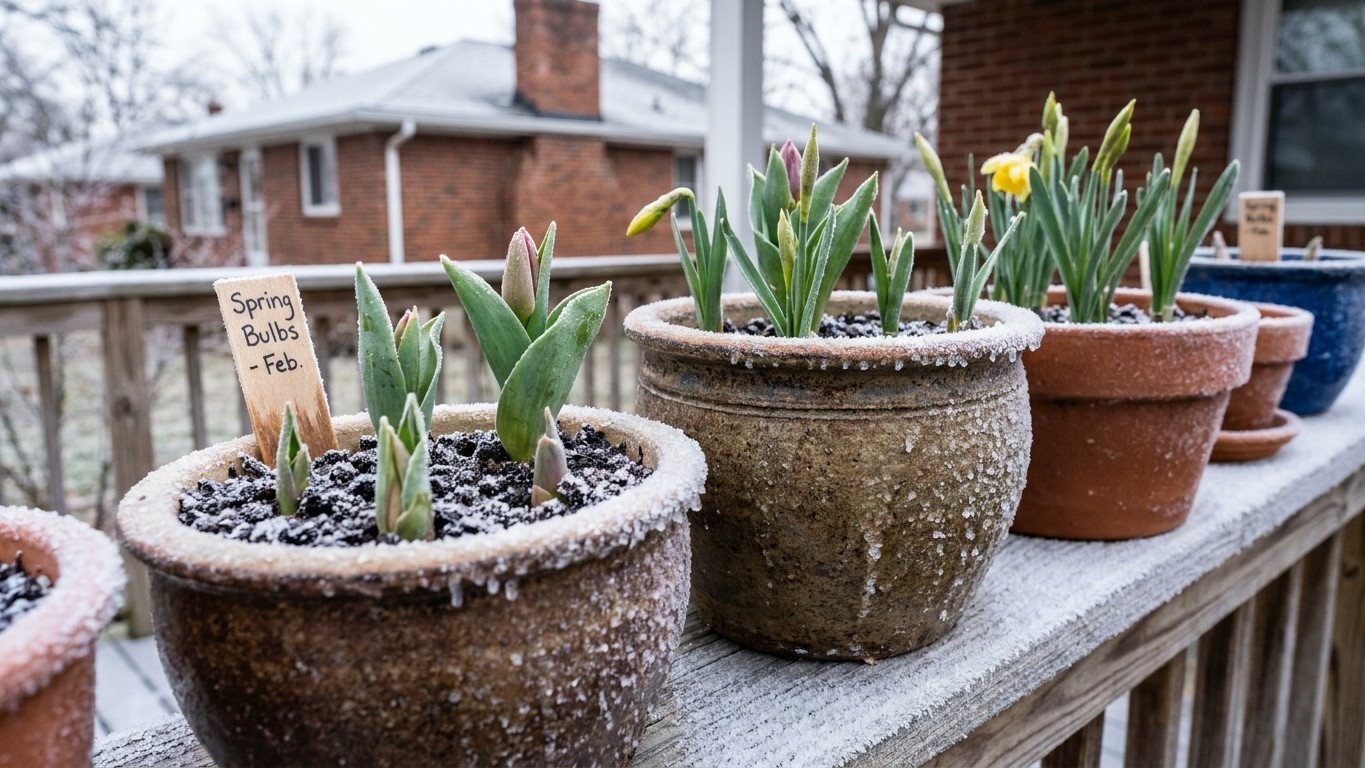

Container-grown Spring Bulbs in North Carolina rarely need artificial forcing indoors, because the state’s winter already delivers more cold than a tulip or daffodil requires. The real risk is different: a pot freezes solid in a way garden soil never does, so a bulb that survives fine in a flower bed can die in the same pot on the same porch.
Why this matters in North Carolina

Start with the number that settles this question: 31.8°F. That’s the average daily minimum temperature during the coldest month at the Charlotte reference station, based on NOAA NCEI’s 1991-2020 climate normals. Spring bulbs like tulips, daffodils, and hyacinths need roughly 12 to 14 weeks with temperatures below 45°F to break dormancy and build a flower stem inside the bulb. A mean daily low of 31.8°F sits more than 13 degrees under that 45°F threshold, which means an ordinary Charlotte-area winter, in the ground, supplies far more chill than these bulbs ask for. That’s the opposite of the classic forcing problem gardeners in mild-winter climates deal with, where the ground never gets cold enough and the chill has to be manufactured in a refrigerator.
So the state isn’t short on cold. The complication is that a container doesn’t behave like garden soil. Soil in a bed is insulated on every side by the earth around it; even when the air drops into the 20s, the ground a few inches down rarely follows all the way. A pot has no such buffer. Its soil is exposed to the air on the sides, the bottom, and the top, so root-zone temperature in a container can track the air temperature almost directly, and wind against the pot walls can push it colder still.
This is where the USDA Plant Hardiness Zone Map matters, and it matters differently across North Carolina than in most single-zone states. The 2023 map puts the whole state somewhere between zone 5b and zone 8b, a range built from one variable, the average annual extreme minimum temperature. That’s a mountains-to-coast spread, not one number, so a recommendation dated to “North Carolina” alone isn’t useful. Anchored to Charlotte, the reference station behind the 31.8°F figure, a bulb rated hardy in the ground there can still fail in a container, because the accepted rule among horticulturists is that a potted plant behaves as though it’s growing one to two zones colder than the same plant in open soil. A bulb that shrugs off winter in a Charlotte flower bed can be pushed into much harsher effective conditions once it’s isolated in a pot on a deck.
That’s the situation this territory is actually in: not a shortage of cold, but a container that concentrates cold beyond what the ground ever sees. Gardeners in the mountains, where the zone range dips toward 5b, face this even more sharply than those in the piedmont or coastal plain, since a container there loses its buffer against an already colder baseline.
How to do it here
The steps below assume a Charlotte-area zone as the reference point, since that’s the station behind the published figures; adjust colder if planting in the mountains, milder near the coast.
- Identify the zone where the container will actually sit through winter, not the statewide range. A pot left outdoors should hold bulbs rated hardy to at least two zones colder than that local zone, since the container effectively strips away the insulation a garden bed provides.
- If the bulb on hand isn’t rated for that extra margin, don’t leave the pot exposed outdoors all winter. Move it somewhere cold but not freezing, an unheated garage that stays reliably above freezing works, or a shed with no heat source.
- Keep that location away from ripening fruit. Apples, pears, and other ripening produce release ethylene gas, and ethylene damages the flower bud forming inside a chilling bulb, so a garage that doubles as a fruit-storage spot isn’t a safe choice.
- Track the cold period against the 12 to 14 week window spring bulbs need below 45°F. A thermometer left in the storage space, checked periodically, is the only way to confirm the bulb is actually getting the chill it needs rather than sitting in a space that’s warmer than it looks.
- For pots that will stay outside all winter, add insulation rather than relying on the bulb’s rating alone. Wrapping the pot in burlap, piling mulch or leaves against the sides, or grouping several containers together against a heated house wall all reduce how much of the pot’s surface is exposed directly to the air.
- Consider sinking the pot into a garden bed up to its rim instead of leaving it freestanding. This borrows the ground’s natural insulation for the coldest months, and the pot can be lifted back out once the worst of winter has passed.
- Confirm drainage before doing any of the above. A container that holds water will have that water freeze and thaw repeatedly around the roots, and that repeated freeze-thaw cycle damages bulb tissue faster than steady cold ever would.
Which bulbs are worth it
Not every spring bulb is a good match for a pot, and the reason usually comes down to two things: how much cold the bulb needs before it will bloom, and how tall and top-heavy the finished stem gets. A bulb with a short chill requirement finishes its cycle faster and is less likely to still be chilling when a container owner wants color on the porch. A bulb that throws up a tall, heavy flower stalk is more likely to topple once it’s in a container instead of anchored by a full bed of soil and neighboring plants.
Where a bulb was never going to reliably return and rebloom in a container anyway, forcing or hard winter exposure costs the gardener nothing extra. Treating it as a one-season purchase, and replacing it the following year, is a reasonable approach rather than a failure.
- Daffodils (Narcissus): sturdy stems that hold up well in pots, and a track record of reliable performance in North Carolina conditions.
- Crocus: low, compact growth that rarely has stability problems in a container of any size.
- Hyacinths: a shorter, dense flower spike that doesn’t lean the way taller bulbs do.
- Species tulips, such as smaller botanical types rather than large hybrid tulips: shorter stems that stay upright in exposed pots.
- Large Darwin hybrid and other tall hybrid tulips: heavy blooms on long stems that lean or snap in wind-exposed containers.
- Alliums: tall, top-heavy seed heads that can pull a lightweight pot over once fully open.
- Any bulb rated for a hardiness zone colder than what the container actually provides, without added protection: it may sprout leaves and then fail before flowering.
What goes wrong, and when you can still fix it
Leaves come up but no flower forms
This points to a chill period that ran short, whether because the storage spot was warmer than it seemed or because the pot spent part of winter somewhere above 45°F. Once leaves have emerged without a flower bud behind them, there’s nothing to do for that bulb this season. The fix is tracking the chill period more carefully next time, using an actual thermometer in the storage location rather than assuming a garage or shed is cold enough.
A flower opens right at soil level, barely visible
This is the sign of a bulb warmed too early, before the stem had time to elongate normally. The flower bud was ready, but it emerged in an environment already warm enough to bloom before the stalk stretched. Nothing rescues that stem this season. Next time, keep the container in cool conditions longer after the chill period ends, letting the stem lengthen before moving the pot into a warmer spot.
The bulb turns soft or the base of the pot smells sour
This is drainage failure, not cold damage. Water sat in the container, froze and thawed repeatedly around the bulb, and broke down the tissue. If caught early, while the bulb still feels firm, repotting immediately in a fast-draining mix and a container with real drainage holes can save it. Once the bulb has gone soft and mushy throughout, it’s lost, and the useful step is improving the pot’s drainage before planting anything else in it.