
In Ontario, the mean daily minimum for the coldest month sits at 13.6°F, measured at the Toronto reference station. That number already clears the 45°F chilling threshold spring bulbs need by a wide margin, which means forcing indoors here isn’t a rescue for a mild winter. It’s a way to move bloom time into the house on your own schedule, using a fridge or an unheated space instead of the flower bed.
Why this matters in Ontario

A mean daily minimum of 13.6°F in the coldest month, drawn from the Environment and Climate Change Canada 1981-2010 Climate Normals for Toronto, tells a specific story. Spring bulbs like tulips and daffodils need roughly twelve to fourteen weeks of temperatures below 45°F to break dormancy and form a flower inside the bulb. At 13.6°F, Ontario’s ground delivers that chill requirement several times over during a normal winter. There’s no shortage of cold here, and that changes what forcing indoors is even for.
In milder regions, forcing exists because the ground never gets cold enough, long enough, for certain bulbs to bloom on their own. That isn’t the Ontario situation. Here, forcing indoors is a deliberate choice to skip the wait for the outdoor thaw, not a workaround for a chill deficit. A gardener in Toronto or anywhere on this hardiness map already has the cold outside the door; forcing just relocates and times it.
The reference station also sits in Canadian Plant Hardiness Zone 7a, using Natural Resources Canada’s seven-variable system, not the single-variable USDA scale used south of the border. That distinction matters if you’re comparing notes with a gardener in the United States, because the two systems don’t convert cleanly. NRCan’s own comparison shows a single Canadian zone can span nine different USDA zones. Zone 7a here describes a climate where garden beds handle winter without help, but it says nothing about what happens to a pot left outdoors on a porch, which freezes through in a way bare ground never does.
That container question is a separate problem from forcing, and it’s worth keeping separate in your head. Forcing is about supplying cold on purpose, indoors, to control timing. A pot sitting outside all winter is about a root ball with no insulating soil mass around it, exposed to the same 13.6°F air that the ground surface feels, but without the ground’s thermal buffer underneath. Different mechanism, different fix, and not what the rest of this page covers.
How to do it here
Because Ontario’s outdoor cold is already sufficient, forcing indoors is really about substituting a controlled space for the garden bed and timing the bulb’s exposure to warmth afterward. The sequence works the same whether you use a refrigerator or an unheated garage, as long as the space holds a steady temperature.
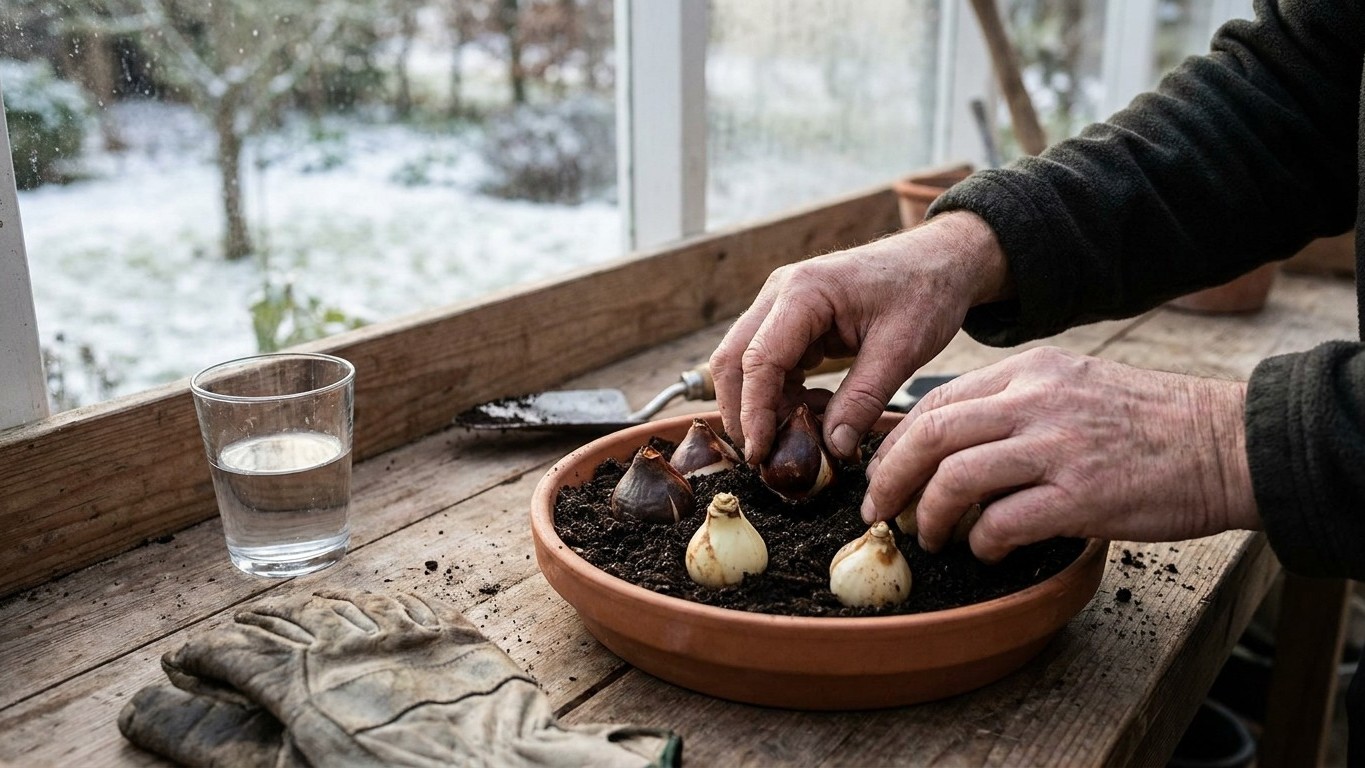
- Choose bulbs suited to forcing (see the next section) and pot them in shallow Containers with drainage holes, setting the bulb noses just at or slightly above the soil line.
- Water thoroughly once after potting, then let the surface dry slightly before the cold period begins so the bulb isn’t sitting in saturated soil for weeks.
- Move the pot to a space that holds steady temperatures below 45°F for twelve to fourteen weeks. An unheated garage works only if it reliably stays above freezing; check it with a thermometer over a few nights before committing bulbs to it, since a garage can dip well below freezing on the coldest stretches given the local 13.6°F coldest-month minimum.
- If using a refrigerator, keep the pot in a drawer away from ripening fruit. Fruit releases ethylene gas as it ripens, and ethylene damages the flower bud forming inside the bulb before it ever reaches the light.
- Check the pot every couple of weeks and water lightly if the top inch of soil is dry. Don’t let it go bone dry for the full chilling period.
- After twelve to fourteen weeks, look for pale shoots and a mass of roots showing at the drainage holes. That’s the signal the chilling period has done its job.
- Move the pot to a cool, dim spot indoors for about a week, then into bright indirect light. Jumping straight from cold storage to a sunny windowsill is the single most common mistake at this stage.
If any pot ends up sitting outdoors again after this process, rather than staying indoors through to bloom, the container needs to be roughly two hardiness zones hardier than the bulb itself, or it needs to be moved into an unheated but insulated space and mulched heavily. A pot’s exposed sides don’t behave like garden soil, and that gap is bigger in a Zone 7a climate than it looks on paper.
Comparing the two chilling spaces
| Location | Temperature control | Main risk |
|---|---|---|
| Unheated garage | Variable, tied to outdoor swings | Dropping below freezing on the coldest nights |
| Refrigerator drawer | Steady, usually 35-40°F | Ethylene exposure near fruit |
Which bulbs are worth it
Not every spring bulb is a good candidate. The ones with a short natural chilling requirement and a compact flower stem tend to force cleanly and predictably. Bulbs with tall stems or long chilling needs are more likely to disappoint, either by flopping in the pot or by refusing to bloom on schedule.
It also helps to know that most forced bulbs, once past their indoor bloom, aren’t worth planting outside afterward. Forcing exhausts the energy stored in the bulb, and the display was the whole purpose of the purchase. Treating these as a one-season buy takes the pressure off if a batch underperforms.
- Paperwhite narcissus, no cold period needed at all, blooming in a few weeks from potting
- Hyacinths, short chill requirement, sturdy short stems that hold up well in a shallow pot
- Crocus, small and fast, well suited to shallow bowls
- Muscari (grape hyacinth), compact and reliable
- Amaryllis, no chilling required, grown from a large bulb for a dramatic single stalk
- Trumpet daffodils, tall flower stems that lean or topple once in bloom in a shallow pot
- Darwin hybrid and other tall tulips, same top-heavy problem as trumpet daffodils
- Fritillaria, uneven and finicky chilling needs that make bloom timing hard to predict
- Alliums, tall stems and chilling requirements that vary widely by variety
What goes wrong, and when you can still fix it
Leaves come up, but no flower forms
This means the cold period ran short of what the bulb needed, so the flower bud never fully developed inside before growth started. There’s no way to correct it once the leaves are already up this season. The bulb has spent its stored energy on foliage instead. If it was bought specifically for forcing, treat it as a one-season loss; if you want another try, start over next year with the full twelve to fourteen weeks logged and checked.
The flower opens on a stem too short to see over the leaves
This is a warming problem, not a cold problem. Moving the pot from cold storage straight into a warm, bright window skips the stem’s chance to elongate gradually. What blooms this way is what you’ll get this season; nothing brings the stem back up after the fact. Next time, hold the pot in a cool, dim spot for about a week before full light and warmth.
The bulb turns soft and rots at the base
Rot in a forcing pot almost always traces back to drainage, either a container without holes or soil that stayed soggy through the chilling weeks. A rotted bulb doesn’t recover this season or any other; it needs to be discarded. The fix is entirely preventive: drainage holes, a pot that isn’t oversized for the bulb, and watering only enough to keep the soil barely moist during the cold period.