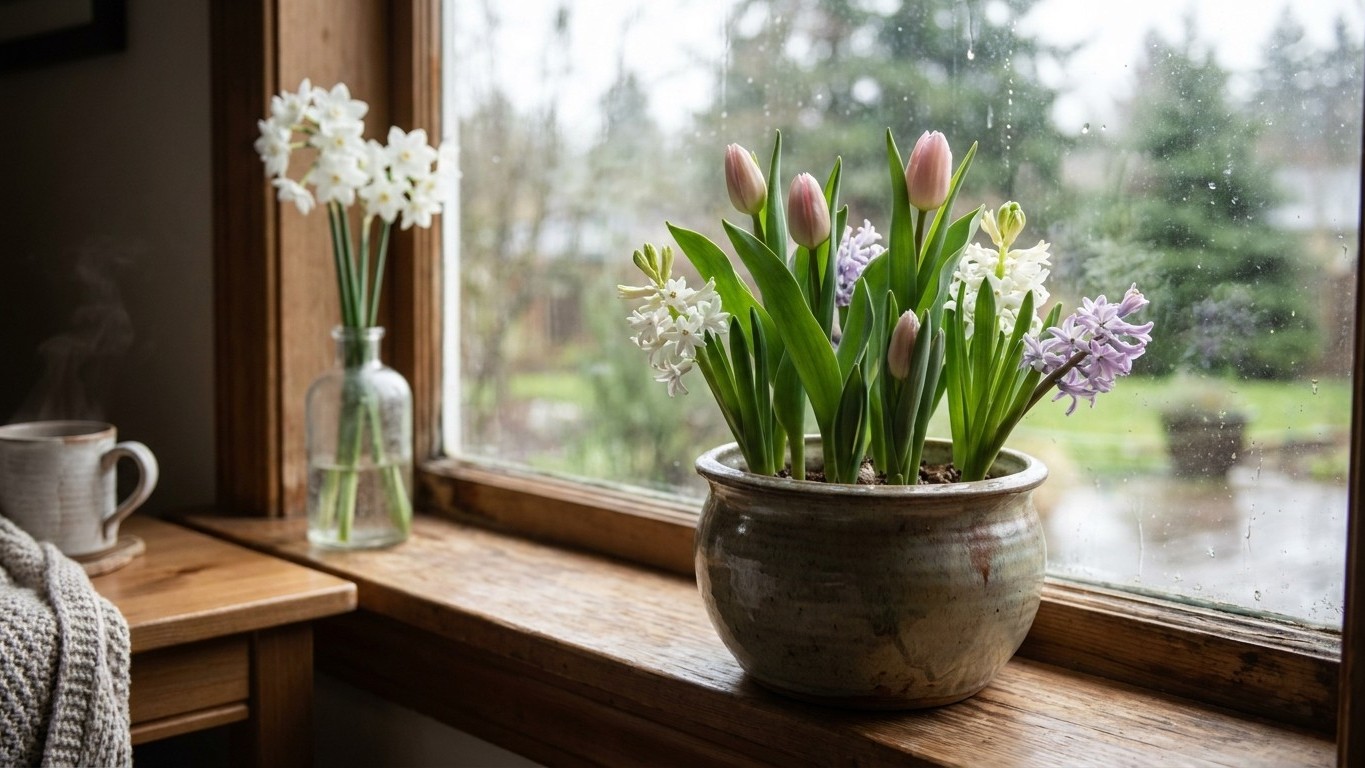

Forcing Spring Bulbs Indoors means giving a bulb its winter chill artificially, then bringing it into a warm room so it blooms weeks before it would outdoors. It works for tulips, hyacinths, crocus, and daffodils, and for paperwhites it works with no chilling at all. The bulb still needs cold; you’re just supplying it in a refrigerator drawer or an unheated garage instead of a garden bed.
Why this matters in Oregon

Start with the number that actually decides this: 36.2°F. That’s the mean daily minimum for the coldest month at the Portland reference station, per NOAA NCEI Climate Normals for 1991-2020. It’s not a record low and not a monthly average high, it’s how cold the nights typically run at their worst, on average, over thirty years.
A spring bulb, whether it’s a tulip, hyacinth, crocus, or daffodil, needs roughly twelve to fourteen weeks below 45°F before it will send up a flower stalk. At 36.2°F, Portland’s coldest-month nights sit comfortably under that 45°F ceiling. That means a bulb planted in the ground here, left alone through a normal winter, gets its chill requirement met without any help. Forcing isn’t rescuing garden bulbs from a winter that’s too mild, this is not Florida or coastal Southern California. It’s a technique for a different goal: getting bloom on your kitchen table in the dead of winter, weeks ahead of the outdoor calendar, in a heated room that never comes close to 45°F on its own.
Containers are the part of this that trips people up. The USDA Plant Hardiness Zone Map, built on the average annual extreme minimum temperature, puts this territory across an unusually wide range, 4a to 9b, depending on elevation and distance from the coast. That range matters less for a bed of bulbs in the ground than it does for a pot. A container’s soil mass is small and exposed on every side, so it freezes clear through, roots and all, in conditions where the same ground three feet away only freezes at the surface. A bulb rated hardy for a Portland-area bed can still die in a pot left on a porch through a hard cold snap, especially toward the colder end of that zone range.
So the practical read for this territory is this: garden hardiness usually isn’t the problem, the outdoor cold here is generally enough to satisfy a bulb’s chill requirement without intervention. The two real issues are wanting bloom out of season indoors, which forcing solves directly, and protecting any bulb you’re overwintering in a container outdoors, which is a freeze-through risk the ground doesn’t share.
How to do it here
The sequence below assumes you’re forcing in a pot, indoors, on a schedule you control rather than leaving a container outside all winter.
- Pick a bulb suited to forcing and check whether it needs a cold period at all. Paperwhites need none. Hyacinths, crocus, and most daffodils need roughly ten to fourteen weeks below 45°F. Tulips generally need the longer end of that range.
- Plant the bulb in a container with drainage holes, in ordinary potting mix, with the top third of the bulb exposed above the soil line.
- Water thoroughly right after planting so the soil is evenly moist, not soggy.
- Move the pot to a spot that holds steady between 35°F and 45°F for the full chilling period. An unheated garage works here as long as it stays above freezing, since a Portland-area garage tends to track close to that 36.2°F coldest-month minimum rather than swinging below it on ordinary nights. A refrigerator crisper drawer works too, but keep it away from apples, pears, or any ripening fruit. Ripening fruit gives off ethylene gas, and ethylene will kill the flower bud inside the bulb before it ever opens.
- Check the pot every couple of weeks. Keep the soil barely moist, not wet, and look for white roots showing at the drainage holes or pale shoots pushing up through the soil. That’s your sign the chilling is working.
- Once the full cold period is complete, and only then, move the pot to a cool, bright room, somewhere around 60°F, for a week or two so the shoot can green up and lengthen gradually.
- After the shoot has some height and color, move the pot to a warm, sunny window for bloom. Skipping the cool intermediate step and going straight from cold storage to a heated living room is the single most common reason forced bulbs disappoint.
- If you’d rather chill a container outdoors instead of in a garage or fridge, the pot needs to be rated at least two hardiness zones tougher than the bulb inside it, or it needs to be moved against a sheltered wall and buried in mulch for the winter. Otherwise, treat any container left outside as a bulb that can freeze straight through.
Which bulbs are worth it
Forcing rewards bulbs with a short chill requirement and a stem that stays upright without garden soil around it for support. It punishes tall bulbs and long-chill bulbs about equally, since both tend to flop or fail in a container on a windowsill.
Forces reliably here
- Paperwhite narcissus, no cold period needed at all, blooms in three to four weeks from potting
- Hyacinth, short chill requirement, sturdy stem, strong scent indoors
- Crocus, short chill requirement, short stem that rarely topples
- Dwarf daffodils such as Tete-a-Tete type, short stem, forgiving of an imperfect chill period
- Grape hyacinth (muscari), short chill requirement, compact and pot-friendly
Tends to sulk
- Standard tulips, long chill requirement and a tall stem that often leans or flops without garden soil to anchor it
- Large trumpet daffodils, tall stem, prone to toppling in a lightweight pot
- Fritillaria, particular about chill length and drainage, unreliable indoors
- Allium, too tall for most indoor containers and slow to bloom even after a full chill
Most forced bulbs are a one-season purchase either way, since a bulb that’s spent its energy blooming indoors out of season rarely has enough left to repeat the show outdoors the following spring at the same quality. That changes the math: if you weren’t planning on that bulb coming back regardless, forcing costs nothing you weren’t already going to spend.
What goes wrong, and when you can still fix it
Leaves, but no flower
This means the cold period ran short of what the bulb needed, the plant put out foliage but never got the signal to form a flower bud. There’s no fix for the pot in front of you. Note the bulb and give it the full twelve to fourteen weeks next time, tracked from potting date to the day it comes out of cold storage.
A flower on a stem too short to see
The chilling was fine, but the bulb was warmed too fast, skipping the cool, bright transition period and going straight from cold storage into a heated room. The stem locks in its final length early, so once it’s short, it stays short. This season’s bloom is what it is. Next time, hold the pot in that 60°F intermediate stage longer before moving it into full warmth.
Rot in the pot
Soft, mushy bulb tissue, sometimes with a bad smell, points to standing water and a pot that never drained. Check the bulb by hand. If it’s still mostly firm, you can repot it in fresh, well-draining mix in a container with real drainage holes and cut back on watering. If it’s soft all the way through, it’s gone, and there’s no version of this that comes back this season or next.