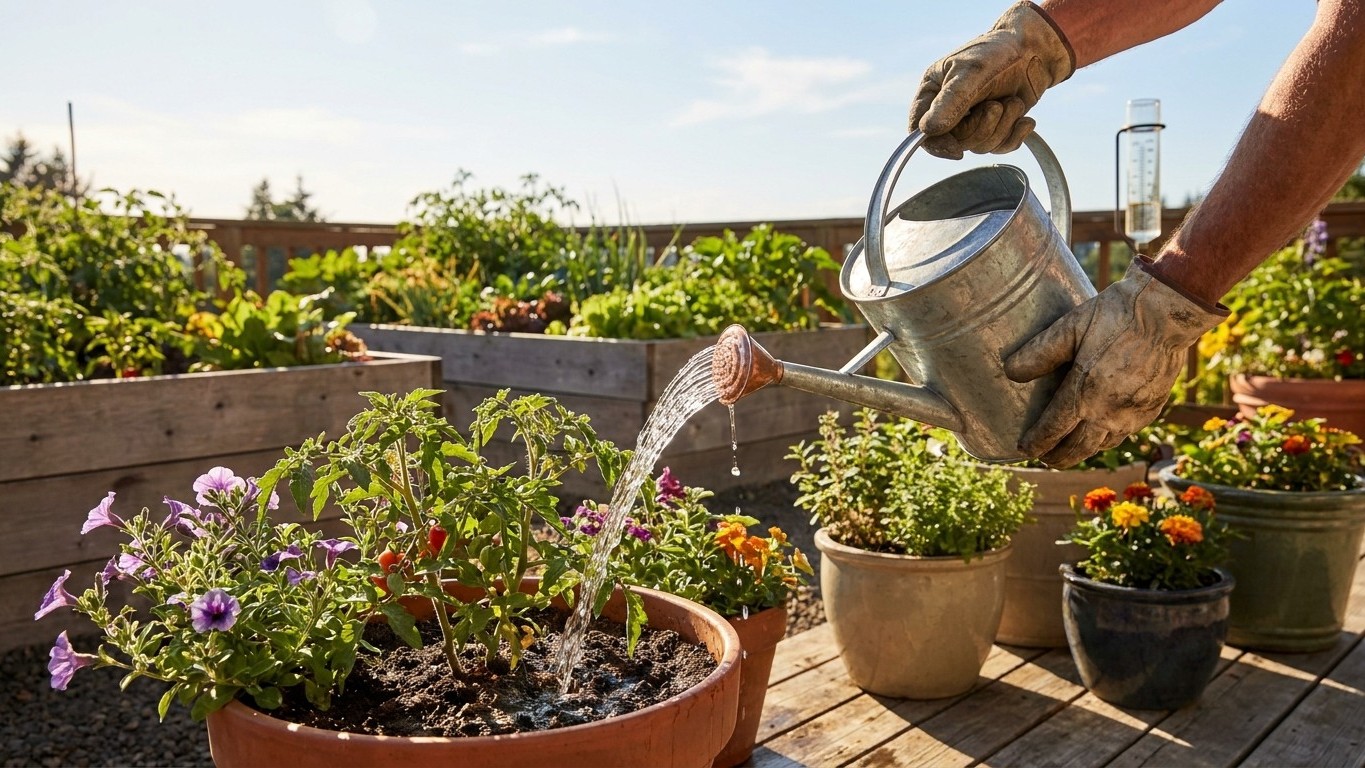

Oregon’s summer numbers are lopsided: plenty of rain falls over the year, but almost none of it shows up in July. That gap is exactly why a watering pot or container matters here, and why the right technique changes month to month rather than staying fixed all season.
What changes here

Two figures set the terms for every gardener in this state. July, the driest summer month, gets 0.51 inches of rain. And the region logs 11.9 days a year at or above 90F. Put together, that’s a short stretch of real heat landing right on top of the driest month of the year, which means the sky simply isn’t going to carry a garden through midsummer here.
A typical garden bed wants roughly an inch of water a week to keep growing well. Spread July’s 0.51 inches evenly across that month’s four-and-a-third weeks, and the sky delivers just over a tenth of an inch a week, about 0.12 inches. That leaves close to 0.88 inches a week for the gardener to supply by hand, hose, or watering pot. June is gentler, with 1.63 inches for the month working out to about 0.375 inches a week from rain alone, still short of the target but not nearly as stingy as July. August tightens back up, at 0.54 inches for the month, close to July’s pace.
None of this is a forecast. These are 1991-2020 normals from the NOAA reference station, and a slope, a nearby ridge, or a spot inside city limits can shift the numbers on any given plot. A rain gauge stuck in the actual bed settles the question faster than any statewide average.
Soil texture is the other half of the equation, and it decides how far that hand-carried inch actually goes. On sandy ground, water drains through within a day, so the inch has to be split into smaller, more frequent doses. On heavy clay, the same inch can sit in the root zone for the better part of a week, which changes the whole rhythm of watering rather than just the amount. Neither soil type changes the target of about an inch a week; it changes how that inch should arrive.
How to water when it matters
The method that works in this climate is deep and infrequent, delivered at the base of the plant, in the morning. Deep watering pushes moisture down where roots actually live, instead of leaving it to evaporate off the top inch of soil. Infrequent watering forces roots to grow downward chasing that moisture, which builds a plant that can ride out a dry stretch. Watering at the base, rather than overhead, keeps leaves dry, and morning watering gives any splashed foliage hours of sun to dry out before nightfall, when damp leaves invite fungal trouble.
Checking the soil at root depth, not just the surface, is what separates a working schedule from a guess. A finger pushed two inches down, or a trowel lifted to check the same depth, tells the real story. Surface soil can look dark and feel damp while the root zone underneath is bone dry, especially once July’s 90F stretches start pulling moisture out fast.
Soil texture sets the rhythm from there. Sandy ground holds little, so it asks for shorter, more frequent soakings rather than one big weekly dose. Heavy clay holds close to a week’s worth of water, but watering it again before it has actually dried starves roots of oxygen and can rot them outright, even though the soil still looks moist on top.
- Check the soil two inches down with a finger or trowel before watering at all; if it’s still damp there, wait.
- In July, plan to supply about 0.88 inches of water over the course of the week through a watering pot, container, or hose, since rain alone covers only a tenth of that.
- Water at the base of the plant, not over the leaves, and do it in the morning so any wet foliage dries before evening.
- On sandy soil, split that weekly amount into two or three shorter sessions rather than one long soak.
- On clay soil, water less often but let it soak in fully, and confirm with the finger test that the top has actually dried before watering again.
Treat the 0.88-inch figure as a starting point for July, not a rule. A container on a sunny deck loses water faster than the same plant in a shaded bed, and the only way to know for sure is to check the soil directly rather than trust a schedule.
What goes wrong
A little water every day
A daily sprinkle feels responsible, but it wets only the top inch or two of soil. Roots have no reason to grow down, so they stay shallow, right where the sun bakes the ground hardest during those 11.9 days a year above 90F. When a heat spike does hit, shallow roots have nothing to draw on.
Watering the leaves in the evening
Wet foliage that sits overnight, especially once temperatures drop, gives fungal disease exactly the damp window it needs. Morning watering at the base avoids the problem entirely, and it costs nothing extra to switch the timing.
Trusting a passing shower
A summer thunderstorm can look like a soaking and still only wet the top half-inch of soil, with the rest running off before it sinks in. Given how thin July’s 0.51 inches already is, skipping a scheduled watering because “it rained” is one of the costliest mistakes to make here. The finger test, two inches down, settles it every time.
Skipping mulch on Containers and beds
Bare soil left exposed during those 90F days gives back to the sun much of what was just watered in. A couple of inches of mulch slows that evaporation and stretches the interval between waterings, which matters most in the exact stretch of summer when rain is scarcest.
Local help
Oregon State University’s Extension Service publishes region-specific guidance on soil, planting, and watering practices, and is the best local reference for anything beyond general figures: extension.oregonstate.edu. Watering restrictions vary by water provider and change with drought conditions, so check with the local utility or municipal water district for current rules before setting a schedule.
Common questions
Does Oregon’s high annual rainfall mean gardens don’t need much summer watering?
No. The 36.9-inch annual total is mostly delivered outside summer; July on its own provides just 0.51 inches, which is why summer watering still has to be carried by hand or container.
How many days a year does Oregon typically hit 90F?
About 11.9 days a year at the reference station, based on 1991-2020 normals. That’s the main driver of extra water demand in a normal summer.
Is a watering pot enough, or does a garden need irrigation?
For containers and smaller beds, a watering pot can supply the roughly 0.88 inches a week that July’s dry stretch leaves uncovered, as long as it’s applied at the base and checked against actual soil moisture rather than a fixed schedule.
Should watering change between sandy and clay soil?
Yes. Sandy soil drains fast and needs shorter, more frequent watering; clay soil holds water close to a week but can drown roots if watered again before the surface has dried.