
Spring bulbs bought in Ontario this fall face one test before they ever bloom: can they get cold enough, for long enough, to trigger flowering next April? The answer varies by species, not by price tag or how the display looks at the garden center. Toronto’s climate data settles that question for most of what’s sold here, and it also draws a line few bulb catalogs will admit: some of what’s on the shelf simply won’t repeat, no matter how carefully it’s planted.
When to plant bulbs in Ontario

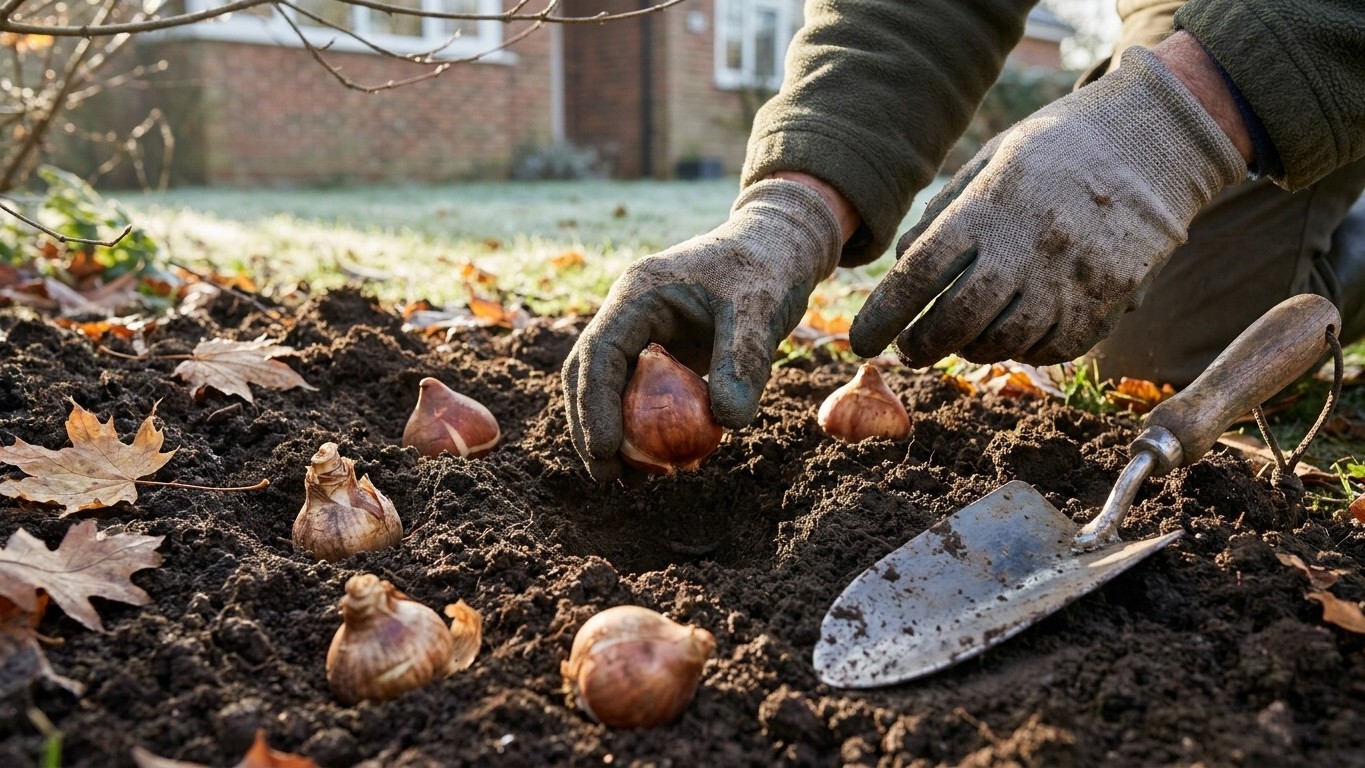
October 16. That’s the average first fall frost recorded at Toronto Pearson, and it’s the number that sets the calendar for anyone planting tulips, daffodils, or crocus this season. The rule growers use is to get bulbs into the ground about six weeks before the soil freezes solid, which across most of southern Ontario lands the planting window somewhere between mid-September and late October.
Plant too early, while soil is still warm from summer, and a bulb reads that warmth as a signal to grow. Shoots push up before winter arrives, and the first hard freeze kills that top growth back, weakening the bulb before it has even rooted. Plant too late, after soil has gone from cool to frozen, and the bulb never develops the root system it needs. It might still flower the following spring, thin and late, but it rarely comes back with any strength the year after.
The six-week window exists because bulbs need a period of cool, workable soil, ideally in the 40s and 50s Fahrenheit, to root before the ground locks up. That rooting can take four to six weeks on its own, so counting backward from the expected freeze date is more reliable than picking a date off a calendar.
Here’s the part most planting guides skip: October 16 is an average, not a promise. Environment and Climate Change Canada calculates it from three decades of data at Toronto Pearson, which means in roughly half of all years the real first frost lands later than that date, sometimes by two weeks or more. Treat the average as the middle of a window, not a deadline. A gardener who waits for the first real cold snap as a signal, then works backward, ends up closer to the right soil temperature than one who digs on October 16 regardless of what the weather is doing.
Local conditions shift this further. Gardens near the Niagara Peninsula, warmed by Lake Ontario, often stay plantable into November. Higher ground north and east of Toronto, and especially districts closer to Algonquin Park or northwestern Ontario, freeze weeks earlier and demand an earlier start. The Pearson Airport station is a reference point, not a forecast for every county.
Whether your winter is cold enough
Every spring bulb sold as “perennial” carries a hidden requirement: a long stretch of cold soil before it will flower at all. Most need twelve to fourteen weeks with soil temperatures below about 45°F. Gardeners who can’t guarantee that outdoors sometimes turn to Growing Spring Bulbs in Containers in Ontario, which allows more control over chilling conditions, or continue with Forcing Spring Bulbs Indoors in Ontario instead. Skip that requirement and the bulb doesn’t die outright, it just refuses to do what it was planted for. Leaves come up in spring, sometimes lush ones, but no flower stalk follows, or the stalk is too short for the bloom to ever clear the foliage. That number, twelve to fourteen weeks below 45°F, is worth remembering before buying any bag of bulbs anywhere, because it’s the standard every variety gets measured against.
Ontario clears that bar with room to spare. The coldest month at the Toronto reference station averages a nightly low of 13.6°F, and soil across most of the province stays cold from November through March, a stretch running closer to sixteen or eighteen weeks below the 45°F threshold rather than the bare minimum twelve. That margin means gardeners here aren’t choosing bulbs at the edge of what the climate allows. They’re choosing from nearly the full range of what garden centers stock, without the extra step, pre-chilling, that milder climates require.
Pre-chilling exists for gardeners who don’t have Ontario’s winter to do the work for them. It means storing bulbs in a refrigerator for about twelve weeks before planting, simulating the cold they’d otherwise miss. Those bulbs have to stay away from apples, pears, and other ripening fruit in that fridge, because the ethylene gas fruit gives off kills the flower bud forming inside the bulb before it’s even planted. None of that applies to a hardy tulip or daffodil going into the ground almost anywhere in this province. The soil does the chilling on its own.
Pre-chilling still comes up here for one category: bulbs that aren’t built for Canadian winters regardless of how long the cold lasts, tender types sold for indoor forcing or treated as annuals, like freesia or ranunculus. Buying those and expecting the ground to vernalize them outdoors is the wasted-money scenario. The soil gets cold enough. The bulb was never built to survive it, chilled or not.
| Bulb | Weeks of cold needed (below 45°F) | What Ontario delivers | Verdict |
|---|---|---|---|
| Tulips | 12-14 weeks | ~16-18 weeks; coldest month averages 13.6°F at night | Clears it, no pre-chilling needed |
| Daffodils | 12-15 weeks | Same winter length | Clears it |
| Hyacinths | 12-14 weeks | Same winter length | Clears it |
| Crocus | 8-15 weeks, species-dependent | Same winter length | Clears it comfortably |
| Alliums | 8-10 weeks | Same winter length | Clears it easily |
| Muscari | 13-15 weeks | Same winter length | Clears it |
| Freesia, ranunculus (tender types) | Not bred for outdoor winter cold | Cold arrives regardless | Fails outdoors; hardiness isn’t a chilling problem |
Which bulbs suit Ontario
The bulbs above aren’t just able to chill properly here, they’re also winter-hardy enough to survive as living tissue underground, which is a separate question from flowering. Ontario’s reference zone, rated 7a in the Canadian hardiness system (a scale built on seven climate variables, distinct from and not convertible to the single-factor USDA zones printed on plant tags in American nurseries), covers most of what’s commonly sold in garden centers here.
Bulbs that hold up
- Tulips – hardy zones 3 to 8
- Daffodils (Narcissus) – hardy zones 3 to 9
- Crocus – hardy zones 3 to 8
- Hyacinths – hardy zones 4 to 8
- Grape hyacinth (Muscari) – hardy zones 4 to 8
- Alliums – hardy zones 3 to 9, depending on species
- Snowdrops (Galanthus) – hardy zones 3 to 9
- Checkered lily (Fritillaria meleagris) – hardy zones 3 to 8
These ranges aren’t hard borders. A tulip rated to zone 3 can still fail in an exposed, wind-scoured spot with no snow cover, and a marginally hardy bulb can outlast its label by a full zone if it’s tucked against a foundation or buried under a thick layer of leaf mulch.
Bulbs that disappoint
Some bulbs sold in the same aisle will disappoint, and they do it in specific, predictable ways. Anemone blanda, often sold beside crocus, is only marginally hardy here and tends to thin out and vanish after a winter or two in anything but a sheltered bed. Ranunculus and freesia aren’t winter-hardy at all in this climate. Left in the ground, they either rot in wet, heavy clay over winter or simply never resurface once the soil freezes solid, a first-year display with no second act. Ixia and sparaxis follow the same pattern, sold as bulbs but built for climates that never see a Canadian winter.
What digs them up here
Squirrels and voles don’t raid every bulb bed equally, and the difference comes down to chemistry, not chance. Daffodils contain lycorine, a compound toxic enough that most animals leave them alone after one taste. Alliums carry the same sulfur compounds that make onions unpalatable to rodents. Snowdrops and fritillaria carry their own bitter alkaloids, and fritillaria in particular has a skunky smell some gardeners use deliberately to protect a whole bed.
Tulips and crocus have no such defense. Squirrels dig them up within days of planting, sometimes within hours, drawn by the same scent that makes them detectable underground.
- Bulbs squirrels and voles typically take: tulips, crocus
- Bulbs squirrels and voles typically leave alone: daffodils, alliums, snowdrops, fritillaria, muscari, hyacinths
The one method that consistently works is physical: laying a sheet of galvanized wire mesh flat over a newly planted bed, pinned at the edges, and leaving it through fall until the ground freezes hard. Bulb shoots push through the mesh openings fine come spring; digging animals can’t get through it in fall, when a freshly turned bed is easiest to raid.
Repellent sprays and granules wash off with the first real rain and need constant reapplication to do anything at all. Gardeners who rely on them tend to find out how little they worked the following April, standing over a bed of daffodil foliage where the tulips used to be.
Where to check for your own county
Every figure in this guide, the October 16 frost date, the 13.6°F coldest-month minimum, the 7a hardiness rating, comes from a single reference station: Toronto Pearson. Ontario stretches from the Niagara Peninsula to the shores of Hudson Bay, crossing several hardiness zones and a spread in first frost dates that can run three weeks or more between the south end of the province and the north.
A planting calendar built on Toronto’s numbers works well for most of the Golden Horseshoe and much of southwestern Ontario. It runs early for the Ottawa Valley, and it runs badly late for anyone gardening near Thunder Bay, Sudbury, or Timmins, where the ground can freeze weeks before Toronto sees its first frost.
The Ontario Ministry of Agriculture, Food and Agribusiness publishes region-specific growing information and is a reasonable starting point for numbers closer to a specific backyard than a single airport station can provide. County and regional offices, along with local Master Gardener chapters, can narrow that further, often down to frost dates and hardiness notes specific to a township rather than an entire province.
None of that changes the chilling math in this guide. Twelve to fourteen weeks below 45°F is the same requirement everywhere in Ontario. It only changes when the calendar should start counting.