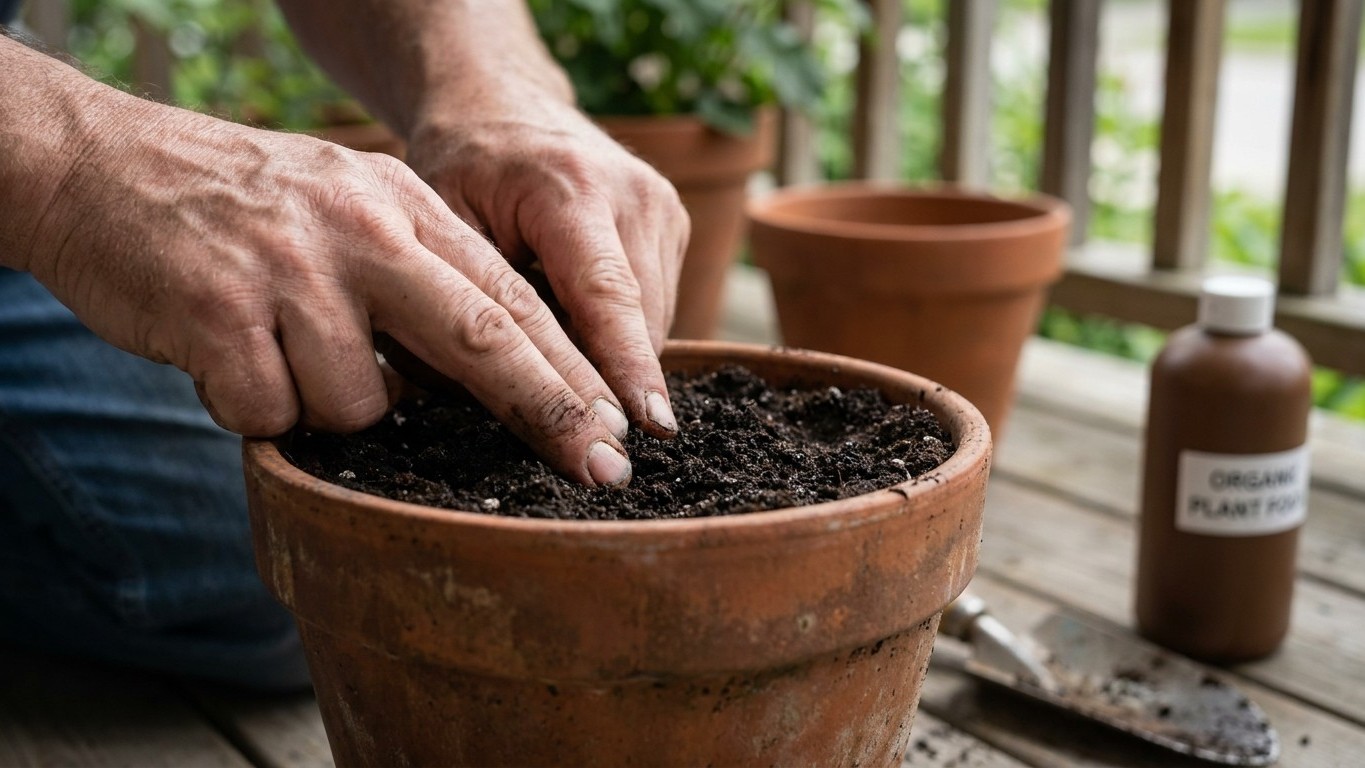

In Ontario, Containers need watering far more often than garden beds, because potting mix holds only a fraction of the reserve that native ground soil does. With June, the driest month of summer, averaging 2.81 inches of rain and the region recording 0.0 days a year at 90F or above, pots depend on the gardener rather than the sky for most of what they need. Checking the mix by hand beats guessing.
What changes here

Two figures set the terms for anyone watering pots in Ontario. June, the driest month of the summer stretch, averages 2.81 inches of rain (July climbs to 2.98, August to 3.07). And the region logs 0.0 days a year at or above 90F. Put together, that means the classic driver of container failure, blistering heat pulling moisture out of a shallow root ball in a single afternoon, almost never happens here. What does happen is a slow, steady deficit: modest rain spread across a month that a container can’t fully use.
Do the arithmetic and the gap becomes concrete. A planted bed generally wants about an inch of water a week. June’s 2.81 inches, divided across roughly 4.29 weeks in the month, works out to about 0.66 inch of rain landing per week on open ground. That leaves close to 0.34 inch a week for the gardener to supply directly to a garden bed. For a container, though, that sky-delivered 0.66 inch rarely arrives intact. A porch overhang, a dense canopy of leaves, or simply the small surface area of a pot’s soil compared to its depth means a good share of that rain never reaches the roots at all.
Native Ontario ground can be sand in some townships and heavy clay in others, and each holds an inch of water differently: sand lets it drain through in hours, clay can sit wet for most of a week. Containers sidestep that variable entirely, because almost every pot here is filled with a commercial potting mix built to drain fast and hold air around the roots. That mix dries out quicker than either sandy or clay ground, which is exactly why the rainfall figures above matter less for a container than for a bed. Treat the driest month’s rain as a bonus, not a plan, and expect to supply most of a container’s water yourself.
How to water when it matters
Deep and infrequent watering, delivered at the base of the plant in the morning, works better in Ontario containers than a light daily splash, and each piece of that method has a reason behind it. Watering deeply pushes moisture down through the whole depth of the pot, which pulls roots downward instead of letting them cluster at the surface where they dry out fastest. Watering at the base rather than overhead keeps foliage dry, which matters in a region where summer humidity off the Great Lakes can already keep leaves damp longer than they should be. Watering in the morning gives the plant hours to draw up what it needs before the heat of the day, and lets any splashed leaves dry before evening, when damp foliage overnight is what actually invites fungal trouble.
Checking the surface of a pot tells almost nothing. The top inch of potting mix can look dry within hours of a soaking while the root zone below is still wet, or look damp on top while the middle of the pot has gone bone dry. Push a finger two inches into the mix, or use a small trowel on larger containers, and water only when that depth feels dry to the touch.
A reasonable starting point for most containers through an Ontario summer is watering every two to three days, more often during stretches without rain, less often right after a soaking downpour. That is a starting point to test against your own pots, not a fixed rule: a small terracotta pot in full sun can need water daily, while a large glazed container in shade might stretch to twice a week.
- Push a finger two inches into the mix before assuming the pot needs water.
- Water slowly at the base until it runs from the drainage holes, not just wets the surface.
- Do this in the morning, so foliage and surface mix dry out before evening.
- Recheck every two to three days as a starting rhythm, adjusting for pot size, sun exposure and material.
- Skip a scheduled watering after a heavy rain, but confirm with a finger check rather than assuming the pot is soaked through.
What goes wrong
A little water every day
A light daily sprinkle wets only the top inch of mix and never reaches the roots lower down. Those roots respond by staying near the surface, where the mix heats up fastest and dries out first, leaving the whole plant more vulnerable during any dry stretch, even in a region with no extreme heat days to blame.
Watering the leaves in the evening
Ontario summers carry enough ambient humidity that wet foliage left overnight, especially in August when rainfall runs highest at 3.07 inches, gives fungal spores hours of damp cover to take hold. Watering at the base sidesteps the problem entirely.
Trusting a rain shower
A quick summer downpour can look soaking on the surface and still leave the root ball dry, particularly if a canopy of leaves or an overhang caught most of it before it reached the pot. Push a finger down two inches after any rain before deciding the container is covered.
Drowning a pot that never got the chance to dry
This is the costlier mistake in a region with steady, moderate summer rainfall like Ontario’s: watering on a fixed schedule regardless of conditions, so a pot that’s still saturated from natural rain gets soaked again. Roots sitting in waterlogged mix suffocate for lack of oxygen, and by the time the plant shows it, the damage is already done below the surface.
Local help
For growing advice specific to Ontario conditions, the province’s agriculture and food resources are maintained through Ontario’s Ministry of Agriculture, Food and Agribusiness. Watering restrictions during dry stretches are set locally and change by municipality and water provider, so check with your own supplier before assuming a rule applies to your address.
Common questions
How often should I water container plants in Ontario during summer?
A starting rhythm of every two to three days works for most containers, adjusted up for small pots in full sun and down for large, shaded ones. Check the mix two inches down before deciding, rather than following the calendar alone.
Does Ontario’s summer rain mean I can skip watering pots?
Rarely for containers. Even in June, the wettest baseline month at 2.81 inches, rain often misses the root zone of a pot because of overhangs, canopies, and the small surface area of container mix compared to its depth.
Why do containers dry out faster than garden beds here?
Potting mix is built to drain quickly and stay light around the roots, which means it holds far less water than native ground, whether that ground is sandy or clay. Combined with a pot’s exposed sides, that mix loses moisture faster on all counts.
Is overheating a real risk for pots in Ontario?
Less than in hotter regions. The reference station records 0.0 days a year at 90F or above, so the bigger risk for local containers tends to be overwatering during the region’s regular rainy stretches rather than heat stress drying them out.