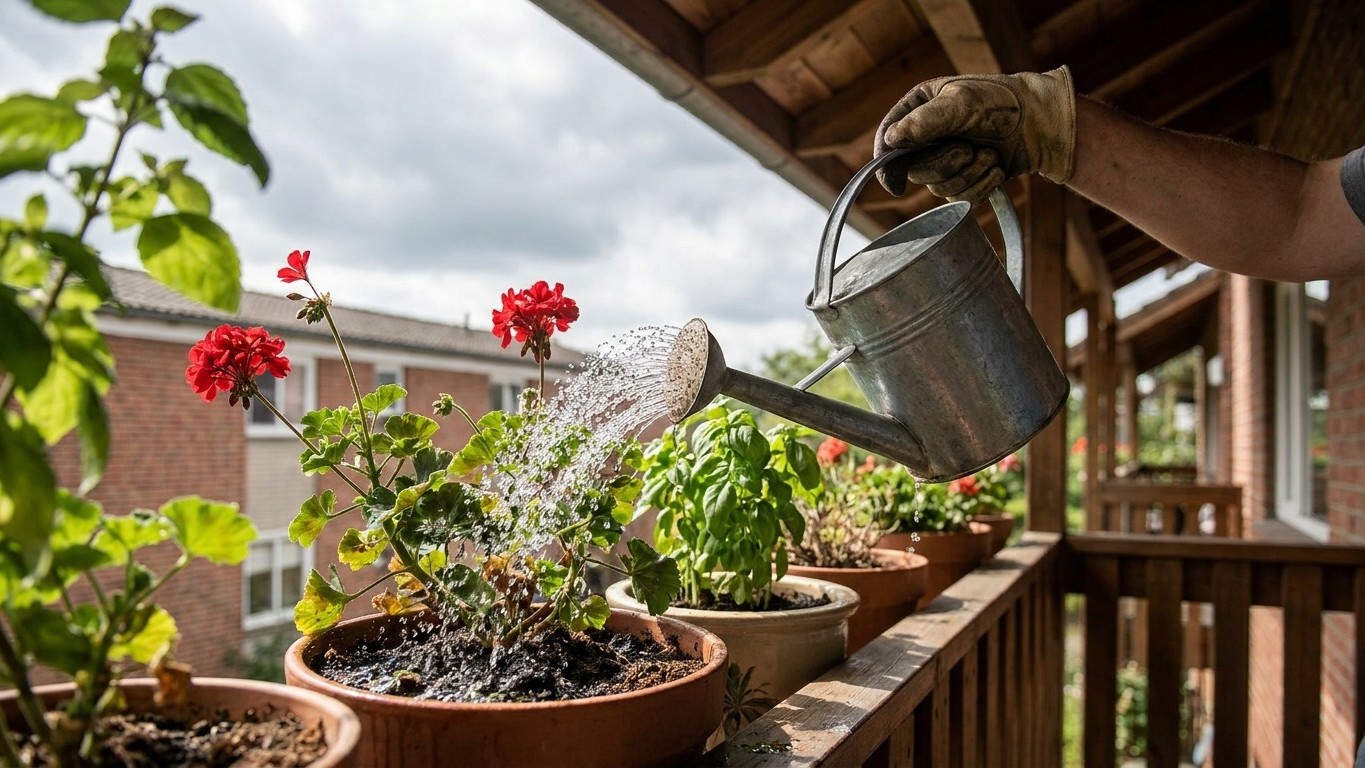

Containers in Quebec dry out faster than the ground ever will, no matter what the sky is doing that week. The reference station near Montreal logs 0.0 days a year at 90°F or above, so heat stress is rare, but the driest summer month still delivers only 3.42 inches of rain, and most of that misses potted plants on a balcony or under a roof overhang entirely. Container watering has to be its own routine here, not a copy of what works on garden beds.
What changes here

The two numbers that decide how often a Quebec container needs water are 3.42 inches, the rainfall of June, the driest month of the growing season, and 0.0, the average number of days a year that reach 90°F at the reference station near Montreal. Together they describe a summer that almost never bakes but also never gets soaked from above in a way a gardener can count on. June’s 3.42 inches is the low point; rainfall climbs to 3.52 inches in July and 3.71 inches in August, so the driest stretch of a Quebec summer sits at the start of the season, not the middle or the end.
A garden bed wants roughly an inch of water a week. Spread June’s 3.42 inches over its thirty days, and an average week brings about 0.8 inch from the sky, close to the mark for a bed sitting in open ground. The remaining 0.2 inch a week is what a gardener has to carry with a can or a hose, and that’s before accounting for a single thunderstorm dumping most of the month’s total in twenty minutes while other weeks stay nearly dry.
None of that arithmetic protects a container. A raised bed or an in-ground planting has a soil profile several feet deep to draw on between rains; a pot has whatever fits inside its walls, usually less than a cubic foot of potting mix, wrapped in plastic or terra cotta that heats up in full sun and sheds water out the drainage holes within minutes of a soak. The 0.8 inch that lands on open soil in an average June week barely wets the surface of a container before running straight through, and a good share of Quebec’s containers sit under a porch roof, a balcony above, or a tree canopy, catching close to none of that rain at all.
Zero days above 90°F does mean the sun isn’t a real threat here, but the drying that still happens comes from wind and stretches of low humidity rather than intense heat, so a container can look fine one afternoon and be bone dry the next. The rainfall figure sets the region’s baseline; the pot itself is what changes the math.
How to water when it matters
Containers ask for the opposite of garden beds in one respect and the same rule in every other. Beds like water deep and infrequent, letting roots chase moisture downward; a container’s whole root system already lives in the top twelve inches or less, so there’s no real depth to chase. What still holds is watering at the base rather than overhead, and watering in the morning rather than at night.
Wetting the foliage instead of the soil sends water past the leaves onto surfaces that dry within the hour, giving the plant nothing while inviting fungal spots on damp leaves. Morning watering lets any splash on the leaves dry before evening, and it gives the plant a full reserve of moisture to draw on through the warmest hours of the day, even a Quebec day that never reaches 90°F. Checking the surface of the mix tells a gardener almost nothing, since the top inch dries within a day even when the root ball below is still soaked. A finger pushed two inches into the mix, or the tip of a trowel, reads the moisture where the roots actually sit.
- Push a finger two inches into the potting mix before watering; if it comes out dry, water, if it comes out cool and damp, wait a day.
- Water at the base until it runs from the drainage holes, not just until the surface looks wet, since that runoff is the sign the whole root ball has been reached.
- Water in the morning, before mid-morning if possible, so both the foliage and the surface mix have time to dry before evening.
- In an average week of Quebec’s driest month, start by checking a twelve-inch pot in full sun every day, and a larger container or one in part shade every two to three days, then adjust from what the finger test shows.
- Skip a scheduled watering after a rain if the two-inch check still comes back damp, and skip the guesswork after a thunderstorm by checking directly rather than assuming the pot caught it.
That daily check for a small pot is a starting point built for an average June, not a rule; a shaded balcony, a bigger container, or a spell of wind will move the number in either direction, and the finger two inches down is what settles it, not the calendar.
What goes wrong
A daily splash on top
Running a little water over the surface every day feels responsible, but it wets only the top inch of mix and never reaches the root ball below. Roots follow moisture, so they stay shallow and crowd near the surface, the part of the container that heats up fastest and dries out first. A layer of mulch or bark on top of the mix slows that evaporation down; leaving the surface bare hands the sun back the moisture that was just poured on.
It rained, no need to water
Quebec’s summer rain often arrives as a short, hard shower rather than a steady soak, and a good share of it never reaches a container at all if that pot sits under an eave, a balcony overhang, or a tree. Even when the rain does land, a soaked surface can look convincing while the mix two inches down stays dry, or the reverse happens: a container that already held wet mix takes on more water than it can drain, sits saturated through a stretch of cool, cloudy weather, and the roots that can’t get oxygen start to rot. The only way to know which happened is the same finger check, not the sound of rain on the roof.
Watering the leaves at night
A sunset watering can feel like it beats the heat, but water sitting on leaves overnight, in the humidity a Quebec summer often holds even without extreme heat, is exactly what fungal disease needs to take hold. Morning watering gives the same relief without leaving the plant wet through the night.
Local help
Quebec’s Ministère de l’Agriculture, des Pêcheries et de l’Alimentation, MAPAQ, publishes growing guidance suited to the province’s climate, including advice for home gardeners working with containers and raised beds; find it at mapaq.gouv.qc.ca. Watering restrictions for outdoor use are set at the municipal level and can change through the season, so check with the local water provider or municipality before assuming any single rule applies province-wide.
Common questions
How often should I water container plants in Quebec during summer?
Check with a finger two inches down. Small pots in full sun often need water daily during June, the driest month, while larger or shaded containers can go two to three days, but let the finger test decide instead of a fixed schedule.
Does Quebec’s rainfall mean I can skip watering containers?
Rarely. The driest summer month brings just 3.42 inches, and containers under an overhang or beneath a canopy catch very little of that in any month.
Is Quebec’s cool summer still a risk for pots?
The reference station near Montreal logs 0.0 days a year at 90°F or higher, so intense heat stress is uncommon, but wind and low humidity still dry out a small volume of potting mix quickly, so regular checks still matter.
Where can I check current watering restrictions?
Restrictions are set by municipality and can change during the season. Contact the local water provider, or check MAPAQ for general provincial gardening guidance.