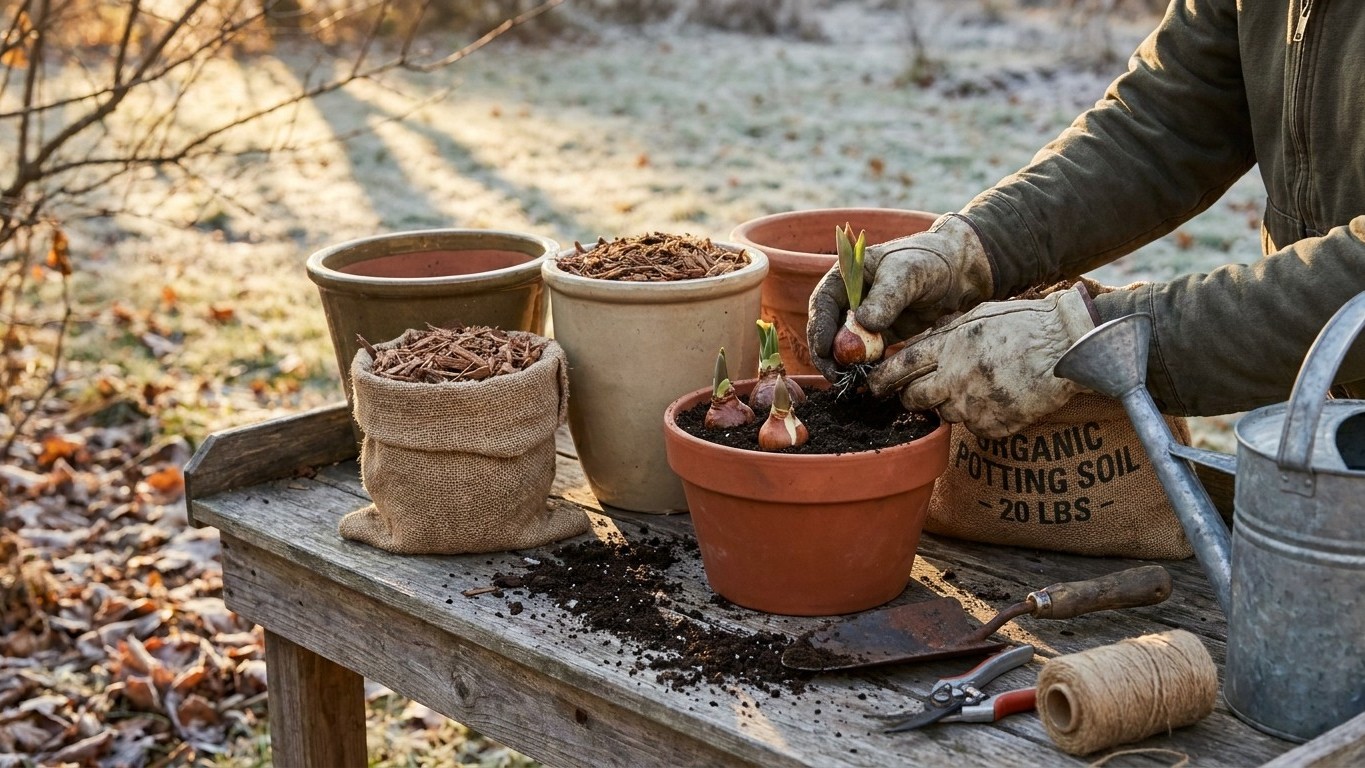

Yes, spring bulbs can be forced and grown in Containers in Pennsylvania, but the container itself is the variable that decides success, not the region’s winter cold. The ground here gets plenty cold for chilling; a pot sitting above ground does not get the same protection, and that gap is what trips up most container gardeners.
Why this matters in Pennsylvania

The mean daily minimum for the coldest month at the Philadelphia reference station sits at 26.0 F, according to NOAA NCEI Climate Normals for 1991-2020. That number matters because a spring bulb needs roughly twelve to fourteen weeks below 45 F to complete its chilling requirement before it will flower. At 26 F, Pennsylvania’s winter air is running nearly twenty degrees colder than that threshold for weeks on end. This is not a state where winter fails to deliver cold. It’s a state where winter delivers more than enough.
That single fact changes which problem a container gardener here actually has. In parts of the country where winters stay mild, forcing exists to supply artificial cold because the outdoors never gets there on its own. Pennsylvania doesn’t have that problem. The chilling hours are already sitting outside the back door.
What Pennsylvania does have is the container problem, and it’s a different mechanism entirely. The USDA Plant Hardiness Zone Map (2023 edition, built on 1991-2020 normals) places the state across a wide band, from 5a to 7b. Philadelphia itself sits toward the milder end of that range; head toward the state’s northern tier or the Laurel Highlands and the zone drops toward 5a. That range matters for anything planted in open ground, because soil several inches down insulates roots even when the air above freezes hard.
A container gets none of that insulation. Soil in a pot is exposed on every side, so it freezes through, roots, bulb, and all, at temperatures the same bulb would shrug off in a garden bed. A bulb rated hardy for a Philadelphia backyard can die in a pot left on that same backyard’s patio, because the pot behaves like a much colder zone than the ground beneath it. That’s the mechanism a container grower here has to plan around, not a shortage of cold.
How to do it here
The sequence below assumes two possible paths: forcing bulbs indoors for an early, controlled bloom, or growing them in a container that stays outdoors through winter. Both start with the same planting step and diverge from there.
- Pot the bulb in well-draining mix, in a container with drainage holes, once outdoor air has cooled but before the ground has frozen hard. A pot with no drainage holes is the single most common cause of bulb rot in containers.
- Decide where the pot will spend winter. If it’s staying outside uninsulated, choose a bulb species hardy at least two zones colder than your local zone. Given the 5a-7b range across the state, a Philadelphia-area gardener working from a 7b baseline should treat the container as though it sits in zone 5b, not 7b.
- If forcing indoors, give the potted bulb twelve to fourteen weeks below 45 F. An unheated garage that stays above freezing works, and so does the crisper drawer of a refrigerator, as long as it’s kept away from ripening fruit. Apples, pears, and other ripening produce release ethylene gas, and ethylene kills the flower bud developing inside the bulb before it ever gets the chance to open.
- Check the chilling location every couple of weeks. Keep the soil barely moist, not wet, and pull out any bulb that’s gone soft or moldy before it spreads to the rest of the batch.
- Move the pot into light and warmth gradually once chilling is complete. Sudden warmth pushes the plant to bloom on a stunted, overly short stem instead of a normal one.
- For pots staying outdoors, insulate before the hard freezes settle in. Sinking the pot into open ground up to its rim, or wrapping the sides in mulch or bubble wrap, blocks the exposure that would otherwise let the container freeze solid the way open air does.
None of these steps require guessing. The chilling location can be checked by hand, the drainage can be checked by looking for holes, and the zone gap can be checked against the USDA map for wherever the pot actually sits.
Which bulbs are worth it
Not every bulb rewards the effort of potting and chilling. The ones that force well tend to share two traits: a shorter cold requirement, and a stem sturdy enough to stand up in a container instead of toppling over once it flowers. The ones that sulk usually fail one of those two tests.
- Tulips: reliable forcers with a moderate chill need and a stem that holds up in most pots.
- Daffodils and narcissus: among the easiest to force, tolerant of slightly shorter chilling.
- Crocus: short cold requirement, fast to bloom once warmed.
- Hyacinths: force readily and are often sold specifically for container work.
- Fritillaria: tall and top-heavy, prone to tipping a container once in bloom.
- Large alliums: the same top-heavy problem, plus a longer chill requirement that’s harder to manage in a fridge drawer.
- Late-season species tulips with extended chill needs: harder to time correctly for an indoor bloom window.
| Bulb | Cold weeks needed | Stem stability in a pot |
|---|---|---|
| Crocus | Shorter end of the range | Low, stable |
| Tulip (standard) | Mid-range | Moderate, generally stable |
| Daffodil/Narcissus | Mid-range | Stable |
| Fritillaria | Longer end of the range | Unstable, top-heavy |
Tulips deserve one more note: many container gardeners already treat them as a single-season purchase, since tulips in pots rarely rebloom well the following year regardless of how they’re handled. Forcing that same bulb costs nothing in the long run. It was never going to come back anyway, so there’s no downside to using it up for one early bloom.
What goes wrong, and when you can still fix it
Leaves come up, but no flower
This means the chilling period ran short. The bulb had enough cold to push foliage but not enough to finish differentiating the flower bud inside. There’s no fix this season. Let the foliage die back naturally, replant the bulb in fall, and give it the full twelve to fourteen weeks below 45 F this time.
A flower appears, but on a stem too short to see over the pot’s rim
The bulb was moved into warmth and light too early, before the roots had time to establish. The stem stays stunted because growth got rushed. Whatever bloom shows up now is what you’ll get this season; there’s no way to lengthen a stem that’s already set. Next round, hold the pot in the cold longer before bringing it into light.
Rot in the pot, at the base of the bulb
This traces back to drainage, almost always. Water sat around the bulb instead of running out, and fungal or bacterial rot set in. If it’s caught early, a single soft spot on an otherwise firm bulb, trimming the damaged tissue and replanting in fresh, well-draining mix can sometimes save it. If the bulb is soft and mushy all the way through, it’s gone for this season, and the fix is a container with real drainage holes next time.