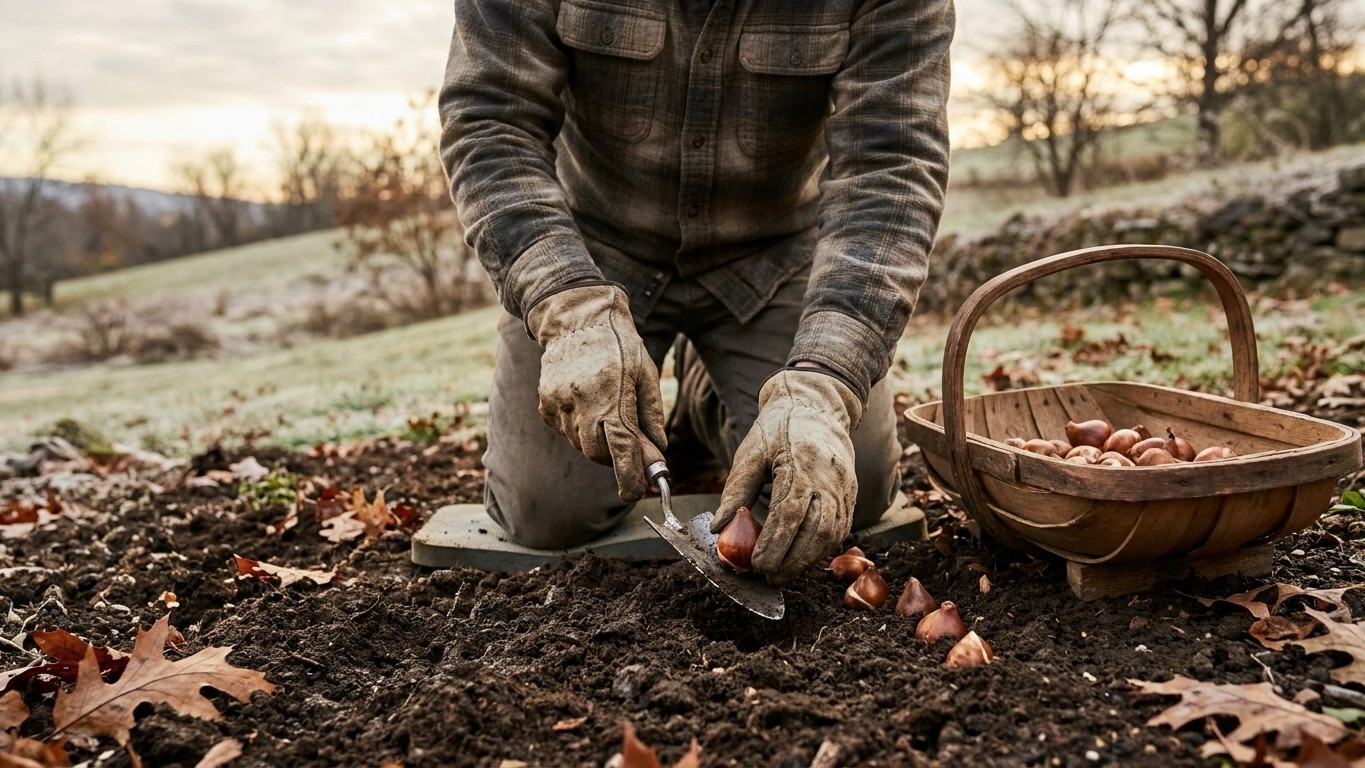

Yes, Pennsylvania gets cold enough for nearly every classic spring bulb — but the state runs from USDA zone 5a in the northern tier to 7b along the Delaware, and a bulb that thrives in Philadelphia can rot or freeze depending on where you garden. Here’s what to plant, when, and what to skip.
When to plant bulbs in Pennsylvania

Spring bulbs go into the ground in fall, and the target is soil that has cooled but not yet frozen solid. The rule of thumb extension agents use is six weeks before the ground freezes hard, which in most of Pennsylvania means working backward from the first fall frost. For the Philadelphia reference station, NOAA’s 1991-2020 Climate Normals put that first freeze between November 5 and November 16. Count back six weeks and the planting window opens in late September and runs through late October for the southeastern corner of the state.
That date shifts hard once you leave the Delaware Valley. The northern tier and the Alleghenies run two to four weeks earlier in fall, so a gardener in Erie or the Poconos should shift the whole window back to mid-September through early October. Planting on a Philadelphia calendar in Tioga County means racing a frost that’s already arrived.
Why the timing matters at both ends
Plant too early, while the soil is still warm from summer, and the bulb reads that warmth as a signal to push top growth. Tender green shoots that emerge in November get killed back hard by the first real freeze, and the bulb spends stored energy recovering instead of building next spring’s flower. Plant too late, into ground that’s already gone cold and hard, and the bulb never has time to grow the roots it needs before winter locks everything down. Roots, not shoots, are the whole point of fall planting — a bulb that goes in without three or four weeks of root-growing weather ahead of it comes up weak, blind, or not at all the following spring.
One more thing worth saying plainly: a first frost date is an average, built from thirty years of records, which means roughly half of all years land on the early side of it. Treat the window as a target with some slack built in, not a deadline. If a warm October stretches on, that’s not a reason to wait — the calendar, not the thermometer, is the better guide here.
Whether your winter is cold enough
Every spring bulb sold as a fall planting — tulip, daffodil, hyacinth, crocus — needs a real winter to flower. Specifically, most require somewhere between twelve and fourteen weeks with the soil below about 45°F. Skip that cold spell, or cut it short, and the bulb doesn’t die outright; it just refuses to do the one thing you planted it for. It puts up leaves, maybe, and skips the flower, or sends up a bud on a stem too short to clear the foliage. Gardeners who can’t guarantee that chilling period in the ground, or who garden on a patio or balcony, may have better luck Growing Spring Bulbs in Containers in Pennsylvania, where the cold exposure can be controlled directly’t count on that outdoor chill, or who want blooms well ahead of the garden, can sidestep the problem entirely by Forcing Spring Bulbs Indoors in Pennsylvania. Gardeners in warm-winter states run into this constantly and end up pre-chilling bulbs in a refrigerator to fake the cold they never get outdoors.
Pennsylvania doesn’t have that problem, and it’s worth showing the numbers instead of just asserting it. NOAA’s Climate Normals put the average nightly low for the coldest month at Philadelphia, the mildest reference point in the state, at 26.0°F. That’s not a record low or a cold snap; it’s the routine overnight temperature through the heart of winter. Soil under that kind of air temperature sits well under the 45°F chilling threshold for a solid three to four months running, from roughly mid-November through February. Even in the state’s warmest corner, the cold requirement isn’t just met — it’s cleared with weeks to spare.
That margin is what buys Pennsylvania gardeners a long, worry-free bulb list and zero need for refrigerator chilling. Move north or up in elevation and the margin only widens, since the northern tier and the Alleghenies sit in USDA zones as cold as 5a. The table below lines up what common bulbs need against what this state delivers.
| Bulb | Weeks of cold required | What Pennsylvania delivers | Verdict |
|---|---|---|---|
| Tulip | 12-16 weeks below 45°F | ~14-16 weeks statewide | Works without pre-chilling |
| Daffodil | 12-15 weeks below 45°F | ~14-16 weeks statewide | Works without pre-chilling |
| Hyacinth | 10-14 weeks below 45°F | ~14-16 weeks statewide | Works without pre-chilling |
| Crocus | 8-15 weeks below 45°F | ~14-16 weeks statewide | Works without pre-chilling |
| Allium | 10-14 weeks below 45°F | ~14-16 weeks statewide | Works without pre-chilling |
Where a bulb doesn’t fit this table — anything native to a Mediterranean or subtropical climate, sold as a novelty at a big-box garden center — treat that gap as a warning, not a technicality. A gardener who plants a bulb that needs cold it can’t get here has spent money on a plant that will grow leaves for a year or two and then vanish.
Which bulbs suit Pennsylvania
Hardiness range and cold requirement both point the same direction for most classic spring bulbs across Pennsylvania’s 5a-7b span. These hold up reliably, from the Delaware Valley to the Alleghenies:
- Daffodil (Narcissus) — hardy zones 3-9
- Tulip (Tulipa) — hardy zones 3-8
- Crocus — hardy zones 3-8
- Hyacinth (Hyacinthus orientalis) — hardy zones 4-8
- Allium — hardy zones 4-8
- Snowdrop (Galanthus) — hardy zones 3-7
- Grape hyacinth (Muscari) — hardy zones 4-8
None of these ranges are a hard line drawn in the sand. A daffodil rated to zone 3 doesn’t stop working at the zone 7b line in Philadelphia’s suburbs — it just means the bulb has room to spare. The reverse matters more: a bulb rated to the edge of its cold tolerance often survives fine tucked against a south-facing foundation wall and fails in an exposed, windswept bed just a few miles away, even within the same county.
What disappoints here
The bulbs that let Pennsylvania gardeners down aren’t usually the ones sold as spring bulbs at all — they’re the tender corms and tubers mixed into the same bins. Gladiolus, dahlia, and ranunculus corms are frequently displayed alongside true hardy bulbs, but none of them tolerate a Pennsylvania winter left in the ground. Plant them in fall expecting a spring show and you’ll get one good summer bloom followed by a soggy, rotted corm the following year, because the state’s winter soil stays wet as well as cold. Anemone coronaria runs into the same problem: it’s rated only to zone 7 or 8 in most catalogs, and even in the mildest Philadelphia yards, a wet winter does it in before the cold does.
What digs them up here
Squirrels and voles raid bulb beds all winter, but they don’t touch everything equally, and the difference comes down to chemistry rather than chance. Daffodils and every member of the allium family, including ornamental onions, contain compounds that make them bitter or mildly toxic to rodents. Tulips and crocus carry no such defense, and both sit near the top of a vole’s or squirrel’s preferred food list.
- Bulbs rodents raid: tulip, crocus, lily
- Bulbs rodents leave alone: daffodil, allium, hyacinth, snowdrop
For the bulbs worth protecting, the one measure that consistently works is a physical barrier: lay galvanized wire mesh directly over the planting bed, pinned at the edges, and leave it in place until the ground freezes hard enough that digging isn’t worth the effort. Repellent sprays and granules sold for this purpose wash off with the first hard rain and need constant reapplication, which makes them unreliable through a Pennsylvania fall that rarely stays dry for more than a week or two.
Where to check for your own county
Every figure above is anchored to Philadelphia, the mildest and best-documented corner of Pennsylvania, and the state stretches across several degrees of latitude and multiple USDA zones from there. A planting window built for the Delaware Valley can run three weeks too late for a garden in Bradford or Potter County, and a hardiness call that’s safe in zone 7b can be a gamble in zone 5a. For a planting calendar and hardiness guidance tuned to your own county, check with Penn State Extension, the state’s land-grant extension service, or contact its local county office directly.