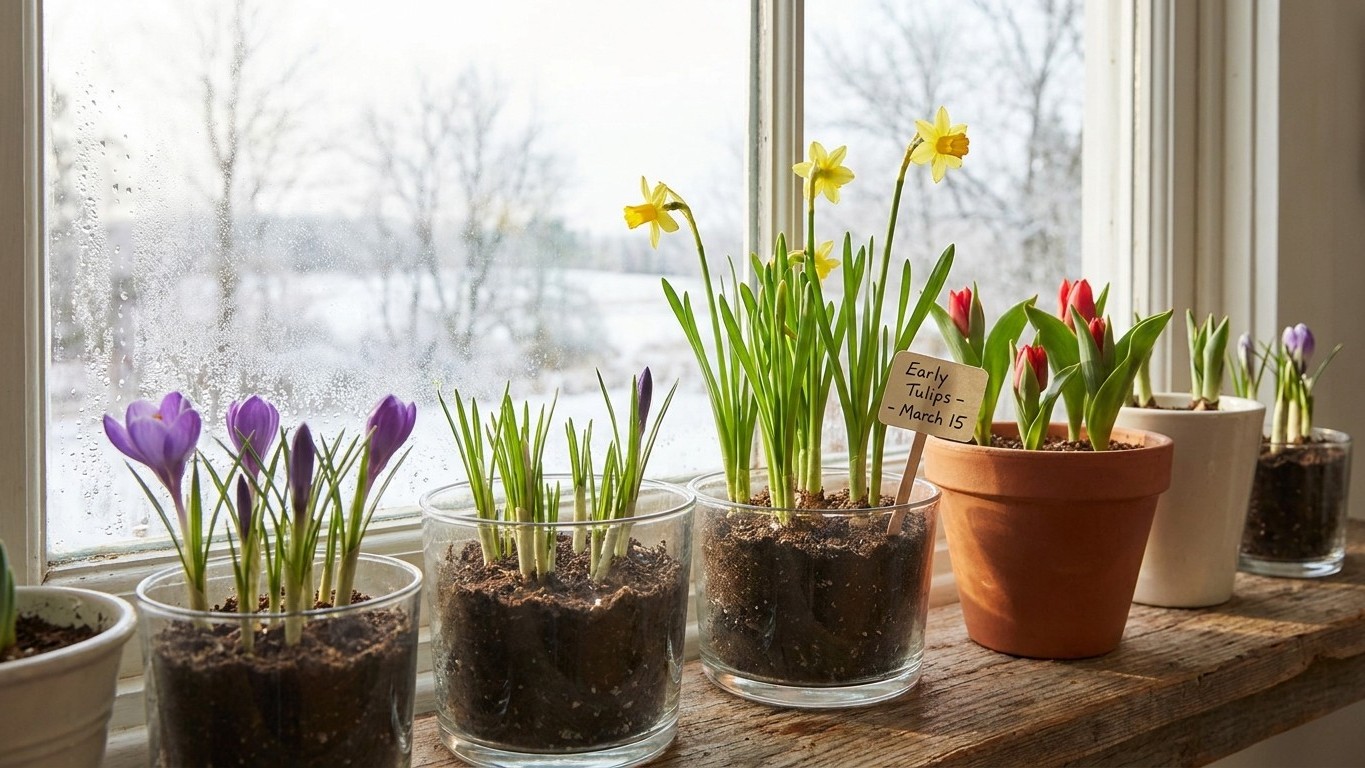

Forcing spring bulbs indoors works in Prince Edward Island the same way it works anywhere: you substitute a refrigerator or a cold garage for the twelve to fourteen weeks of chill a bulb needs, then bring it into warmth and light so it blooms weeks ahead of the garden outside. The harder question is which bulbs are worth the shelf space, and where the cold actually comes from on this island.
Why this matters in Prince Edward Island

The average daily low in Charlottetown’s coldest month sits at 10.3 F, and the province carries a Canadian hardiness rating of zone 5b, based on Natural Resources Canada’s 1991-2020 normals for the province’s reference city. That is a genuinely cold winter. A bulb sitting in a garden bed here gets far more than the twelve to fourteen weeks below 45 F that tulips, daffodils, and crocus need to set a flower bud. There is no shortage of cold in Prince Edward Island’s ground.
That single fact changes what “forcing” means here. In places where winters stay mild, forcing indoors exists because the ground never gets cold enough on its own, so the gardener has to fake the chill in a fridge before the bulb will bloom at all. That is not the problem in this province. The soil handles the chill requirement without any help.
What Prince Edward Island’s winter does threaten is anything in a pot. A container has no insulating mass around it the way garden soil does. At an average low of 10.3 F, an unprotected pot left outdoors will freeze solid, roots and all, while six inches below the surface of a garden bed the same night stays milder and never fully freezes. A bulb rated hardy for zone 5b in the ground can die in a pot exposed to that same 5b winter, because the pot experiences a colder effective zone than the soil around it.
So this is a container problem, not a missing-cold problem. Gardeners in Prince Edward Island force bulbs indoors for two reasons that have nothing to do with a chill deficit: to get bloom on a windowsill in the dead of winter, weeks before anything outdoors would show color, and to keep a potted bulb from a freeze-through that the same bulb, planted in a bed, would shrug off. Anyone reading advice written for a mild-winter region and assuming their own PEI ground needs the same help is solving a problem the local climate doesn’t actually have.
How to do it here
The sequence is the same whether the bulb is destined for a windowsill in January or a pot that needs to survive the porch in December. What changes locally is where the twelve to fourteen weeks of chill actually happen, since an unheated garage in this climate can itself drop well below freezing on the coldest nights, and a warm kitchen fridge is not a substitute for judgment about where fruit sits.
- Pick bulbs sized for forcing and pot them in a container with drainage holes, using fresh potting mix, with the bulb noses sitting just at or barely below the surface and not crowded against the pot wall.
- Water once, thoroughly, until it runs from the drainage holes, then let the surface dry slightly before moving the pot to cold storage.
- Move the pot to a location that stays reliably between about 35 F and 45 F for the full twelve to fourteen weeks: an unheated garage works only if it does not swing below freezing on the coldest nights, which in a winter averaging 10.3 F it can. A refrigerator crisper drawer is the more dependable option, provided no ripening fruit shares that drawer, since the ethylene gas fruit gives off can abort the flower bud inside the bulb before it ever gets the chance to open.
- Check the soil weekly and keep it barely damp, never wet, through the entire chilling period. Standing moisture in a cold, dark pot is the single most common cause of rot before forcing even starts.
- Once shoots reach roughly one to two inches, usually after the full chilling period has passed, move the pot to a cool, bright room, around 50 to 60 F, for about a week before exposing it to full warmth.
- Move the pot into a warm, sunny spot to finish. Bloom typically follows within two to three weeks of that final move.
- If the pot is meant to overwinter outdoors rather than come inside, remember it needs a bulb rated hardy at least two Canadian zones colder than 5b to survive unprotected, or it needs to be moved into an unheated shed or garage, or mulched heavily and sunk into a garden bed so the surrounding soil buffers it the way open ground does.
Which bulbs are worth it
Not every bulb repays the trouble of forcing, and the reason usually comes down to two mechanical facts: how long the cold requirement runs, and how tall the flower stem gets relative to the pot holding it up. A short chill requirement means less time tied up in a fridge drawer. A short, sturdy stem means the finished pot doesn’t flop over on the windowsill.
Where a bulb was never going to survive Prince Edward Island’s ground anyway, forcing it costs nothing in the long run. Paperwhite narcissus and amaryllis are tender bulbs with no realistic future outdoors in a zone 5b winter, so using them once for indoor bloom and discarding them afterward isn’t a loss against some alternative outdoor life they were never going to have.
Bulbs that force reliably here
- Paperwhite narcissus: needs no cold period at all, blooms in three to four weeks from potting, short stem holds up well in a shallow bowl.
- Hyacinths: about a 12-week chill, thick short stems that rarely need staking.
- Crocus: as little as 8 to 15 weeks of chill depending on variety, low growth habit that never risks toppling.
- Amaryllis: no chill requirement, large indoor-only bulb bred purely for pot display.
Bulbs that sulk
- Tall trumpet daffodils: want a longer chill than most gardeners give them and grow a stem too tall for most pots without staking.
- Tulips: need 14 to 16 weeks of consistent cold and are unforgiving of any warm interruption during that period.
- Giant alliums: long chill requirement combined with a flower stalk that is awkward indoors at full height.
What goes wrong, and when you can still fix it
Leaves, but no flower
This means the chilling period ran short. The bulb had enough cold to push leaf growth but not enough to finish forming the flower bud inside itself, which happens earlier, during dormancy, than most gardeners expect. There is no fix once the leaves are up. The bulb needs a full, uninterrupted chill next time, not a rescue this season.
A flower low on the stem, hard to even see
This is the opposite problem: the pot was pulled into warmth too soon or too fast, before the stem had time to elongate the way it does when the temperature rise is gradual. Moving the pot back to a cooler, bright spot can slow things down slightly, but a stem that has already stalled at a few inches will not catch up. This one is not saveable this season either.
Rot in the pot
Soft, brown, foul-smelling tissue at the base of the bulb means water sat against it with nowhere to drain, usually from a pot without real drainage holes or from watering too heavily during the cold storage weeks. A rotted bulb cannot be saved. The fix is for next time: drainage holes, a lighter hand with the watering can, and checking the pot rather than watering on a schedule.