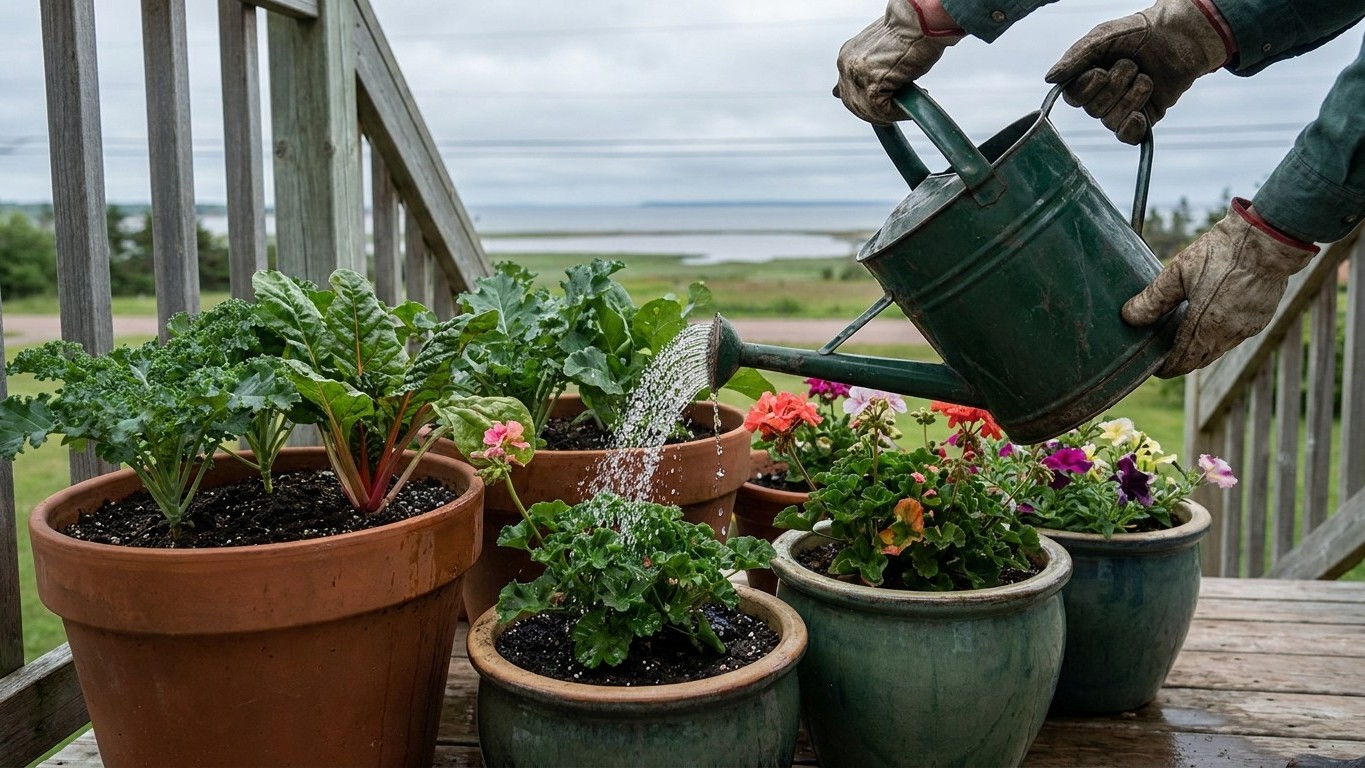

Prince Edward Island gardens rarely bake under punishing heat, but that doesn’t mean the sky covers the bill. July, the driest summer month on record, brings 3.15 inches of rain, and the region logs zero days a year at or above 90F. That combination means containers and beds still need a deliberate watering routine here, just not one built around heat stress the way a Southern garden would be.
What changes here

Start with the two numbers that set the terms for every gardener on the Island. At the Charlottetown A reference station, July, the driest month of summer, averages 3.15 inches of rain. The same station records 0.0 days a year reaching 90F. Together those figures describe a garden climate that’s short on scorching afternoons but not automatically generous with water when it’s needed most.
The arithmetic matters more than the headline number. A vegetable bed or a bed of annuals wants roughly one inch of water a week to keep growing steadily. Spread July’s 3.15 inches evenly across the month’s four and a half weeks, and the sky is delivering about 0.7 inch a week on average. That leaves close to a quarter inch a week for the gardener to make up with a hose or a watering can, and that gap widens fast if July turns dry the way driest months sometimes do, since 3.15 inches is an average, not a guarantee for any single season.
The zero days above 90F changes what that missing quarter inch actually does to a plant. Without heat spikes driving fast evaporation, water that lands on the soil tends to stay put longer than it would in a hotter state, which buys a bit of forgiveness if a watering day slips by. It doesn’t buy forgiveness from the soil itself, though. On a sandy bed, that same inch of water drains through within a day, leaving roots dry again well before the week is out. On heavy clay, the same inch can sit near the surface for most of a week, which sounds convenient until standing moisture starts pushing oxygen away from the roots. Knowing which kind of ground is under a given bed changes the watering plan more than the rainfall number does on its own.
How to water when it matters
The method that works on the Island isn’t different in principle from good watering anywhere, but the details are worth setting to this ground rather than to a generic gardening guide. Deep, infrequent watering pushes roots downward, chasing moisture that’s stayed lower in the soil after the surface has dried. Watering at the base keeps foliage dry, which matters in a climate that already carries plenty of humidity off the Northumberland Strait and the Gulf of St. Lawrence, since wet leaves overnight are an open invitation to fungal disease. Morning watering gives the plant hours to take up moisture before the afternoon sun and any breeze start pulling it back out through the leaves.
Checking the soil beats checking the calendar. A finger or a trowel pushed two inches down tells the truth a dry-looking surface can hide, especially on clay ground where a crust forms on top while the layer below stays damp, or on sandy ground where the opposite happens: the surface looks fine while the root zone below is already bone dry.
- Push a finger or trowel two inches into the soil before deciding to water; if it’s dry at that depth, water regardless of what the surface looks like.
- Water at the base of the plant, directly onto the soil, keeping the foliage dry to reduce the risk of overnight disease.
- Water in the morning, giving the plant hours to draw up moisture before the day’s evaporation picks up.
- Aim for about one inch of water a week on garden beds, split into two shorter soakings on sandy ground or delivered as one longer soak on heavy clay.
- Check containers daily, since potting mix dries out far faster than ground soil, and water whenever the top inch feels dry to the touch.
That one-inch target is a starting point, not a rule. A bed that drains fast through sand will ask for water more often than this schedule suggests, and a dense clay bed will ask for less. Watch the plants and the soil, not just the schedule.
What goes wrong
A daily sprinkle that never reaches the roots
A quick pass with the hose every evening feels responsible, but it wets only the top inch or two of soil. Roots follow the water, so they stay shallow and close to the surface, right where the ground heats up fastest and dries out first. A plant watered this way is more fragile, not less, than one watered deeply once or twice a week.
Watering leaves at night
Wet foliage that sits overnight without sun or wind to dry it gives fungal spores exactly the conditions they need to take hold. It’s a bigger risk on the Island than it might be somewhere drier, since the region’s humidity already keeps leaves damp longer after any watering or dew.
Trusting a rain shower without checking
A short summer downpour can look like it solved the watering problem for the week when it’s actually only wet the top half-inch of soil, especially where the ground has already crusted over. The finger test settles it faster than guessing from how hard the rain sounded on the roof.
Watering a bed that hasn’t dried
This is the mistake that costs the most on the Island specifically. With no days reaching 90F to speed up evaporation, and clay-heavy ground in many parts of the province holding moisture for close to a week, adding more water to a bed that’s still damp from the last soaking drowns roots rather than feeding them. Checking that the soil has actually dried at root depth before watering again matters more here than chasing a fixed schedule.
Local help
Watering restrictions vary by municipality and utility, and they change from year to year, so check with your own water provider before setting a routine. For broader guidance on soil, crops and growing conditions across the province, the Prince Edward Island government’s agriculture resources are the starting point worth bookmarking.
Common questions
Do Prince Edward Island gardens need less water than hotter states?
Less driven by heat stress, yes, since the region averages zero days a year at or above 90F. But rainfall in the driest summer month still falls short of the one-inch weekly target most beds need, so supplemental watering stays necessary.
How often should containers be watered on the Island?
Daily checks are the safer habit, since potting mix dries out faster than garden soil regardless of the local climate. Watering whenever the top inch of mix feels dry keeps container plants ahead of stress.
Is overwatering really a bigger risk than underwatering here?
On clay-heavy ground, yes. Without intense heat to speed up evaporation, water lingers longer near the roots, and adding more before the soil has dried invites root rot rather than solving a watering problem.
What’s the fastest way to tell if a bed needs water?
Push a finger or a trowel about two inches into the soil. If it’s dry at that depth, water; if it’s still damp, wait, even if the surface looks parched.