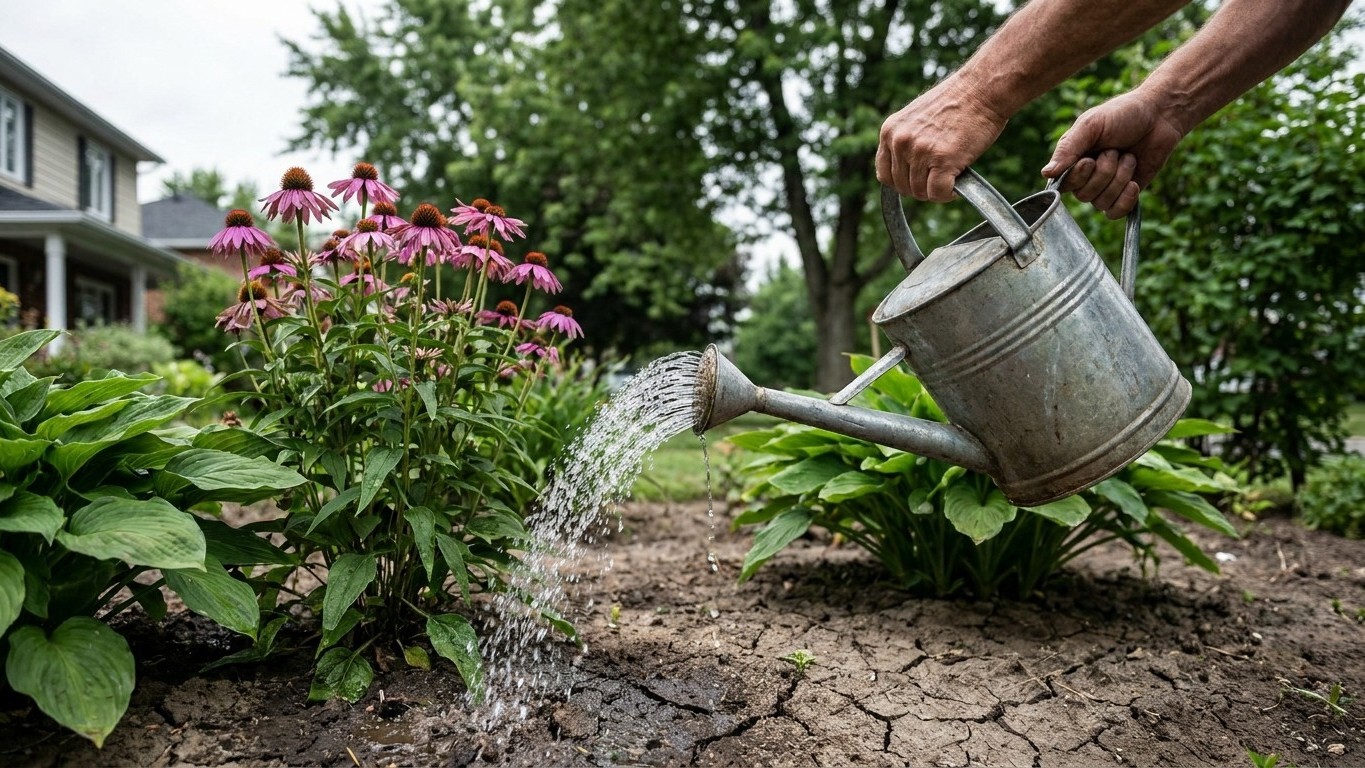

Quebec gardens need far less rescue-watering than most of the US, thanks to cool summers and rain that shows up almost every week. But “less” isn’t “none.” During a dry stretch, the timing and depth of watering matter more than the total amount, and getting that wrong is the difference between a bed that thrives and one that limps through August.
What changes here

June averages 3.42 inches of rain around Montreal, the driest month of the Quebec summer. The region also logs, on average, 0.0 days a year at or above 90°F. Put those two numbers side by side and the picture is clear: this is a climate where drought stress creeps in slowly, from stretches without rain, rather than from heat that cooks plants in an afternoon.
Run the arithmetic and the gap becomes concrete. A vegetable bed or a perennial border generally wants about an inch of water a week to keep growing without stalling. Spread evenly across June’s four-plus weeks, 3.42 inches works out to roughly 0.8 inch a week falling for free, in an average week of that driest month. That leaves the gardener carrying about 0.2 inch, a modest top-up, to close the gap in a typical week.
Averages are the problem, not the solution. Quebec’s summer rain rarely arrives in neat weekly installments. More often it’s a thunderstorm that dumps half an inch in twenty minutes, followed by ten dry days, then another burst. A June with 3.42 inches on paper can still leave a bed bone-dry for a week and a half if that rain fell in two events instead of four.
Soil texture decides how much of that inch actually reaches the roots. On sandy ground, water drains through within hours, so a heavy rain gives a short-lived boost. On heavy clay, common across much of the St. Lawrence lowlands, the same inch can sit near the surface for the better part of a week, feeding roots slowly but also risking waterlogging if more is added before it drains. Without a soil test of your own plot, the safest move is to treat 0.8 inch a week as what the sky usually provides, and check the rest with your hands, not your calendar.
How to water when it matters
The method that works in this climate is deep and infrequent, applied at the base of the plant, in the morning. Deep watering pushes moisture down six to eight inches, where it trains roots to grow downward and reach reserves that survive a dry week. Frequent shallow watering does the opposite: it keeps roots near the surface, where the topsoil dries out fastest and heat, even without hitting 90°F, still bakes it hard. Watering at the base instead of overhead keeps leaves dry, which matters because wet foliage overnight is an invitation for fungal disease. Morning watering gives roots first access to moisture before the day’s evaporation and lets any incidental leaf splash dry within the hour.
Checking soil moisture before watering avoids the most common error: trusting the surface. The top half-inch can look dry while two inches down the ground is still cool and moist, or the reverse. A finger pushed two inches into the soil, or a trowel pulled up for a quick look, tells the real story in a few seconds.
- Push a finger or trowel two inches into the soil near the root zone; if it’s still damp, hold off on watering.
- Water at the base of the plant with a soaker hose, drip line, or watering can, avoiding the leaves.
- Water before 9 a.m. so any splashed foliage dries quickly and roots get first access to moisture.
- Soak deeply rather than lightly: aim for about 1 inch of water in a single session so it reaches 6 to 8 inches down.
- On sandy soil, split that inch into two shorter soakings a few days apart, since sand drains fast and holds little.
- On clay soil, one deep soaking a week is usually enough; clay holds moisture far longer and drowns roots if watered again before it’s dried.
Start from roughly 0.8 inch a week arriving as rain in a typical June, topped up to a full inch when the week stays dry. That’s a starting point, not a rule; the only way to know for certain is to check your own soil two inches down before reaching for the hose.
What goes wrong
A little water, every day
A daily five-minute sprinkle feels responsible but wets only the top inch of soil. Roots stay shallow to chase that moisture, then have nothing to fall back on the first week the schedule slips.
Watering the leaves after supper
Evening watering that hits foliage leaves it wet for eight or nine hours overnight. That’s exactly the window fungal spores need to take hold, and it’s a common source of mildew and blight in Quebec gardens by late summer.
Trusting a shower that never soaked in
A ten-minute downpour can look like a thorough watering while wetting only the top half-inch of soil, especially on compacted or clay ground where water runs off before it soaks in. A finger check two inches down settles the question in seconds; the rain gauge tells you what fell, not what reached the roots.
Watering clay before it has dried
Because clay holds a week’s worth of water, adding more on a schedule rather than by feel is the mistake that costs the most in this region. Roots sitting in saturated clay for days lose access to oxygen and start to rot, even though the plant above ground still looks thirsty.
Skipping the mulch
Bare soil gives back a large share of any watering to the sun within a day. A two- to three-inch layer of mulch slows that loss and keeps the moisture from a soaking working for the plant instead of evaporating back into the air.
Local help
For crop-specific and seasonal watering guidance, Quebec’s agriculture ministry, MAPAQ, publishes advice for home and commercial growers across the province. Watering restrictions during dry spells are set locally and can change from one municipality to the next, so check with your own water provider before setting a schedule, rather than relying on provincial averages alone.
Common questions
How often should I water a Quebec garden during a dry spell?
Once or twice a week with a deep soaking is usually enough for established plants, adjusted by soil type: sandy ground needs shorter, more frequent watering, while clay needs less frequent but deeper sessions.
Does Quebec really need less watering than most US gardens?
Generally yes. With 0.0 average days a year above 90°F, evaporation losses are lower than in most of the continental US, and summer rainfall, even in the driest month, covers most of a garden’s weekly need.
What’s the biggest watering mistake in this climate?
Watering clay soil again before it has dried from the last rain or soaking. It drowns roots rather than starving them, which is the opposite problem gardeners in hotter, drier states usually face.
Is morning or evening watering better here?
Morning, without exception. It gives roots access to water before the day’s heat and evaporation, and it lets any wet foliage dry out before nightfall, cutting the risk of fungal disease that thrives in Quebec’s humid summer nights.