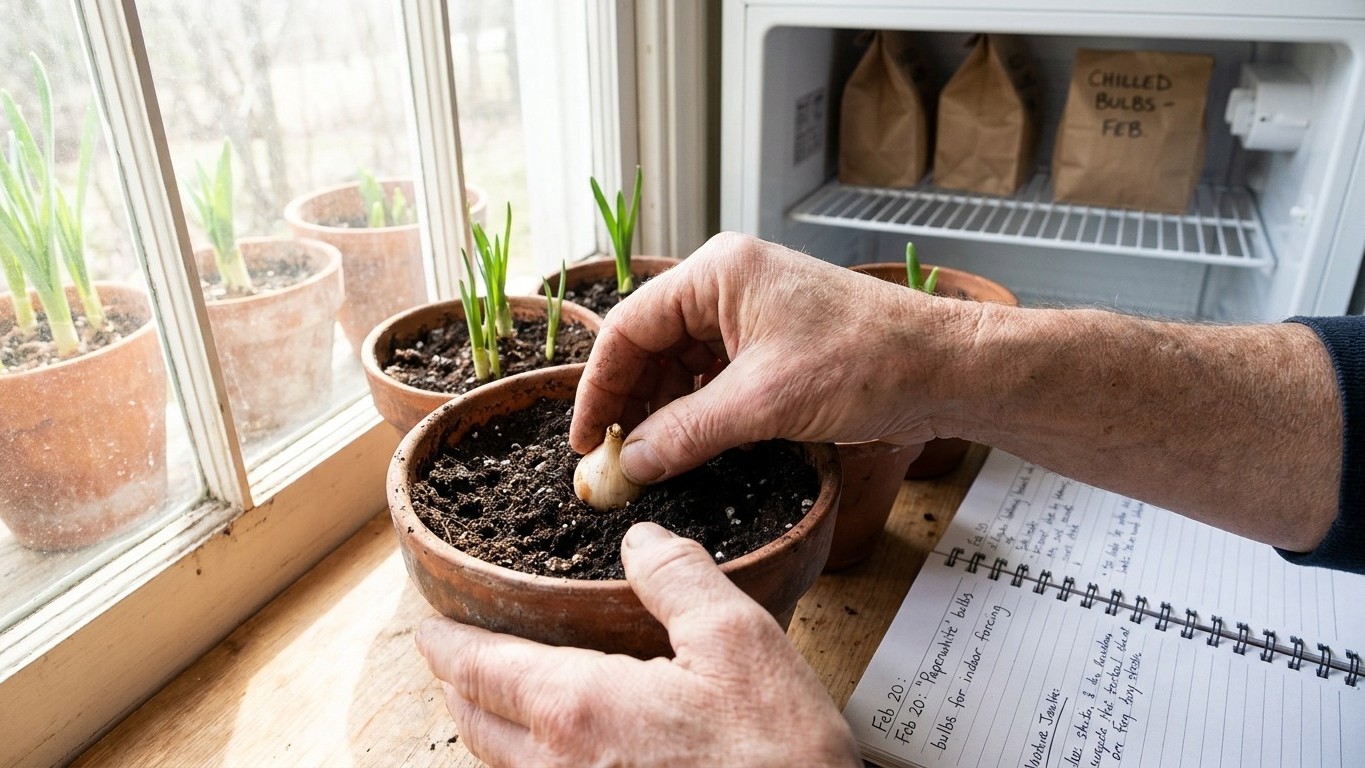

South Carolina’s winters rarely stay cold long enough, or evenly enough, for tulips, hyacinths and daffodils to break dormancy on their own schedule. Forcing indoors sidesteps that gap: you supply the twelve to fourteen weeks of chill in a refrigerator or unheated garage, then bring the bulb into warmth and light on your timeline instead of the sky’s. It works statewide, but the details shift depending on where in South Carolina you garden.
Why this matters in South Carolina

The mean daily minimum temperature in the coldest month, measured at the Charleston reference station, is 38.9°F, according to NOAA NCEI Climate Normals for 1991-2020. That number matters more than any record low you might remember from a hard winter. It tells you what a bulb actually experiences on an average cold night, not the rare extreme.
A spring bulb like a tulip or hyacinth needs roughly twelve to fourteen weeks with soil temperatures staying below 45°F to complete the chemical process that lets it flower. At 38.9°F average, South Carolina’s coldest month sits below that 45°F threshold, but the state’s hardiness range runs 7a to 9a on the USDA Plant Hardiness Zone Map (2023 edition, based on the same 1991-2020 normals), and that range covers a lot of ground. Upstate counties trend colder, coastal counties trend warmer, and in the warmer stretches, especially near the coast, the ground often doesn’t stay cold long enough, consistently enough, across the full chill window. That’s the situation forcing solves: not a total absence of cold, but an unreliable or shortened supply of it.
Containers face a separate problem, and it’s not about total chill hours. A pot sitting above ground freezes through entirely, roots included, whenever outdoor temperatures drop hard, while the same cold in a garden bed only bites the top few inches before insulating soil beneath protects the bulb. That means a bulb rated hardy for a South Carolina bed can still die in a pot left outside, because the container offers no buffer. If you’re planning to force bulbs in containers rather than in the ground, the hardiness zone that describes your yard doesn’t describe your pot.
Put those two facts together and the practical takeaway is this: in the milder parts of the state, particularly toward Charleston and the coast, forcing indoors is often the more dependable route to a spring bloom than counting on the ground to do the work. Further upstate, where winters run colder, in-ground planting timed to the season can still deliver blooms without forcing, but forcing remains the reliable option when you want blooms on a schedule you control, in a pot, or on a windowsill regardless of ZIP code.
How to do it here
Forcing is a sequence, and skipping a step, or shortening the cold period, is the single most common reason it fails. Here’s the order that works, and where in South Carolina you’ll actually find each condition.
- Choose bulbs suited to forcing and buy them as soon as they’re available in fall, since bulbs held too long in a warm store lose vigor before the cold treatment even starts.
- Pot them in a container with drainage holes, nose up, close together but not touching, in ordinary potting soil, then water thoroughly once.
- Find a cold space that holds steadily below 45°F without freezing solid. An unheated garage works in the colder months if it stays above freezing, since a hard freeze inside the pot can damage the developing root system. A spare refrigerator, or a drawer in the main fridge, is the more reliable option in the warmer parts of the state where outdoor cold doesn’t stay consistent long enough on its own.
- Keep the bulbs away from ripening fruit if you use a refrigerator. Apples, pears and other ripening produce give off ethylene gas, and ethylene kills the flower bud forming inside the bulb before you ever see it. A drawer or shelf with no fruit at all is the safer bet.
- Leave them in the cold for the full twelve to fourteen weeks the bulb needs, checking soil moisture every couple of weeks so it never dries out completely during the chill period.
- If you’re forcing in a container that will sit outdoors during the cold treatment, remember the pot must be rated at least two hardiness zones colder than your bulb’s tolerance, or you need to move it into an unheated space and mulch it heavily, because the container offers none of the insulation a garden bed does.
- Move the pot into bright, indirect light at room temperature once the chill period is complete, and expect shoots and flowers within two to four weeks depending on the species.
Which bulbs are worth it
Not every bulb rewards the effort equally, and the difference usually comes down to how short the chill requirement is and how the plant holds itself up once it blooms. A bulb with a short cold requirement forces faster and gives you results sooner. A bulb that throws up a tall, top-heavy stem often flops in a pot indoors, where there’s no wind or surrounding foliage to hold it upright the way there is outdoors.
Worth knowing too: for bulbs that are essentially a one-season purchase in much of South Carolina anyway (tulips being the classic example in the milder zones, since they rarely rebloom reliably here), forcing costs you nothing in the long run. You weren’t getting a second year from that bulb regardless, so using it up indoors for a guaranteed bloom is a reasonable trade.
- Paperwhite narcissus, which need no cold period at all and bloom in as little as three to four weeks from planting.
- Hyacinths, compact and sturdy enough to stand upright indoors after their chill period.
- Crocus, small and quick, well suited to shallow bowls.
- Tulips, especially since most won’t reliably rebloom outdoors in the warmer parts of the state anyway.
Bulbs that tend to disappoint indoors:
- Daffodils with tall, narrow stems, which frequently topple once the flower opens and the head gets heavy.
- Alliums, whose long chill requirement and tall flower stalks make them a poor match for pot culture.
- Large-cupped daffodil varieties generally, for the same top-heavy reason as above.
What goes wrong, and when you can still fix it
Leaves but no flower
This means the cold period ran short of the twelve to fourteen weeks the bulb needed, or the temperature during that period crept above 45°F too often. There’s no rescue for a bulb already in growth; the flower bud simply never finished forming. The fix is for next time: track the weeks in the cold space, and use a thermometer there rather than assuming the space is cold enough.
A flower on a stem too short to see
This happens when the pot was moved into warmth too early, before the shoot had a chance to elongate in cool conditions first. Once it’s happened, the stem won’t stretch out further this season. Going forward, give the pot a week or two in a cool, bright spot, well below room temperature, before moving it to full warmth.
Rot at the base of the bulb, in a pot
Soft, mushy tissue at the bulb’s base, sometimes with a sour smell, points to standing water and no real drainage, often from a pot without drainage holes or soil packed too tightly. A bulb that’s already gone soft can’t be saved this season. The bulbs still firm nearby in the same pot can sometimes be salvaged if you repot them immediately into fresh, well-draining soil with functioning drainage holes.
Related guides
- Growing Spring Bulbs in Containers in South Carolina
- Forcing Spring Bulbs Indoors in South Dakota