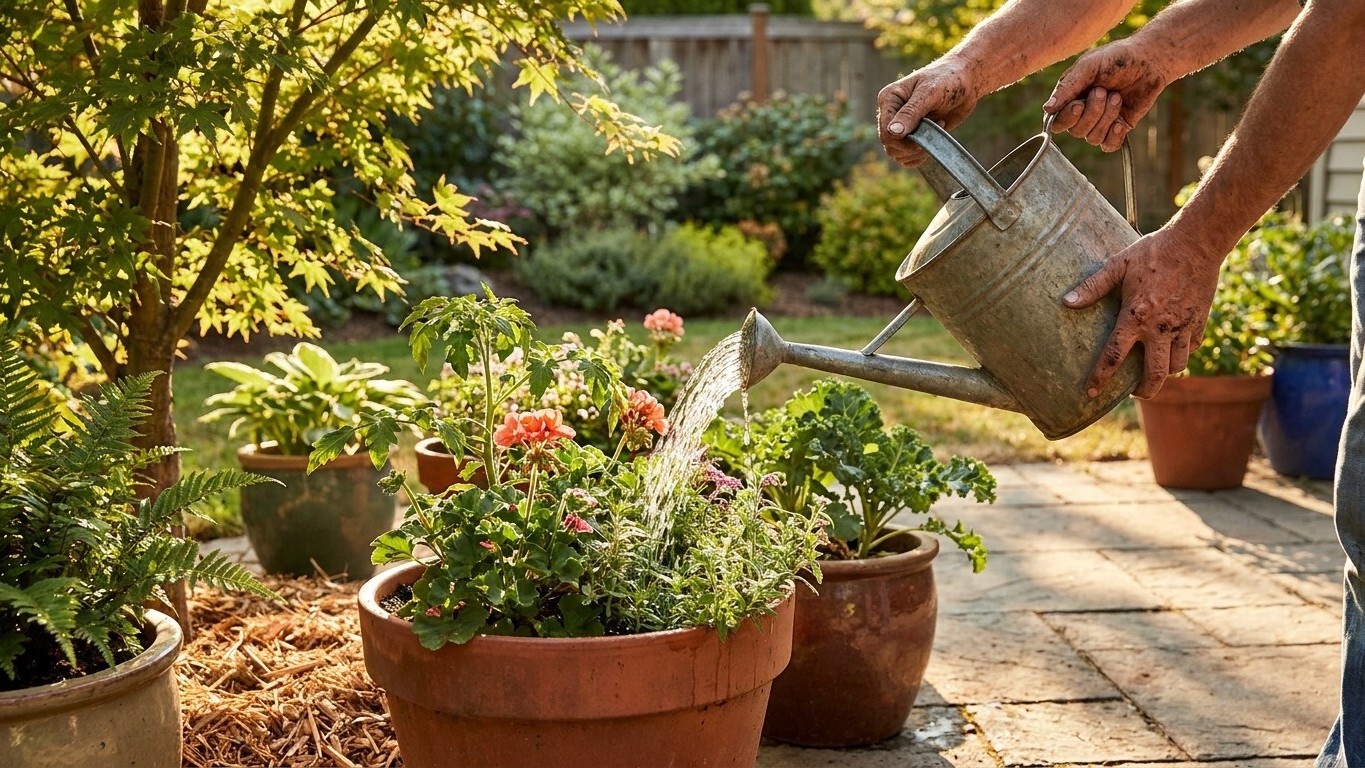

Washington’s summer rain barely covers a tenth of what a garden bed needs, and container plants dry out faster still. The reference climate data for the state shows just how much the gardener has to make up by hand, and how heat and soil combine to change the answer week to week.
What changes here

July is Washington’s driest summer month, averaging just 0.6 inches of rain at the reference station. The same station logs only 3.0 days a year at or above 90F. Put those two together and you get a climate that isn’t brutally hot, but is remarkably stingy with water exactly when plants are growing hardest.
A vegetable bed or a well-rooted perennial border wants roughly an inch of water a week. Spread that 0.6 inches of July rain evenly across the month and an average week delivers about 0.14 inches from the sky. That leaves the gardener responsible for close to 0.86 inches every single week, whether it comes from a hose, a drip line, or a watering can carried out to the containers on the patio.
Soil texture decides how far that hand-carried water actually goes. A sandy bed lets an inch of water pass through the root zone within a day, so it needs smaller, more frequent drinks to keep up. A heavy clay bed holds that same inch for the better part of a week, which sounds convenient until it’s watered again too soon and roots start sitting in standing moisture. Neither behavior is unique to Washington, but the state’s dry-July pattern means the penalty for guessing wrong on either soil type shows up fast: sandy ground goes from moist to bone-dry in a matter of days once the rain stops.
None of this is a forecast. These are 1991-2020 normals for one reference station, and a slope, a rain shadow east of the Cascades, or a city lot with reflected heat will all shift the real number on a given property. A cheap rain gauge left in the yard, checked weekly through summer, tells a gardener more about their own patch than any regional average can.
How to water when it matters
The method that works on Washington ground is deep and infrequent, delivered at the base of the plant, done in the morning. Deep watering pushes moisture down to where roots actually live instead of leaving it to evaporate off the top inch of soil. Watering at the base rather than overhead keeps leaves dry, which matters more than it sounds like it should. Morning watering gives the plant a full day to take up what it needs before evening humidity and cooler night air arrive, the exact conditions fungal disease thrives in.
Checking whether the soil actually needs water beats watering on a schedule. A finger pushed two inches into the soil, or a trowel pulled up near the root zone, tells the real story; the surface can look dry an hour after a soak while the root zone below is still holding plenty.
Soil texture sets the rhythm. Sandy ground holds little reserve, so shorter, more frequent soakings suit it better than one big weekly dose. Heavy clay holds a week’s worth of water easily, but watering it again before it has actually dried invites root rot rather than growth.
- Check soil moisture two inches down with a finger or trowel before watering at all.
- If dry at that depth, water slowly at the base until roughly 1 inch has soaked in, adjusting up or down for sandy or clay soil.
- Water in the early morning, before the day’s heat sets in.
- Recheck at the same depth two to three days later rather than watering again on a fixed schedule.
- Add two to three inches of mulch to slow evaporation between waterings.
Start with that 1-inch guideline and treat it as a baseline to adjust, not a rule; a container on a sunny deck will need checking far more often than a shaded bed in the same yard.
What goes wrong
A little water every day
Daily light sprinkling feels attentive, but it wets only the top inch or two of soil. Roots follow the water, so they stay shallow and near the surface, exactly where summer heat bakes the ground hardest. A deep, less frequent soak trains roots to grow down into cooler, more stable soil instead.
Watering the leaves in the evening
Wet foliage that sits overnight, especially in the mild, damp air common to Washington evenings, is an open invitation to fungal disease. Morning watering lets leaves dry by afternoon; evening watering leaves them wet for eight or more hours in the dark.
Trusting a passing shower
A brief summer shower can look like it solved the watering problem while wetting only the top half-inch of soil. Given how little rain July actually delivers here, on average about 0.6 inches for the whole month, a single afternoon storm rarely replaces a real watering session. The finger test settles the question the sky can’t.
Skipping the mulch
Bare soil under a dry-summer sun gives back moisture almost as fast as it’s added. With roughly 0.86 inches a week resting on the gardener’s shoulders rather than the sky’s, letting that water evaporate straight back out is the costliest mistake in a climate this stingy with July rain. A two- to three-inch mulch layer is what keeps that hand-carried water where it’s needed.
Local help
Washington State University Extension runs the state’s official gardening and horticulture guidance, county by county, at extension.wsu.edu. Watering restrictions vary by local water district and change from year to year depending on drought conditions, so check with your own water provider for current rules before setting an irrigation schedule.
Common questions
How often should I water container plants in Washington summers?
Containers dry out faster than garden beds because their soil volume is smaller and exposed on all sides. Check the top two inches with a finger daily during the hottest stretches, since pots can need water every day or two even when a nearby bed goes a week between soakings.
Is Washington’s summer rain enough for a vegetable garden?
No. July averages just 0.6 inches of rain, far short of the roughly 1 inch a week most vegetable beds need, so supplemental watering is necessary through the dry months.
Does Washington’s mild summer heat mean I can water less?
Not necessarily. With only 3.0 days a year reaching 90F, heat stress is low, but the dry July rainfall still leaves most of the watering job to the gardener rather than the weather.
What’s the biggest watering mistake for new Washington gardeners?
Assuming a passing shower or the region’s reputation for rain has done the job. The finger test at root depth, not the sound of rain on the roof, is what actually confirms a bed has enough water.