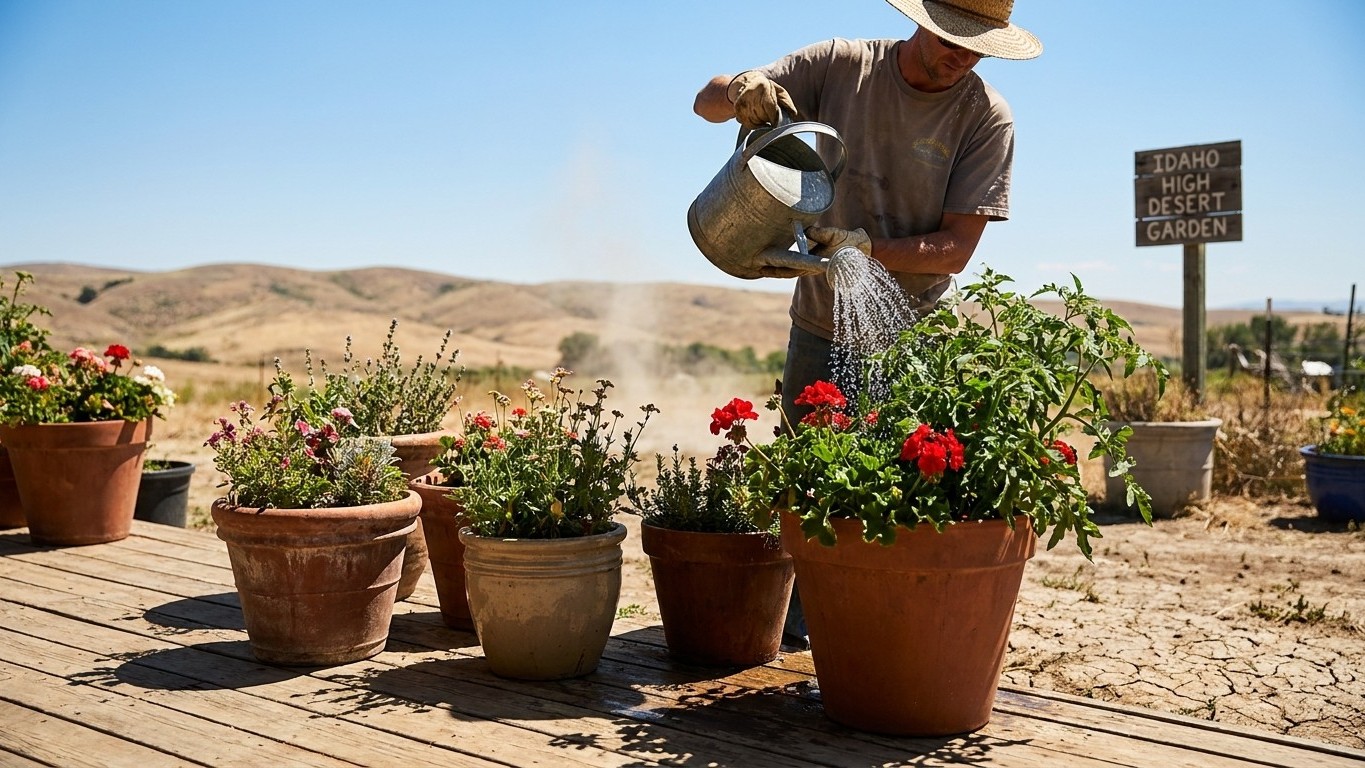

Idaho’s summer climate sets a strict water budget for gardens and Containers: driest month rainfall drops to 0.17 inches while 47.5 days a year push past 90F. Together those numbers mean the sky covers only a sliver of what a garden needs, and the watering can or hose does the rest. Getting the container size, the schedule and the depth right matters more here than in wetter states.
What changes here

Two figures set the terms for every Idaho gardener. August, the driest summer month, brings just 0.17 inches of rain. And the region logs 47.5 days a year at 90F or hotter. Read together, that’s a state where the calendar delivers almost no water exactly when the heat load is pulling the most moisture out of the soil. A garden bed can’t rely on August showers to do any real work.
The arithmetic makes the gap concrete. A vegetable bed or perennial border wants roughly an inch of water a week to keep growing well. Spread August’s 0.17 inches evenly across that month’s four-plus weeks, and the sky is contributing something on the order of 0.04 inches a week, a rounding error next to the inch a plant actually needs. That leaves the gardener responsible for close to the full inch, delivered by hose, watering can or drip line, almost every single week of the driest stretch of summer.
June looks a little better on paper, with 0.75 inches for the month, but July drops to 0.21 inches, so the whole June-through-August stretch averages only about 1.1 inches of rain total. Over three months, that’s less than what a single well-managed bed would want in two weeks. Soil texture changes how far that little rain goes: a sandy plot lets what does fall drain through within a day, so it needs shorter, more frequent top-ups, while a heavier clay soil holds moisture longer and can go further between waterings, provided it isn’t already waterlogged. Either way, the sky isn’t carrying the load in an Idaho summer. The container does.
How to water when it matters
Deep, infrequent watering beats a light daily splash in Idaho’s climate, and the reason comes down to where roots decide to grow. A plant that gets a shallow sprinkle every day never has to reach down for moisture, so its roots stay near the surface, right where 47.5 days of 90F-plus heat can bake them dry within hours. A deep soaking that reaches six to eight inches down pushes roots to follow the water, anchoring the plant lower where the soil stays cooler and damp longer between waterings.
Morning is the better time to water, before the day’s heat sets in. Water applied early has hours to soak down to the root zone before evaporation and afternoon heat pull it back out of the top inch of soil, the layer that dries fastest on a 90-degree day. Watering at the base of the plant rather than overhead keeps leaves dry, which matters far more in a state with any humid or muggy stretches, since wet foliage overnight is where fungal problems get their start.
Checking the soil rather than the calendar is the only reliable way to time each watering. A finger pushed two inches into the ground, or a small trowel pulled up a scoop of soil, tells the real story: if it’s dry at that depth, it’s time to water, no matter what the surface looks like or what the forecast promised.
- Push a finger or trowel two inches into the soil near the root zone; if it’s dry at that depth, water now.
- Apply water slowly at the base of the plant, aiming for roughly 1 inch delivered that week as a starting point, adjusted up on sandy ground and down on heavy clay.
- Water in the early morning, giving the soil hours to absorb moisture before the day’s heat and any afternoon wind pull it back out.
- On sandy soil, split that inch into two shorter soakings during the week rather than one large one, since sand holds little moisture at a time.
- On clay soil, wait until the top few inches have visibly dried before watering again, since clay can hold a week’s worth of moisture and drown roots if watered too soon.
- Recheck at the two-inch depth a day or two after watering to see how long that amount actually lasted in your own soil, and adjust the next cycle from there.
That one-inch-a-week figure is only a starting point. The real answer comes from watching how quickly your own plot dries out between waterings and adjusting from there.
What goes wrong
A daily sprinkle that never soaks in
This is the costliest habit in a state logging 47.5 days a year above 90F. A quick daily splash wets only the top inch of soil, training roots to stay shallow. Once a heat wave hits, those surface roots have nowhere cooler or damper to retreat to, and the plant wilts fast, even though it was “watered” every day that week.
Watering the leaves in the evening
Soaking foliage after sundown feels efficient, but it leaves leaves wet all night with no sun or breeze to dry them. That damp window is exactly when fungal diseases like powdery mildew and various leaf spots get their foothold, turning a well-intentioned evening watering into a slow disease problem over the following weeks.
Trusting a passing thunderstorm
A loud summer storm can look like it solved the watering problem, but a fast, heavy downpour often runs off a dry, sun-baked surface before it soaks in, wetting only the top half-inch of soil. With August averaging just 0.17 inches for the entire month, one storm rarely makes up the deficit. The only way to know is the same finger test used for every other watering decision, checked at two inches down, not by how loud the rain sounded on the roof. Skipping mulch compounds all three mistakes, since bare soil gives back to the sun and wind whatever moisture was just delivered.
Local help
The University of Idaho Extension publishes region-specific guidance on garden watering, soil types and drought-tolerant planting for the state’s growing conditions. Watering restrictions vary by city and water district and change from year to year, so check current rules with your local water provider before setting an outdoor schedule, rather than relying on general climate figures alone.
Common questions
How often should I water my garden in Idaho during summer?
Start with about an inch a week, delivered in one or two deep soakings rather than daily sprinkles, then adjust based on how fast your specific soil dries out at root depth.
What is the best time of day to water in Idaho?
Early morning, so water has time to reach the root zone before the day’s heat, which can reach 90F or higher on roughly 47.5 days a year, pulls surface moisture back out.
Can I rely on rainfall alone during an Idaho summer?
No. The driest month, August, averages only 0.17 inches of rain, and even the full June-through-August stretch totals about 1.1 inches, far short of what most beds need over three months.
How do I know if my soil actually needs water?
Push a finger or small trowel two inches into the soil near the plant. If it’s dry at that depth, water; if it’s still damp, wait and check again the next day.