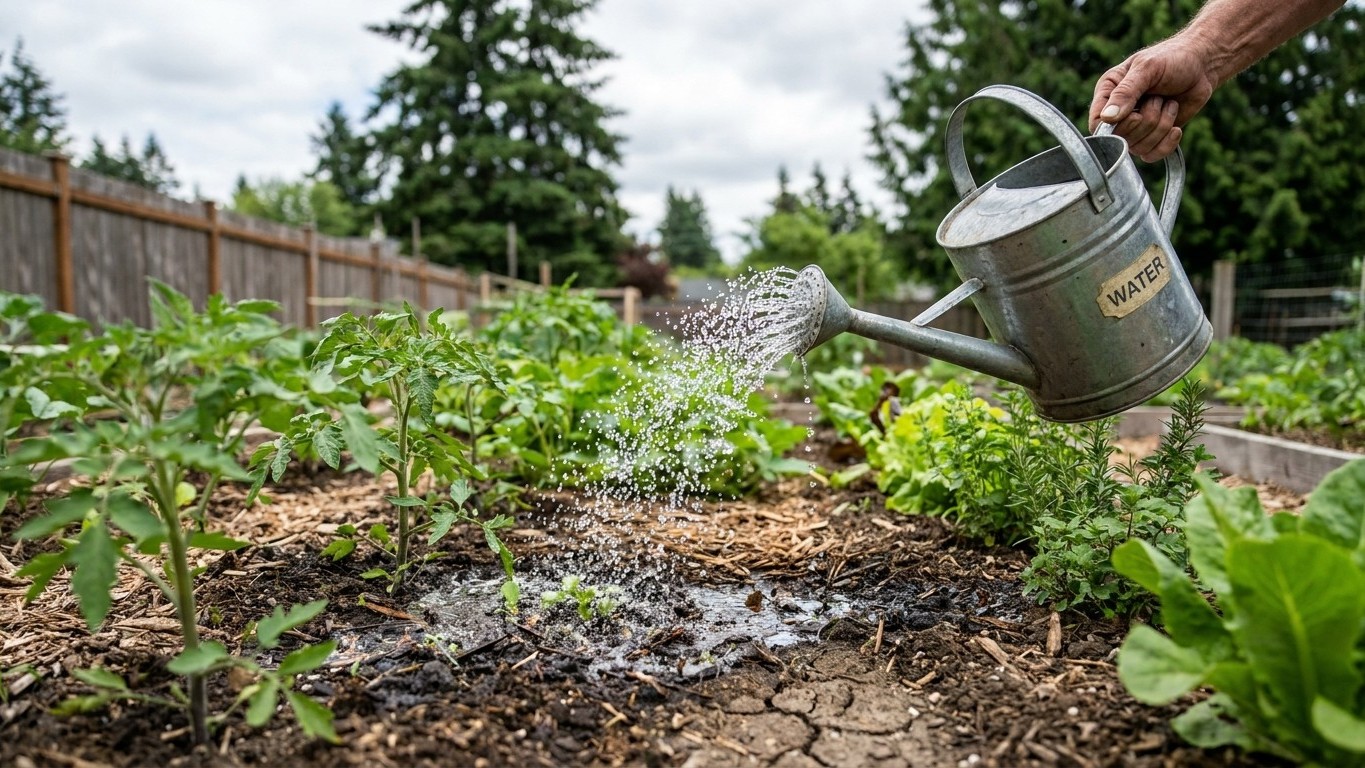

Water Washington gardens deeply and infrequently rather than daily, aiming for the equivalent of about an inch a week through July, the driest stretch of summer. Because the region logs just 3.0 days a year at or above 90F, heat stress builds slowly, but the sky offers almost nothing to help: soil dries out from neglect, not from a heat wave.
What changes here

Two numbers set the terms for every watering decision in this region: July brings 0.6 inches of rain, the driest month of the year, and the area sees only 3.0 days a year that reach 90F. Together they describe a garden that isn’t baking under relentless heat, but is quietly starving for water anyway, because the summer sky simply stops delivering it.
Run the arithmetic and the gap becomes obvious. A vegetable bed or a young shrub wants roughly an inch of water a week to keep growing without stress. July’s 0.6 inches, spread across the month’s roughly 4.3 weeks, works out to about 0.14 inch of rain a week from the sky. That leaves close to 0.86 inch that has to come from a hose, a drip line, or a watering can, week after week, for the entire month. June (1.45 inches) and August (0.97 inches) are a little more forgiving, but July is the month where the gap between what falls and what’s needed is widest.
Soil texture changes how far that carried water goes. On sandy or fast-draining ground, an inch applied today can pass below the root zone within a day, so the same weekly total has to be split into more frequent, lighter sessions. On heavy clay, that same inch can sit in the top foot of soil for a week, which is useful in a dry month but risky if a gardener waters again before the ground has had a chance to dry. Neither soil type changes the weekly target much, but both change how that target should be delivered.
The low count of 90-degree days matters just as much as the rainfall figure, because it means the danger here isn’t scorched leaves on a single brutal afternoon. It’s the slow, cumulative deficit of a whole dry month where nothing forces the issue until plants are already wilting.
How to water when it matters
The method that fits this climate is deep, infrequent watering at the base of the plant, done in the morning, and each piece of that answers to something the plant is actually doing underground. Deep watering pushes moisture down where roots can follow it, rather than leaving them shallow and dependent on the next light rain, which in a month like July simply may not arrive. Watering at the base, instead of overhead, keeps leaves dry, since wet foliage is where fungal problems start. Morning watering gives the soil surface time to dry before evening, when cooler temperatures and lingering moisture create ideal conditions for disease.
Checking soil moisture beats guessing every time. A finger pushed two inches into the ground, or a trowel pulled up to check the same depth, tells a gardener whether the root zone is actually dry, since the surface can look parched while an inch down still holds moisture, or look damp while everything below is bone dry.
Soil texture sets the rhythm from there. Sandy ground holds little water and drains fast, so it asks for shorter, more frequent soakings, sometimes every two to three days in July’s driest stretch. Heavy clay holds a week’s worth of water but punishes impatience: watering it again before it has dried invites root rot rather than growth.
- Start with about an inch of water applied once a week during July, adjusting the split based on how the soil feels two inches down.
- Water at the base of the plant, using a soaker hose, drip line, or the spout of a watering can held low, never a sprinkler aimed at the leaves.
- Water in the early morning, before the heat of the day sets in, so moisture soaks in rather than evaporating off the surface.
- Check soil at root depth with a finger or trowel before each watering session, and skip a session if it’s still damp.
- On sandy soil, shorten the interval to every two or three days with a lighter amount each time; on clay, stretch it toward once a week with a fuller soak.
That one-inch-a-week figure is a starting point, not a rule carved in stone. Container plants, raised beds, and newly planted shrubs all drink faster than an established bed in the ground, and the only way to know for certain is to check the soil itself rather than the calendar.
What goes wrong
A daily sprinkle that never reaches the roots
A few minutes with the hose every evening feels responsible, but it wets only the top inch of soil. Roots follow the water, so they stay shallow and close to the surface, which is exactly where they bake once a stretch of dry, mild weather settles in. Deep, infrequent watering trains roots to grow downward, where moisture actually lingers.
Watering the leaves after dinner
Overhead watering in the evening leaves foliage wet through the cool overnight hours, the exact window fungal disease needs to take hold. Morning watering lets the sun and warming air dry leaves within a couple of hours.
Trusting a passing shower to have done the job
A quick summer shower can look convincing but often wets only the top half-inch of soil before running off or evaporating. The only way to know is a finger or trowel check at root depth, not a glance at a wet sidewalk.
Assuming the rainy season will bail out a dry July
This is the mistake that costs the most locally. Washington’s wetter months build a habit of relying on frequent light rain, but June, July, and August together bring only about 3.0 inches total, with July alone at 0.6 inches. A garden coasting on old winter moisture runs dry well before the mild, low-heat days give any visible sign of stress. Mulch left off the bed makes it worse, since bare soil surrenders whatever moisture was just applied straight back to the air.
Local help
Washington State University Extension offers region-specific guidance on garden watering, soil types, and drought management through its WSU Extension service. Watering restrictions vary by water district and can change seasonally, so check current rules directly with your local water provider before setting a summer watering schedule.
Common questions
How often should I water my garden during a Washington summer?
Aim for about an inch of water a week during July, the driest month, split into fewer sessions on clay soil and more frequent light sessions on sandy soil, adjusted based on a soil check two inches down.
Do I need to water less because Washington summers aren’t very hot?
No. With only 3.0 days a year reaching 90F, heat stress isn’t the main risk here, but the low rainfall in June, July, and August still creates a real water deficit that has to be made up by hand.
Is morning or evening better for watering?
Morning. It gives foliage time to dry before evening, avoiding the damp, cool overnight conditions that favor fungal disease.
How do I know if a rain shower was enough to skip a watering?
Check with a finger or trowel two inches into the soil. A shower that only dampens the surface half-inch isn’t a substitute for a deep watering.