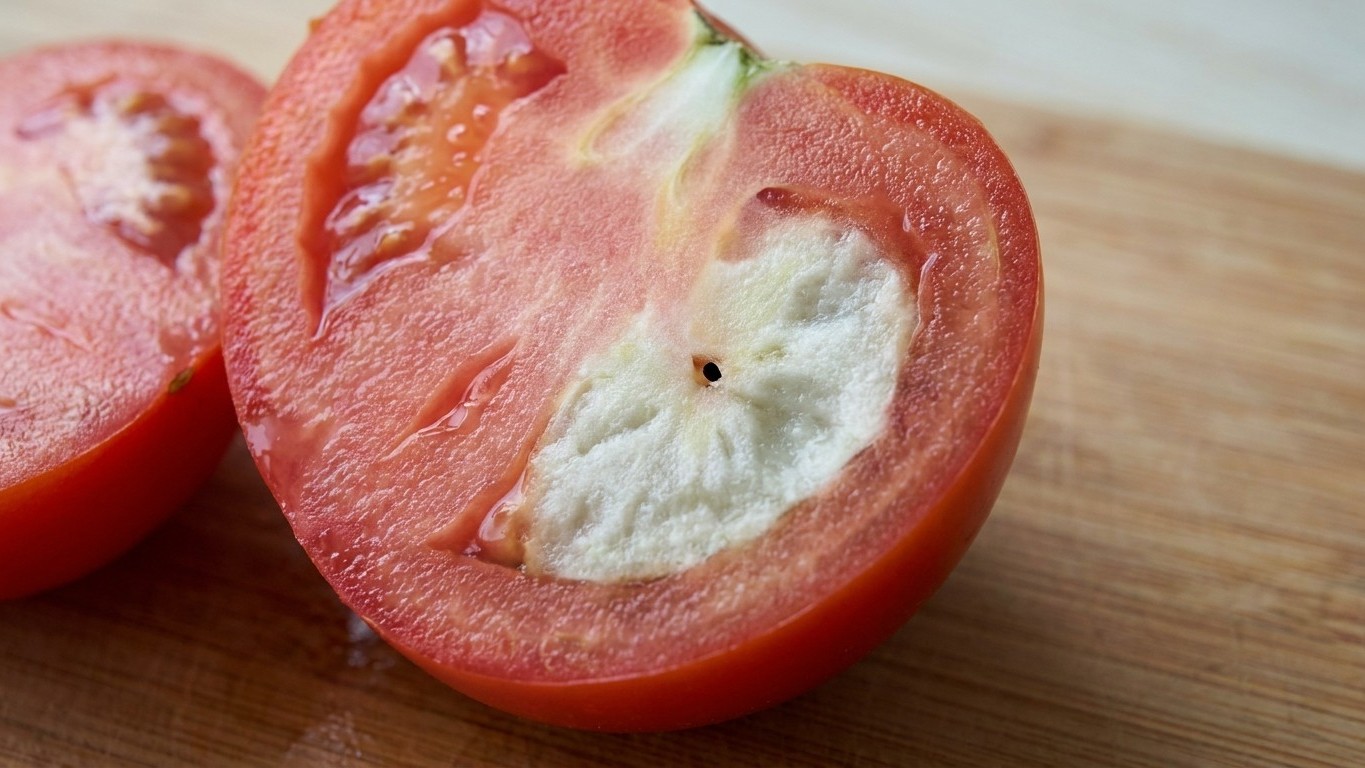

Those pale, cloudy patches sitting just under the skin of an otherwise ripe tomato are almost always stink bug feeding damage. The good news: on an established plant, it’s cosmetic. Cut around the spongy spot and the rest of the tomato is fine to eat. The bad news is limited to seedlings and very young fruit, where the same feeding can distort growth. Here’s how to be sure, and what to do about it.
What the damage looks like

Slice into a tomato with this kind of damage and you’ll find a patch of white, pithy tissue sitting just beneath the skin, usually with a tiny dark speck at its center. That speck is the actual puncture wound, left by a needle-thin mouthpart the insect uses to pierce the fruit and feed on the juice inside. The pale area around it isn’t rot and it isn’t mold. It’s plant tissue that stopped developing normally after an enzyme was injected during feeding, which is why it stays firm and dry rather than turning soft or watery.
The discriminating detail is location and depth: this damage sits under intact skin, not on the surface, and there’s no visible entry hole large enough to see without a hand lens. The skin itself looks completely normal from the outside, maybe with a faint dimple or slightly lighter blotch once the fruit starts to color. Growers sometimes don’t notice anything until they cut the tomato open for a sandwich and find a cloudy, cottony patch staring back at them.
These spots can show up anywhere on the fruit, not just at the blossom end or the stem end. On a single tomato you might find one puncture site or several, scattered without any obvious pattern, because the insects feed opportunistically wherever they land on the ripening fruit. The tissue directly under the skin tends to be the whitest and most compact; deeper into the flesh, the discoloration fades out gradually rather than stopping in a sharp line.
None of this smells off, and there’s no sliminess or drainage associated with it, which matters because it rules out several rot diseases that can look superficially similar from the outside. The flesh stays dry to the touch even where it’s discolored. That dryness, combined with the pinprick mark at the center of each spot, is the signature to look for before assuming anything worse is going on.
Making sure it is this and not something else
A few other common tomato problems produce discoloration that gets confused with stink bug injury. Cutting the fruit open and checking where the damage sits, and whether there’s an actual hole, settles most of the confusion in under a minute.
Blossom end rot
Blossom end rot shows up specifically at the blossom end (the bottom of the fruit, opposite the stem), starting as a water-soaked patch that turns brown to black and leathery. It’s caused by inconsistent watering interfering with calcium uptake, not by an insect. The test: stink bug spots can appear anywhere on the fruit and stay pale and pithy; blossom end rot is always at that one end and turns dark and sunken.
Catfacing
Catfacing produces puckered, scarred, sometimes lumpy tissue near the blossom end, usually traced back to cool temperatures during flowering that disrupted normal fruit formation. The scarring is on the surface and often deforms the shape of the fruit itself. Stink bug damage leaves the fruit’s shape and surface looking normal; the problem is hidden beneath the skin.
Tomato fruitworm
Fruitworm damage means an actual bored hole, often with visible frass (insect droppings) around the entry point, and a feeding tunnel running into the fruit. The test is simple: if you can see or feel a real hole big enough to fit a toothpick, that’s a fruitworm, not a stink bug. Stink bug punctures are pinpricks invisible without close inspection.
When it shows up
Stink bug damage tracks with fruit development rather than with any date on the calendar. Fruit becomes vulnerable once it sets and starts sizing up, but the heaviest feeding tends to concentrate during the stretch from mature green through the early stages of ripening, when the sugars inside the fruit start climbing and the skin is still thin enough to pierce easily.
Fruit hanging on the outer, sun-exposed part of the plant gets hit more than fruit tucked deep in the foliage, simply because it’s easier for the insects to find and land on. A dense, well-leafed plant with fruit clusters shaded by their own canopy tends to show noticeably less damage than a sparse, open plant of the same variety growing nearby.
There’s also a migration pattern worth knowing: stink bugs often build up first on weedy field edges, cover crops, or neighboring host plants, then move into the vegetable garden once those alternate food sources dry down, get mowed, or get harvested. A garden bordered by an unmown weedy strip, or planted next to a field of soybeans or sorghum coming to maturity, is at higher risk simply because of what’s happening right next door. Watching for that shift, rather than watching the calendar, is the better early-warning sign.
What to do now
- Harvest ahead of full ripeness. Once damage starts showing up on a few fruit, pick the rest of that cluster at the mature green or breaker stage and let them finish ripening indoors on a counter, away from further feeding.
- Salvage damaged fruit. Cut out the pithy white patch; the remaining flesh is safe to eat. This costs nothing and wastes less of the harvest than tossing the whole tomato.
- Hand-pick adults and egg masses. Stink bug eggs are laid in tight, barrel-shaped clusters on the undersides of leaves. Check leaves in the morning when adults are sluggish, and drop both eggs and adults into a bucket of soapy water.
- Plant a trap crop at the garden’s edge. Sunflowers, sorghum, or millet planted along the perimeter draw stink bugs away from the tomatoes and give you a concentrated spot to monitor and hand-remove them.
- Use floating row cover on young plants. Cover seedlings and plants still setting their first fruit clusters, since that’s the stage where feeding can actually stunt or deform growth rather than just leave a cosmetic mark. Remove the cover once flowers need pollinator access.
- Protect the predators already working for you. Parasitic wasps that target stink bug eggs, along with predatory insects like the spined soldier bug, keep populations in check for free. A broad-spectrum insecticide wipes those out along with the pest, often making the following season worse.
- Targeted insecticidal soap as a last resort. Applied directly to nymphs in the evening, it has some effect on younger stages but does little against mobile adults, and repeated applications are usually needed.
- Labeled chemical control only if damage is severe on young plants. A pyrethroid product specifically labeled for stink bugs on tomatoes, applied strictly by label rate and preharvest interval, is the last option. Availability and restrictions vary by state, so check the label before buying rather than after.
Stopping it coming back
- Clear fallen fruit, plant debris, and dead foliage from the garden at the end of the season, since adult stink bugs overwinter in exactly that kind of shelter.
- Mow or manage weedy borders adjacent to the garden, particularly mustards and legumes, which host early-season populations before they move to tomatoes.
- Keep a trap crop like sunflowers or sorghum planted at the garden’s edge every year, shifting its exact spot slightly season to season.
- Walk the garden early in the growing season checking leaf undersides for egg clusters, before fruit is even set, so the population never builds up unchecked.
- Leave habitat, like a strip of flowering plants, for parasitic wasps and other natural predators rather than reaching for a broad-spectrum spray at the first sign of an adult.
- Cover young transplants and early fruit clusters with row cover, since that stage is where feeding actually affects the plant’s growth rather than just marking the fruit.
Common questions
Can I still eat a tomato with cloudy spots under the skin?
Yes. Cut away the pale, pithy tissue and the rest of the fruit is normal to eat. The damage is localized and doesn’t spread through the whole tomato or make it unsafe.
Do stink bugs damage the whole plant or just the fruit?
Mostly the fruit. On young seedlings, heavy feeding can stunt growth or distort new leaves, but on an established plant with fruit already forming, the impact stays limited to the fruit itself.
Will one stink bug ruin my whole tomato harvest?
Unlikely. A single insect or a light population usually marks a handful of fruit here and there. Widespread damage across most of the crop points to a larger population that built up nearby, often on weeds or a neighboring field.
Do stink bugs prefer certain tomato varieties?
They feed opportunistically on whatever fruit is available and ripening, without strong documented variety preference. Fruit exposed on the outer canopy in full sun tends to get hit more than fruit shaded deep inside a dense plant, regardless of variety.