
North Florida gardeners get a real answer to this question by working backward from two numbers: how many days each summer punch past 90°F, and how many nights fall below the mark where pepper flowers simply stop setting fruit. The peppers that ripen here are the ones that finish their bloom-to-fruit work inside the gap between the last frost and that heat wall, not the ones bred for a longer, milder season somewhere else.
The short answer

Jacksonville, the reference station for this part of the state, averages 73.2 days a year at or above 90°F, according to NOAA NCEI Climate Normals covering 1991 to 2020. That’s not a handful of scorching afternoons in August. It’s better than two full months of heat load spread across the growing season, and it lands squarely on top of the window when many pepper plants would otherwise be setting their heaviest flush of fruit.
Heat load matters because pepper flowers are fragile machinery. Utah State University Extension’s guidance on peppers is blunt about it: fruit set fails at both ends of the thermometer. Push days above 90°F and blossoms drop before they pollinate. The plant isn’t damaged, exactly, but it stalls, and every day it spends stalled is a day it isn’t building the next set of pods. With 73.2 such days averaged across a typical year at the Jacksonville station, a north Florida grower should expect a real midsummer slump, not a hypothetical one. Planning the calendar so the bulk of flowering happens before that heat load piles up is the single biggest lever available.
The other end of that same failure point is nights below 55°F, and this is where the record gets thinner. This site tracks days-at-or-above-90°F for the territory, but it does not carry summer night minimum data. That’s not a small omission. A pepper plant flowering during a stretch of unusually cool nights, even in a place with a hot reputation, can drop blossoms just as fast as one baking in a heat wave. North Florida isn’t immune to cool snaps sliding through in early spring or a rare cool front in early summer, and there’s no substitute here for watching your own thermometer through the nights when your plants are flowering. Don’t assume a “southern” location means the cool-end risk doesn’t apply. It means the risk shows up on a different calendar, usually clustered near the start and tail ends of the season rather than in the middle of it.
Put those two pieces together and the short answer is this: the peppers that ripen well in a north Florida season are the ones whose flowering window can be timed to miss both edges of that gap, planted early enough to avoid frost, moved to the garden once soil has warmed, and pushed toward heavy fruit set before the run of 90°F days really gets going.
When to start seed here
The arithmetic here isn’t complicated, but it does require working backward from two anchor points instead of one. Here’s how to walk through it for a north Florida garden, and how to redo it for your own county if your microclimate runs earlier or later.
- Start with the frost window. NOAA NCEI’s 1991-2020 Climate Normals, using 32°F freeze probabilities at station USW00013889 (the Jacksonville area), put the last spring frost somewhere between February 16 and March 7. That’s a three-week band, not a single date, and it reflects real year-to-year variation. Out of thirty years in that record, three saw no freeze at all. Treat the later end of that window as the safer bet unless you’ve watched your own site closely.
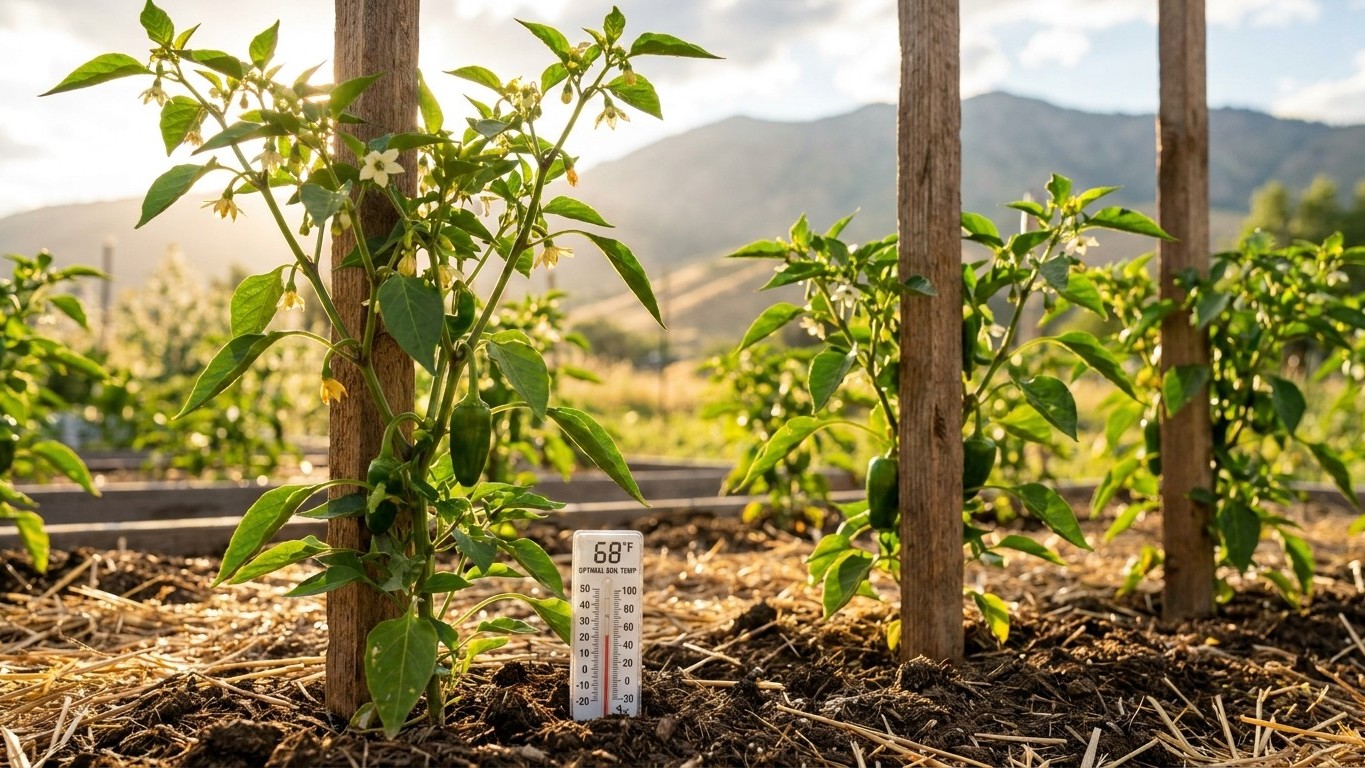
- Add the soil-temperature check. Utah State University Extension is specific that peppers should go into the ground once soil reaches 60°F, and only after frost risk has passed. Air temperature can feel warm well before soil catches up, especially after a cool, wet stretch, so a simple soil thermometer pushed a few inches down beats guessing from the calendar.
- Count backward 8 to 10 weeks for indoor seed starting. If you’re aiming for a transplant date in early March, on the earlier side of that frost window, count back 8 to 10 weeks and you land in late December to early January as the point to start seed indoors under lights. If you’re playing it safer and transplanting closer to March 7, that indoor start slides to early or mid-January.
- Build in a buffer for a slow spring. Because three weeks of frost-date variation is baked into the record, a seedling that’s ready a week or two before its transplant date is far less costly than one that’s still too small when soil hits 60°F and the calendar says go.
Growers further inland or in a low-lying frost pocket should shift this whole sequence later; growers in a genuinely warm microclimate near the coast might shave a few days off. The point of doing the math this way, rather than copying a fixed date off a seed packet, is that it self-corrects for wherever you actually garden within the region.
What goes wrong here
- Blossom drop during a summer heat spell. Once days start stacking up in the 90°F-plus range, count on flowers falling instead of setting. There’s no product fix for this; the remedy is scheduling, not spraying. Get the bulk of flowering done before peak heat arrives, provide light afternoon shade during the worst stretches, and accept that midsummer will be a slow patch for fruit set on most varieties, with production picking back up as days shorten and heat load eases.
- Blossom drop during an unexpected cool night. Because this site doesn’t track summer night minimums, this failure can catch growers off guard. A pepper plant flowering through a run of nights that dip toward or below 55°F will drop blossoms the same as it would in a heat spell, just earlier or later in the season. Watch your own nighttime lows during flowering rather than assuming the region’s reputation for heat rules this out. If a cool snap is forecast, a lightweight row cover overnight can hold enough warmth to protect open blossoms.
- Sunscald on exposed fruit. Strong Florida sun on fruit that’s lost its leaf cover, from pruning, wind damage, or disease, leaves pale, papery patches that soften and rot. The fix is keeping foliage intact through the fruiting period rather than pruning peppers hard the way some gardeners do with tomatoes, and it’s worth checking plants after any storm that strips leaves.
- Blossom-end rot on developing fruit. This shows up as a dark, sunken spot on the fruit’s bottom end and traces back to inconsistent watering interrupting calcium uptake, not to a soil calcium shortage most of the time. Even, regular watering through fruit development, especially during the hot stretch when soil dries fast, does more to prevent it than any soil amendment.
Common questions
Do all pepper varieties struggle equally with north Florida’s heat?
The record used for this page doesn’t break heat tolerance down variety by variety. Utah State University Extension names several pepper types in its general guidance but doesn’t attach a heat rating, a days-to-maturity figure, or a size to any of them, so any specific variety-by-variety heat ranking you see elsewhere isn’t sourced to that guidance. What’s verified is the general mechanism: fruit set fails above 90°F and below 55°F regardless of variety, so timing the flowering window matters more than the label on the seed packet.
Is the February to March frost window the same across all of Florida?
No, and this matters. The February 16 to March 7 window comes from a station in the Jacksonville area, representing north Florida specifically. Central and south Florida run effectively frost-free, and the growing calendar there flips: the main pepper season runs through the cooler months, and summer becomes the hard stretch to manage rather than the reward at the end of a spring planting.
How many days above 90°F should I plan around?
Jacksonville’s 1991-2020 average is 73.2 days a year at or above 90°F. That’s a long-term average, so some years will run hotter and some cooler, but it’s a reasonable planning figure for budgeting how much of the growing season will fall under heat stress for flowering peppers.
What if my nights stay warm well into what should be the cool season?
That’s exactly the kind of local variation this page can’t predict, because summer night minimum data isn’t tracked here by territory. A warm night stretch during flowering carries the same heat-side fruit-set risk as a run of 90°F days, so tracking your own overnight lows during bloom is the only reliable way to catch it before it costs you a fruit set.