
Utah’s growing season runs hot enough to stall pepper fruit set on the worst days and short enough that timing your transplant date matters more than which variety you pick. The state averages 52.1 days a year at or above 90 F, concentrated in the exact weeks peppers need to be flowering. Get the start date right and watch your own nighttime lows, and most varieties sold for home gardens will ripen before fall.
The short answer

Salt Lake City’s reference station logs 52.1 days a year at or above 90 F, a figure drawn from the NOAA NCEI 1991-2020 Climate Normals. That’s not a handful of scorching afternoons in late July. It’s a stretch that typically runs from mid-June through August, overlapping almost exactly with the window when a spring-transplanted pepper plant is setting its first flush of fruit. Pepper flowers abort when daytime highs climb past 90 F, and Utah’s valleys hit that mark often enough that a gardener who transplants late, pushing flowering into the hottest stretch of summer, can watch blossoms drop for weeks with nothing to show for it.
The fix isn’t a different variety. It’s timing the plant so its main flowering push lands before the 90 F days stack up, or accepting that fruit set will pause mid-summer and resume once temperatures ease in early fall. Gardeners who transplant on schedule (below) generally get their first flowers in before the heaviest heat arrives, then ride out a slow patch in July and August before a second flush sets as nights cool.
The other failure point sits at the opposite end of the thermometer, and it’s just as unforgiving. Pepper flowers also drop when nighttime temperatures fall below 55 F, whether that happens in a cool snap right after transplant or in the first chilly nights of September. This matters because Utah’s valley and mountain locations vary enormously in how cold their summer nights run, and this site does not carry summer night minimum data for any Utah territory. There’s no shortcut here: check your own overnight lows through a home thermometer or a nearby weather station log, especially in the first few weeks after transplant and again as fall approaches. A location that looks warm by day can still drop into the 40s at night, and that alone can suppress fruit set even when the 90 F days never show up.
When to start seed here
Peppers need 8 to 10 weeks indoors before they’re ready to go in the ground, according to Utah State University Extension, and they can’t go outside until two conditions are both met: the frost risk has passed and the soil has warmed to 60 F. Here’s how to work backward from those two anchors to a seed-starting date for your own county.
- Find your local frost window. NOAA’s 1991-2020 Climate Normals put the last spring freeze at the Salt Lake City reference station somewhere between April 12 and April 29, based on the 30 to 70 percent freeze-probability band. That’s a valley reading. Utah’s higher elevations run colder and later, southern Utah runs milder and earlier, so treat this range as a starting point to check against your own local frost records, not a statewide rule.
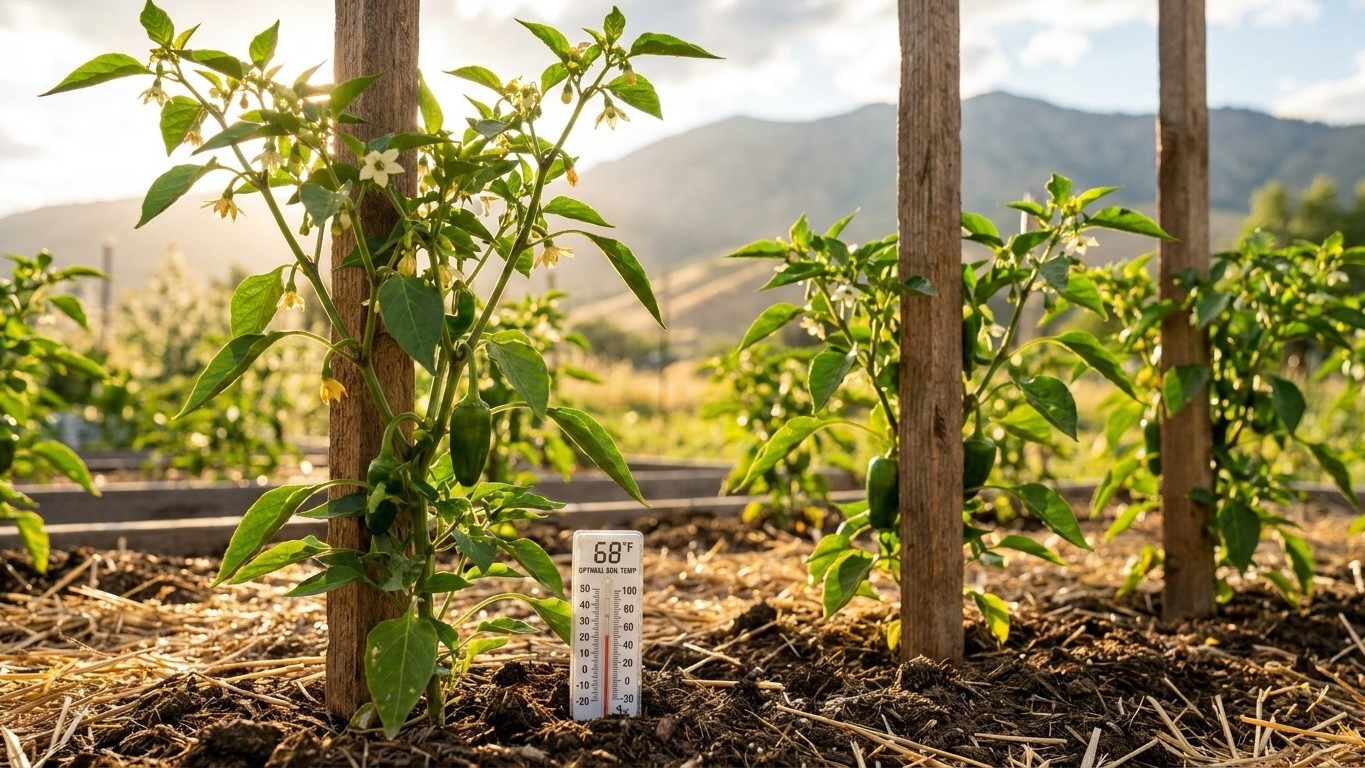
- Add the soil-temperature check. Air temperature clearing frost risk doesn’t mean the soil is ready. Pepper roots stall in cold soil even when the air feels warm enough, so wait until a soil thermometer pushed a few inches into the bed reads a steady 60 F before transplanting, even if that pushes your date a week or two past the last frost.
- Count back 8 to 10 weeks for seed starting. If your soil is hitting 60 F in early May, an 8-week head start means starting seed indoors around early March; a 10-week head start moves that to mid-February. Split the difference if you’re unsure which end of the range your variety needs, and lean toward 10 weeks if you’re starting seed for the first time, since pepper germination is slower and less predictable than most vegetable seed.
- Build in a buffer for a slow germination run. Pepper seed can take two to three weeks just to sprout under cool indoor conditions, longer than most gardeners expect. Starting a few days earlier than the strict 8-to-10-week math costs nothing and protects against a transplant that’s too small on the day the soil finally warms up.
The arithmetic is simple once you have your two local numbers: your last-frost window and the date your soil typically reaches 60 F. Everything else is counting backward from there.
What goes wrong here
- Blossom drop from a hot spell. Once daytime highs push past 90 F, an event Utah sees an average of 52.1 days a year, flowers can abort before setting fruit. There’s no rescue for a heat wave already underway, but timing transplant early enough that the first heavy flush of bloom lands before the hottest weeks reduces how much fruit you lose to it. Shade cloth over the row during the worst afternoons can also buy a plant a few extra usable flowers.
- Blossom drop from a cool night. The same failure shows up at the other end of the scale: nights below 55 F stop fruit set just as effectively as heat does. Because this varies block by block across Utah’s elevation range, track your own overnight lows rather than assuming a valley location stays warm after dark. A frost cloth or row cover thrown over plants on unexpectedly cool nights in late spring or early fall can protect a flush of blooms that would otherwise drop.
- Sunscald on exposed fruit. Utah’s summer sun is intense enough, given how many days run at or above 90 F, that fruit left uncovered by foliage can develop pale, papery patches on the side facing the sun. Keeping plants well-watered so leaf cover stays full, and avoiding over-aggressive pruning during the hottest stretch, keeps fruit shaded and reduces scald.
- Blossom-end rot from uneven watering. Irregular soil moisture, common in a state where irrigation depends entirely on the gardener rather than reliable summer rain, interferes with calcium uptake and shows up as a dark, sunken patch on the fruit’s blossom end. Consistent, deep watering on a set schedule, rather than sporadic soaking, is the standard fix, along with mulch to buffer soil moisture swings between waterings.
Common questions
How many days of 90 F heat does Utah typically see in a growing season?
The Salt Lake City reference station averages 52.1 days a year at or above 90 F, based on NOAA NCEI’s 1991-2020 Climate Normals. That’s the figure to weigh against your transplant date, since those hot days are the ones most likely to stall flowering.
Does this site say how cold Utah nights get in summer?
No. This site tracks days above 90 F for Utah but does not carry summer night minimum temperatures for any Utah territory. Because pepper fruit set fails below 55 F at night, check your own local overnight lows rather than guessing from elevation or region.
When is the last frost date for Utah gardens?
At the Salt Lake City reference station, NOAA’s 1991-2020 Climate Normals put the last spring freeze between April 12 and April 29. Salt Lake sits in a mild valley; higher parts of Utah run colder and later, and southern Utah tends to run warmer and earlier.
How far ahead should I start pepper seed indoors?
Utah State University Extension recommends starting seed 8 to 10 weeks before transplanting, with transplant timing set by two conditions: frost risk has passed and the soil has reached 60 F. Count backward from your local dates for those two markers to land on a seed-starting date.