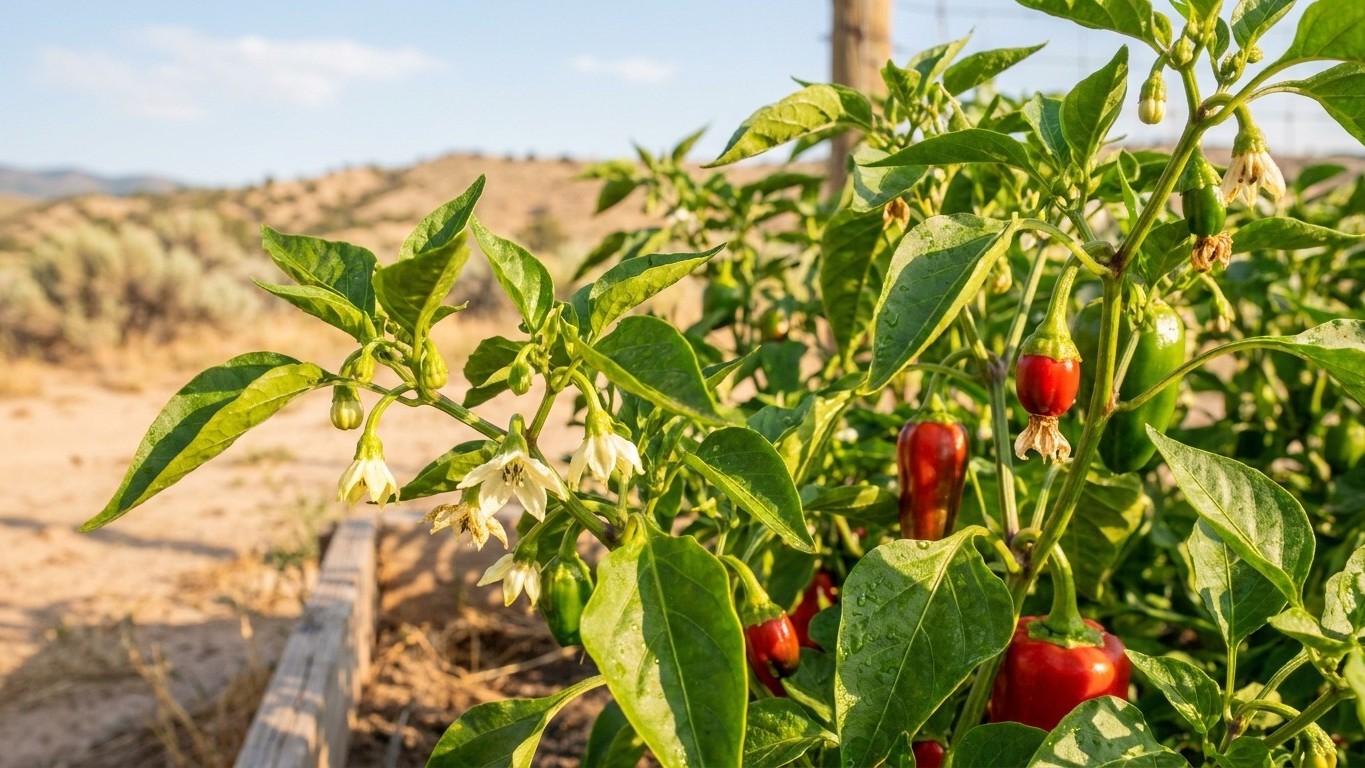

Peppers need warmth to set fruit, but Utah delivers both extremes in the same growing season. The Salt Lake City reference station logs 52.1 days a year at or above 90 F, hot enough to shut fruit set down for stretches of mid-summer. Cool nights early and late in the season can do the same. The fix is timing: start seed 8 to 10 weeks before transplanting into 60 F soil after the last frost, then watch your own nights once the heat arrives.
The short answer

Fifty-two days. That’s how many days a year Salt Lake City’s reference station spends at or above 90 F, based on NOAA’s 1991-2020 Climate Normals. Fifty-two point one, to be exact, and that number matters more to a pepper plant than almost anything else in the garden. Peppers stop setting fruit once daytime highs push past 90 F for any real stretch. The flowers open, the pollen struggles, and the plant aborts the bloom rather than commit resources to fruit it can’t finish in that heat. Fifty-two days a year is a lot of chances for that to happen, clustered mostly in July and August when Utah’s high-desert sun is working hardest.
What that means in practice: a pepper plant that looked loaded with blossoms in June can go quiet for weeks once the mercury climbs, then pick back up once a cooler stretch rolls through. This isn’t a disease or a nutrient problem. It’s the plant’s own limit. Utah State University Extension’s guidance on peppers puts it plainly: fruit set fails at both ends of the thermometer, not just the hot one, a point explored further in Why Peppers Fail to Set Fruit in Utah. Choosing among the Pepper Varieties That Ripen in a Utah Season can help offset some of that lost fruit-set window.
The other end is nights under 55 F. Cold nights slow pollen viability and can cause the same blossom drop as scorching afternoons, just for the opposite reason. This is where the picture gets more complicated for Utah gardeners, because this site tracks daytime heat, the days-above-90 count, statewide, but it doesn’t carry summer night-low averages county by county. Utah’s terrain swings widely: valley floors near Salt Lake City tend to hold heat overnight, while benches and higher elevations lose it fast once the sun drops, even in the middle of July.
That means there’s no shortcut here. You can’t guess your overnight lows from your latitude, and you can’t borrow the coldest-month average and stretch it into a summer estimate. Those figures don’t translate season to season. If you want to know whether your peppers are losing fruit set to cool nights rather than hot days, you have to watch your own thermometer through June, July and August, ideally with a min-max recorder near the bed. If blossoms are dropping on a night when the daytime high wasn’t unusual, cool overnight temperatures are the more likely cause.
When to start seed here
The transplant date drives the whole calendar backward. Peppers go into the ground only once two conditions are both met: frost risk has passed and the soil has warmed to 60 F. Working backward from there tells you when to start seed indoors.
- Find your local last-frost date. For the Salt Lake City valley, NOAA’s 1991-2020 Climate Normals put the last 32 F freeze in the 30 to 70 percent probability band between April 12 and April 29, based on station USW00024127. That’s a mild-valley reading. Most of Utah sits higher and colder than Salt Lake City, so mountain valleys and benches should expect frost risk lingering later into May. Southern Utah, by contrast, tends to clear frost earlier than this window.
- Wait for 60 F soil, not just a frost-free calendar date. Soil temperature and air temperature don’t warm together in spring, especially where the ground stays shaded or wet longer. A thermometer pushed a few inches into the bed is the only reliable check. Transplanting into cold soil, even on a warm-feeling day, stalls root growth and sets the plant back weeks.
- Count backward 8 to 10 weeks from that transplant date. Utah State University Extension calls for 8 to 10 weeks of indoor growing time before a pepper plant goes outside. If soil in your area typically hits 60 F in early May, an 8-week head start means seed goes into trays around the second week of March; a 10-week head start pushes that to late February.
- Adjust the whole calendar for your elevation and microclimate. A gardener at lower elevation in a valley moves on a different schedule than one a few miles away on a higher bench. If your local last frost historically lands two or three weeks later than the Salt Lake City window, add that same delay to both the transplant date and the seed-starting date. The 8-to-10-week gap between the two stays fixed. It’s the calendar around it that shifts.
The point of doing this arithmetic yourself, rather than copying a single date off a seed packet, is that Utah’s terrain makes one statewide transplant date close to meaningless. A date that works in the Salt Lake valley can be three weeks too early on a bench thirty miles away.
What goes wrong here
- Blossom drop in a hot spell. Once daytime highs climb past 90 F, and Utah logs that kind of heat around 52 days a year at the Salt Lake City reference station, open flowers abort instead of setting fruit. The remedy is shade cloth over the row during the hottest afternoon hours, plus even soil moisture so the plant isn’t fighting drought stress on top of heat stress. Skip a heavy fertilizer application during a heat spike too; a flush of new growth competes with fruit set for the same resources.
- Blossom drop on a cool night. The same dropped-flower symptom shows up when nights fall below 55 F, usually early in the season or during a late cold snap. Since this site doesn’t track summer night lows county by county, the only way to catch this is a thermometer in the garden. If flowers are dropping and the daytime highs weren’t unusual, check your nights before assuming it’s a heat problem. Row cover pulled over the bed in the evening can buy a few degrees on a marginal night.
- Sunscald on the fruit. Utah’s elevation and thin, dry air mean stronger direct sun than lower, more humid states get at the same temperature. Fruit exposed on the south and west side of the plant can develop a soft, sunken, papery patch. Leaving more foliage on the plant, rather than pruning it open for airflow, gives fruit natural shade; light shade cloth over exposed rows during peak summer helps as well.
- Blossom-end rot. This shows up as a dark, leathery spot on the bottom of the fruit, and it’s a calcium-delivery problem more often than a true calcium shortage. Uneven watering, letting soil dry out hard and then flooding it, is the most common cause in a garden where irrigation is the only water source through a dry summer. A consistent watering schedule solves most cases without any soil amendment at all.
Checking this against your own county
Every number in this article comes from a single reference station in the Salt Lake City valley, and Utah’s terrain makes that station a poor stand-in for the whole state. A garden at higher elevation, in a canyon, or on a north-facing bench can run weeks behind the frost dates and heat counts used here. Before committing to a seed-starting date, check it against local numbers.
Utah State University Extension (extension.usu.edu) publishes county-level growing guidance, including localized frost information and planting calendars, and its horticulture staff can answer specific questions tied to a given zip code or elevation. That’s a better source for your particular garden than any statewide average, including the ones in this article. Treat the days-above-90 count and the frost window here as a baseline for calibrating your own observations, not as a substitute for a thermometer in your own soil.
Common questions
Why do pepper plants stop setting fruit in July but start again in September?
Because daytime highs climb into the 90s during Utah’s core summer, and pepper flowers abort at that heat rather than setting fruit. Utah State University Extension notes that fruit set fails at both extremes of the temperature range. Once daytime highs ease back in early fall, flowering can pick back up, provided nights haven’t dropped below 55 F yet either.
Should I start pepper seed earlier if I live above the Salt Lake valley?
Yes. If your local last-frost date runs later than the Salt Lake City window of April 12 to April 29, push your seed-starting date back by the same number of weeks, keeping the 8-to-10-week gap before transplant intact.
Does shade cloth actually help peppers set fruit in Utah heat?
Shade cloth doesn’t change the plant’s biology, but lowering leaf and flower temperature during the hottest hours can keep some blossoms from aborting. It works alongside consistent watering, not as a replacement for it.
Is blossom-end rot a sign I need to add calcium to the soil?
Not usually. Most home garden cases trace back to inconsistent watering rather than a true calcium shortage. Fixing the irrigation schedule solves the problem more often than adding a soil amendment does.