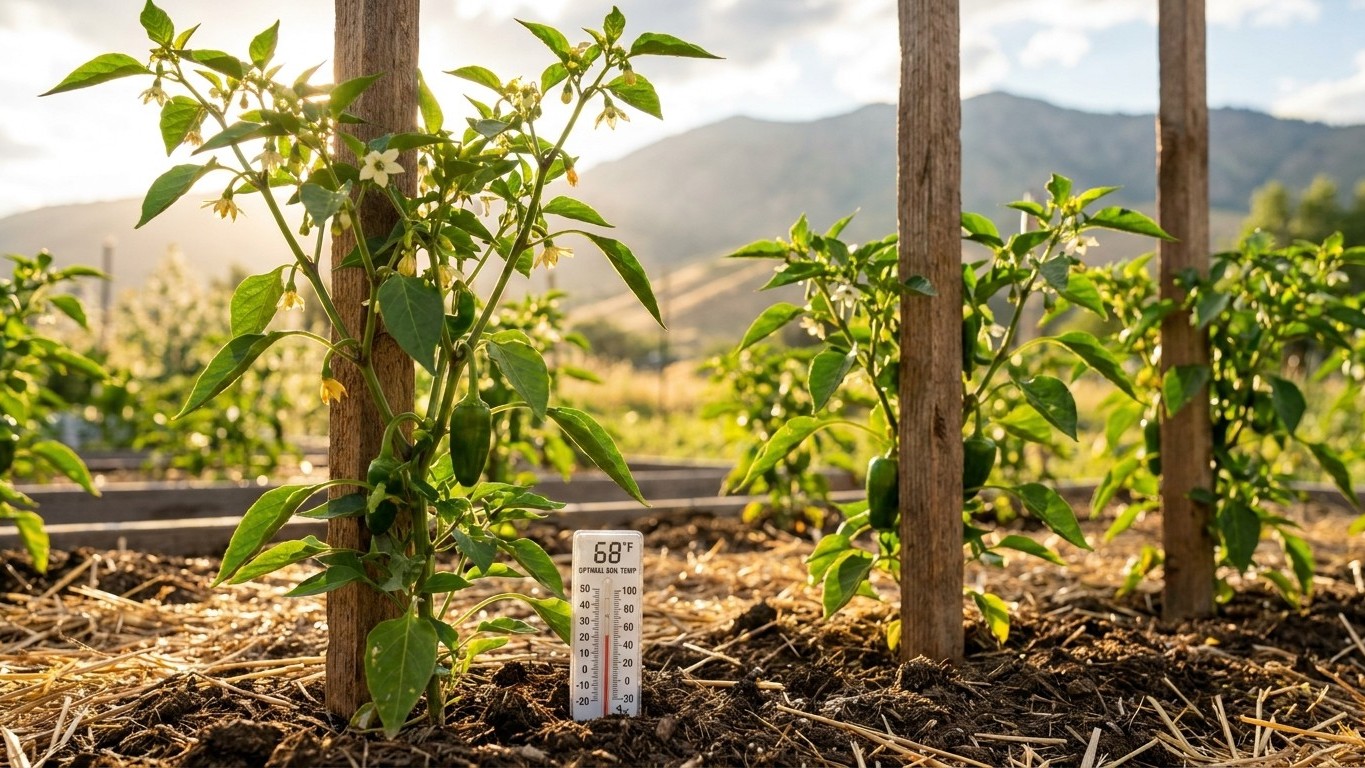

Nova Scotia’s growing season rarely delivers punishing heat, but it also rarely guarantees warm nights early or late in the season. That combination shapes which pepper varieties actually ripen here: the answer isn’t about picking a “hot climate” plant, but about matching the crop’s need for 8 to 10 weeks indoors before transplant, a soil temperature of 60 F, and a season long enough for fruit set to happen before cold nights or a late frost cut things short.
The short answer

Start with the number that matters most for pepper fruit set: at the Halifax reference station, the average is 0.0 days a year at or above 90 F, according to the Canadian Climate Normals 1981-2010. For a pepper grower, that figure means one entire side of the fruit-set failure equation barely applies here. Utah State University Extension notes that pepper fruit set fails at both ends: nights below 55 F, or days above 90 F. Given that Halifax averages zero days that hot, the heat-driven blossom drop that punishes pepper growers in warmer states almost never shows up as the reason a Nova Scotia crop fails.
That’s the encouraging half. The other half of the same equation is nights under 55 F, and here the answer gets harder to give with any precision. This site tracks the summer heat load for each territory, meaning the count of days at 90 F or higher, but it does not carry summer night minima. Nova Scotia’s coastline, its inland valleys and its higher ground don’t share one nighttime temperature profile, and there’s no shortcut from latitude, or from how cold the winter gets, to how cool a given yard runs on a July or August night. A property near the Bay of Fundy can run several degrees cooler after dark than one twenty miles inland, and that’s exactly the kind of gap a province-wide average will never show.
If a grower’s summer nights are dropping into the low 50s or lower, especially in June and again in September, that’s the failure mode worth watching here, not sunburned fruit or blossom drop from heat. Practically, this means the deciding factor for peppers grown in Nova Scotia isn’t which variety can “take the heat.” None grown here really need to. It’s which variety can set fruit within the number of reliably warm nights actually available between transplant and the first cool snap of fall. That’s a question every grower answers with a thermometer left outside overnight through the shoulder months, not with a province-wide figure.
When to start seed here
The arithmetic behind a pepper-starting schedule in Nova Scotia works backward from two fixed points, then adjusts for what’s happening in a specific yard. Here’s how to walk through it:
- Set the frost baseline. Environment and Climate Change Canada’s Canadian Climate Normals 1981-2010 put the average last spring frost at Halifax Stanfield Int’l A at May 7. That’s a mean date, not a guarantee: frost falls later than May 7 in roughly one year out of two. Treat it as the midpoint of a window, never as a safe transplant date.
- Wait for soil, not just for the calendar. Utah State University Extension is clear that peppers go in after frost and once soil reaches 60 F, not simply once the frost date has passed. Cold, wet spring soil in much of Nova Scotia can lag well behind the air temperature, so the actual transplant date is often one to three weeks after the frost-risk period eases, depending on how much sun a bed gets and whether it’s mulched or bare.
- Count back 8 to 10 weeks for indoor seed starting. Working from a transplant target built on the two points above, and Utah State’s 8-to-10-week window, indoor seed starting typically falls in the back half of winter into very early spring. Counting from an expected transplant date in mid to late May puts seed starting roughly at the start of March at the earliest, and no later than mid-March for the shorter end of the window.
- Shift the whole schedule for local geography. The May 7 figure comes from one coastal station. Inland valleys, higher ground and districts north of Halifax often run frost-free later, which pushes both the transplant date and the indoor start date back by however many extra weeks that county typically holds cold air. There’s no single correction factor here: it comes from a grower’s own frost history, not from a province-wide table.
What goes wrong here
- Blossom drop during a rare hot spell. Even where 90 F days are close to nonexistent on average, a short heat spike can still occur and stall fruit set for a few days. Shade cloth over the row during the hottest afternoons, and steady, deep watering rather than surface sprinkling, keeps plants from compounding heat stress with drought stress.
- Blossom drop from a cool night. This is the more likely failure point in this climate. Utah State University Extension names nights below 55 F as the cool-end trigger for fruit-set failure. Since this site doesn’t carry night minima for Nova Scotia specifically, the fix starts with tracking a grower’s own overnight lows in late spring and early fall, and holding off on transplanting, or covering plants with row cover on cold nights, until those minima are reliably above that threshold.
- Sunscald on exposed fruit. Where a pepper plant has lost leaf cover, from wind damage, storm loss, or over-eager pruning, fruit exposed directly to strong sun can develop pale, papery patches. Leaving foliage largely intact and avoiding heavy pruning through the fruiting stretch keeps developing peppers shaded by their own canopy.
- Blossom-end rot on the fruit’s bottom. This shows up as a sunken, leathery patch and traces back to inconsistent water delivery interrupting calcium uptake, not to a soil calcium shortage in most gardens. Watering on a steady schedule, and mulching to keep soil moisture even between rain events, addresses the root cause more reliably than adding calcium products.
Common questions
Do Nova Scotia summers get too hot for peppers?
Essentially no. The Halifax reference station averages 0.0 days a year at or above 90 F, so the heat-driven half of the pepper fruit-set failure equation almost never applies in this province.
What’s the safest date to transplant peppers in Nova Scotia?
There isn’t a single safe date published here. The average last spring frost at Halifax Stanfield Int’l A is May 7, but that’s a mean date, meaning frost arrives later about half the time. Transplant only after both frost risk has passed for a specific site and soil has warmed to 60 F.
Can pepper seed be started too early indoors?
Yes. Utah State University Extension puts the indoor window at 8 to 10 weeks before transplant. Starting well ahead of that window tends to produce leggy, stressed seedlings that struggle after transplant rather than getting a head start.
Why do peppers stop setting fruit even when it isn’t especially hot?
Cool nights are the likely cause in this climate. Fruit set fails when nights drop below 55 F, and since this site doesn’t track summer night minima for Nova Scotia, the only reliable check is a thermometer left outside overnight on a specific property, particularly in early June and again in September.