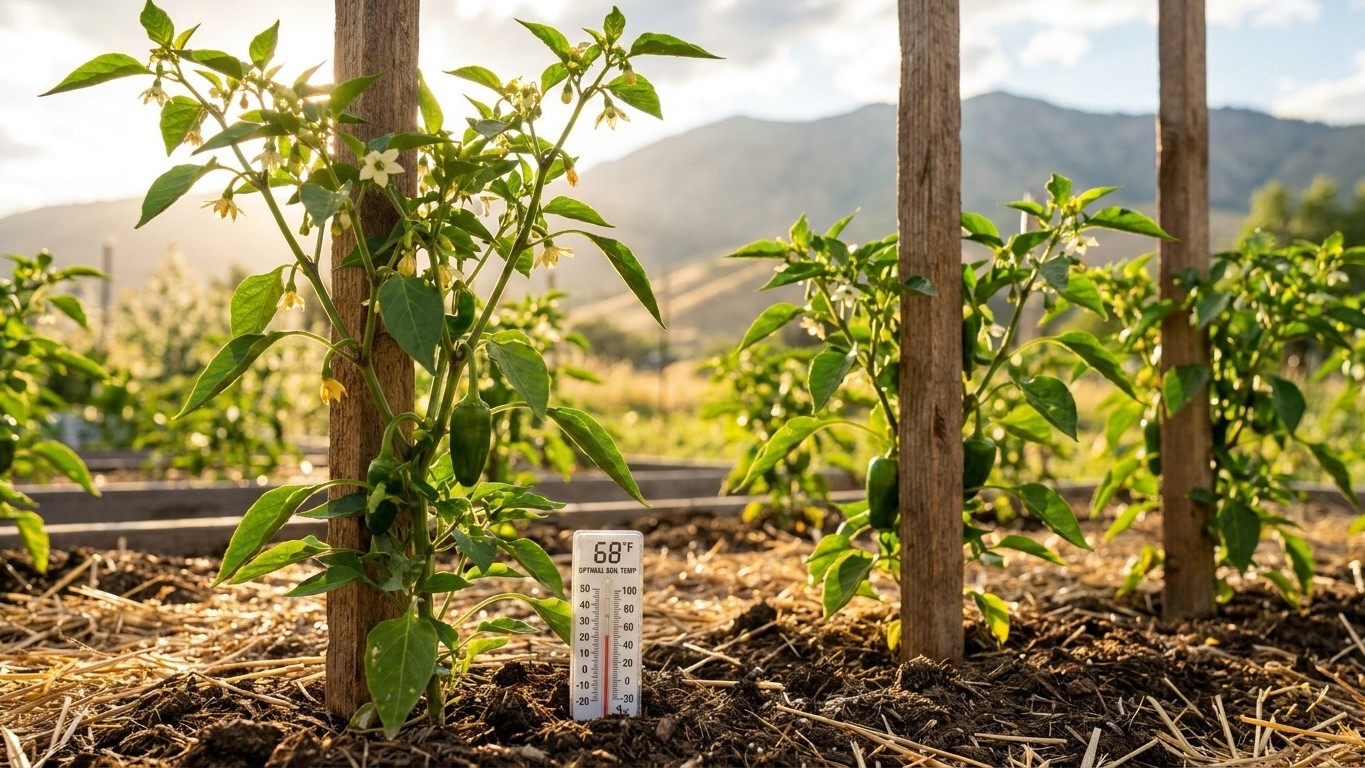

In Rhode Island, most gardeners can expect roughly nine days a year hot enough to stall pepper fruit set, and cool nights that same site can’t measure for you. The workaround is timing: start seed early enough indoors, transplant only after both frost and soil temperature clear their marks, and watch your own thermometer through the hottest and coolest stretches of summer.
The short answer

Rhode Island averages 9.4 days a year at or above 90 F, based on NOAA NCEI Climate Normals from 1991-2020 measured at the Providence reference station. That’s not a heat wave every week of summer. It’s a handful of scattered afternoons, usually clustered in July and into early August, when the air simply gets too hot for a pepper flower to hold. Above 90 F, pollen turns sterile or the flower drops before it ever sets fruit. Nine days doesn’t sound like much until one of them lands during the exact week your plants are loaded with blossoms and nothing else.
That’s the hot end. The cool end matters just as much, and it’s the one number this site can’t hand you. Peppers stop setting fruit when nights drop below 55 F, according to Utah State University Extension. Rhode Island’s coastal areas, its river valleys, and its inland hill towns don’t cool off the same way on a given August night. A garden two miles from Narragansett Bay can sit ten degrees warmer after sunset than one tucked into a low-lying inland pocket, and neither of those readings comes from a latitude chart or a monthly average. This site carries the days-above-90 count because that’s a measured, published normal. It does not carry summer night minima, and no responsible source should ask you to guess them from how far north you live or from what January looked like last winter.
The practical move is a cheap min-max thermometer set outside near the pepper bed, checked a few times a week from late June through August. If you’re seeing nights routinely below 55 F into June, or a stretch of afternoons pushing past 90 F in midsummer, that’s the window where blossoms drop and fruit set pauses. It usually starts again once conditions moderate. Rhode Island’s short run of 90-degree days means the hot-end problem is real but limited. The cool-end risk depends entirely on your specific yard, and only your own reading of it will tell you when to stop worrying and when to start covering plants or picking earlier varieties for next season.
When to start seed here
Working backward from transplant date is the only arithmetic that actually holds up across a state as microclimate-variable as Rhode Island. Here’s how the count works, step by step, so you can rerun it for your own county rather than trust a single statewide date.
- Find your local last spring frost window. At the Providence reference airport station, NOAA’s 1991-2020 climate normals put the 30 to 70 percent probability band for a 32 F freeze between April 7 and April 17. That’s the reference-city figure only. Suburban yards and rural gardens away from the coast typically see their last frost run one to two weeks later than the airport reading, and gardens at higher elevation inland can lag further still. Check your own county extension data or a few years of your own frost log before locking in a date.
- Add the soil temperature requirement on top of frost. Frost clearing isn’t the trigger by itself. Peppers need soil at 60 F before transplant, and soil warms slower than air, especially in a spring with a wet start. In practice this often pushes actual transplant timing later than the frost-free date alone would suggest. A simple soil thermometer pushed four inches down, checked over a few mornings, tells you more than any calendar guess.
- Set your transplant date as the later of those two conditions. Not frost-free OR warm soil. Both. If your frost-free date lands in mid-April but soil hasn’t hit 60 F yet, wait for the soil. If soil is warm early but a late frost risk lingers, wait for that to pass instead.
- Count back 8 to 10 weeks from that transplant date to find your indoor seed-starting date. Utah State University Extension recommends starting pepper seed indoors 8 to 10 weeks before transplant. If your working transplant date sits in late May, for example, that puts seed-starting somewhere in the second half of March, with the exact week depending on whether you’re planning for the 8-week or the 10-week end of that range.
- Build in a buffer for a slow germination year. Pepper seed can be slower and less even to sprout than tomato seed, especially at cooler room temperatures. Starting on the earlier side of your 8-to-10-week window gives you room to lose a week to uneven germination without pushing transplant date back.
None of this arithmetic needs a single fixed date to work. It needs your own frost observation, your own soil thermometer, and a calendar. Redo the count each year rather than copying the same date forward, since a warm March or a cold April shifts everything downstream of it.
What goes wrong here
Rhode Island’s pepper failures tend to cluster around three predictable patterns, and each one has a fix that doesn’t require replacing the plant.
- Blossom drop during a hot spell. When afternoon highs push past 90 F, which happens on average 9.4 days a year here, flowers can abort before setting fruit. Utah State University Extension notes that fruit set fails at both temperature extremes, not just the hot one. The remedy during a heat run is light afternoon shade cloth over the bed and consistent deep watering in the morning, so plants aren’t fighting heat stress and drought stress at the same time. Fruit set typically resumes once temperatures moderate, since the failure is a temporary block rather than permanent damage to the plant.
- Blossom drop from a cool night. The other end of the same problem: nights below 55 F stall fruit set just as effectively as extreme heat does. This site doesn’t carry night-minimum data for Rhode Island, so the fix starts with your own outdoor thermometer. If you’re logging repeated nights under 55 F into late spring or a cool snap in late summer, a floating row cover thrown over plants in the evening can hold a few extra degrees of warmth. Watch your own readings rather than assuming a date on the calendar is safely past the cool-night risk.
- Sunscald on exposed fruit. Rhode Island summer sun is strong enough that peppers with thin leaf cover, especially after pruning or storm damage, can develop pale, papery patches on the side of the fruit facing direct afternoon sun. This isn’t a disease. It’s sun damage to the fruit skin. Keeping foliage intact rather than heavily pruning plants back, and letting the plant’s natural leaf canopy shade its own fruit, is the simplest prevention.
- Blossom-end rot on the fruit’s bottom tip. A dark, sunken patch at the blossom end of the pepper signals a calcium delivery problem, usually triggered by inconsistent watering rather than a true calcium shortage in the soil. Wide swings between bone-dry and soaked soil interrupt the plant’s ability to move calcium to developing fruit. Even, regular watering, along with a layer of mulch to buffer soil moisture swings during a dry stretch, addresses most cases without needing a soil amendment.
Common questions
How many days a year are actually too hot for pepper fruit set in Rhode Island?
NOAA’s 1991-2020 climate normals put Rhode Island at 9.4 days a year reaching 90 F or above, measured at the Providence reference station. Days at or above 90 F are the threshold where fruit set can fail on the hot end, so that’s roughly the scale of the hot-weather risk in a typical year here, concentrated mostly in July and early August.
Does this site tell me what nighttime lows to expect in my yard?
No. This site carries days-above-90 counts by territory but does not carry summer night minimum temperatures. Since fruit set also fails below 55 F at night, and that risk varies sharply by yard, coastal exposure, and elevation within Rhode Island, you’ll need your own outdoor thermometer readings rather than a latitude-based guess.
When should I actually transplant peppers outside in Rhode Island?
Transplant only after both conditions clear: your local last frost date has passed, and soil temperature has reached 60 F. At the Providence reference airport station, the last spring frost window (32 F freeze, 30 to 70 percent probability) runs April 7 to April 17, but suburban and rural gardens typically see frost clear one to two weeks later than that airport figure, and soil often warms to 60 F later still.
How far back should I count for starting pepper seed indoors?
Utah State University Extension recommends 8 to 10 weeks indoors before transplant. Once you’ve set your own transplant date, based on frost clearing and soil hitting 60 F in your specific location, count back 8 to 10 weeks from that date to find your seed-starting window.