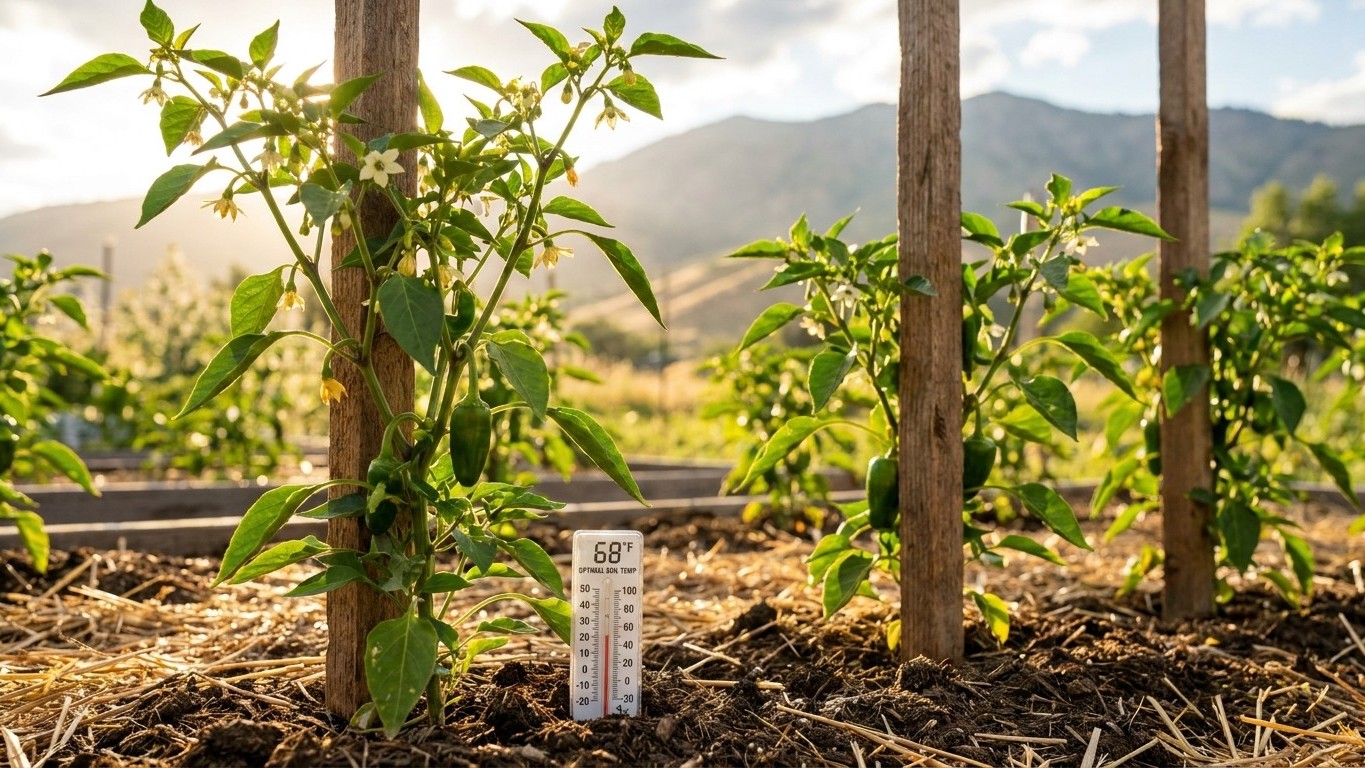

Massachusetts gardeners can ripen a full pepper crop, but only if they respect two temperature walls rather than one. Start seed indoors 8 to 10 weeks before transplant, move plants out once soil hits 60 F after the last frost, and track both the hot spells and the cool nights that stall fruit set. The state’s brief run of 90-degree days matters less than most people assume; the real risk hides in the shoulder weeks on either side of summer.
The short answer

Boston’s reference station logs an average of 10.2 days a year at or above 90 F, based on NOAA’s 1991-2020 Climate Normals. That’s a modest number compared to the Mid-Atlantic or the Deep South, and it tells you something specific: pepper plants here rarely spend enough consecutive days in extreme heat to shut down pollination for long. A short heat spike in July or August might cause a few days of blossom drop, but the crop usually recovers once temperatures ease back into the 80s.
The heat side of the equation
Ten days of 90-plus heat spread across a whole growing season is not the same as ten days in a row. In most years those hours cluster into two or three separate heat events, often in late July. That pattern favors pepper growers, because plants get recovery windows between stress periods. Flowers that abort during a heat wave get replaced by new blooms once conditions moderate, so the season rarely gets wiped out by heat alone in Massachusetts the way it might in a region with a longer, unbroken hot stretch.
The cold side nobody tracks
Fruit set fails at the other end too. Peppers stop setting fruit when nights drop below 55 F, according to Utah State University Extension. That threshold matters more in a New England summer than the heat number does, because cool nights can show up even in June and again in early September, well before frost. This site does not carry summer night-minimum data for Massachusetts, and there’s no reliable way to guess those figures from latitude or from how cold the coldest month runs. A location’s overnight lows depend on elevation, tree cover, distance from the coast, and whether cold air pools in a low spot in the yard, factors no regional average can capture. The only dependable move is to watch your own thermometer on a covered porch or in the actual bed through June and again as nights lengthen in late August, and treat any night reading near 55 F as a signal that fruit set may pause for a few days.
When to start seed here
The timeline for pepper seed in Massachusetts works backward from two fixed points: the last spring frost and the soil temperature peppers need before they can go outside. Here’s how the arithmetic runs, and how to redo it for your own address.
- Find your last frost window. NOAA’s 1991-2020 Climate Normals put the last spring freeze at the Logan reference station between April 1 and April 8. That station sits at the mildest, most waterfront spot in the state, so treat it as a floor, not a forecast. Inland valleys, higher elevations, and Berkshire County towns frost measurably later in spring and earlier in fall, sometimes by two to three weeks.
- Wait for 60 F soil, not just a frost-free calendar date. A frost-free night doesn’t mean the ground has warmed up. Pepper transplants stall or sulk in cold soil even when air temperatures look fine, so check soil temperature directly with a probe thermometer pushed a few inches into the bed rather than relying on the date alone.
- Count backward 8 to 10 weeks from your expected transplant date. If your soil typically reaches 60 F in early May, an 8-week head start puts your indoor sowing date in early March; a 10-week head start pushes it to late February. Growers in colder inland pockets, where soil warms later, should push seed-starting back correspondingly rather than sowing on the same February date as a coastal neighbor.
- Build in a buffer for a late cold snap. Because the Logan dates mark a probability band rather than a guarantee, keep transplants under cover or ready to bring indoors for a week or two after your area’s typical last-frost date, especially inland.
Redo this math with your own county’s frost data and your own soil thermometer reading each spring rather than a fixed date on a seed packet. A gardener in Worcester County working from a mid-April soil warm-up will land on a different seed-starting week than someone in a warmer coastal pocket near Boston, even though both are technically the same state.
What goes wrong here
Most pepper failures in a Massachusetts garden trace back to one of three predictable problems, each tied to a temperature swing rather than a disease or pest.
- Blossom drop during a hot spell. When a run of 90-degree days hits, especially with high humidity, flowers can drop before they set fruit. The plant isn’t sick, it’s just pausing reproduction under stress. The fix is patience combined with steady watering and light afternoon shade during the worst of the heat; new flowers typically resume setting fruit once temperatures ease.
- Blossom drop from a cool night. The flip side shows up when nights slide under 55 F, which can happen even in a supposedly warm month if a clear, dry air mass moves through. Row cover pulled over plants in the evening, or simply choosing a warmer microclimate near a south-facing wall, helps buffer these dips.
- Sunscald on exposed fruit. Peppers that ripen on a plant with sparse foliage, often after pruning too hard or after early leaf loss from disease, develop pale, papery patches on the side facing direct sun. Leaving more foliage intact, or using light shade cloth during the hottest afternoon hours, protects the fruit without blocking pollinators.
- Blossom-end rot. Dark, sunken patches at the fruit’s blossom end usually trace back to uneven watering rather than a soil deficiency alone; a plant that dries out and then gets soaked can’t move calcium to the fruit fast enough. Consistent, even irrigation, especially through a dry August stretch, prevents most cases.
Common questions
Can I skip starting seed indoors and direct-sow peppers in Massachusetts?
Direct-sowing rarely works here. Peppers need 8 to 10 weeks of indoor growth before they’re ready for a transplant date that itself waits on 60 F soil after the last spring frost. Sowing directly outside would push harvest dangerously late into a season that already runs on a tight margin.
Does the state’s low count of 90-degree days mean heat is never a problem for peppers?
No. Even with only 10.2 days a year averaging 90 F or higher at the Boston reference station, a single heat wave during peak flowering can still cause a temporary drop in fruit set. The low annual count just means those stressful stretches tend to be short and interrupted by cooler recovery days.
How do I know if my nights are too cool for fruit set?
There’s no published regional figure for Massachusetts summer night minimums on this site, and none should be guessed from latitude or from winter temperatures. Place a min-max thermometer near your pepper bed and check it through June and late August; readings consistently near or below 55 F signal a fruit-set pause.
Should I plant peppers earlier if I live in a warmer coastal town near Boston?
You can shift slightly earlier, since the Logan-area frost window of April 1 to April 8 reflects a milder, waterfront location. But treat that date as the earliest reasonable target rather than the norm, since even nearby suburbs can run measurably cooler and frost later into spring.