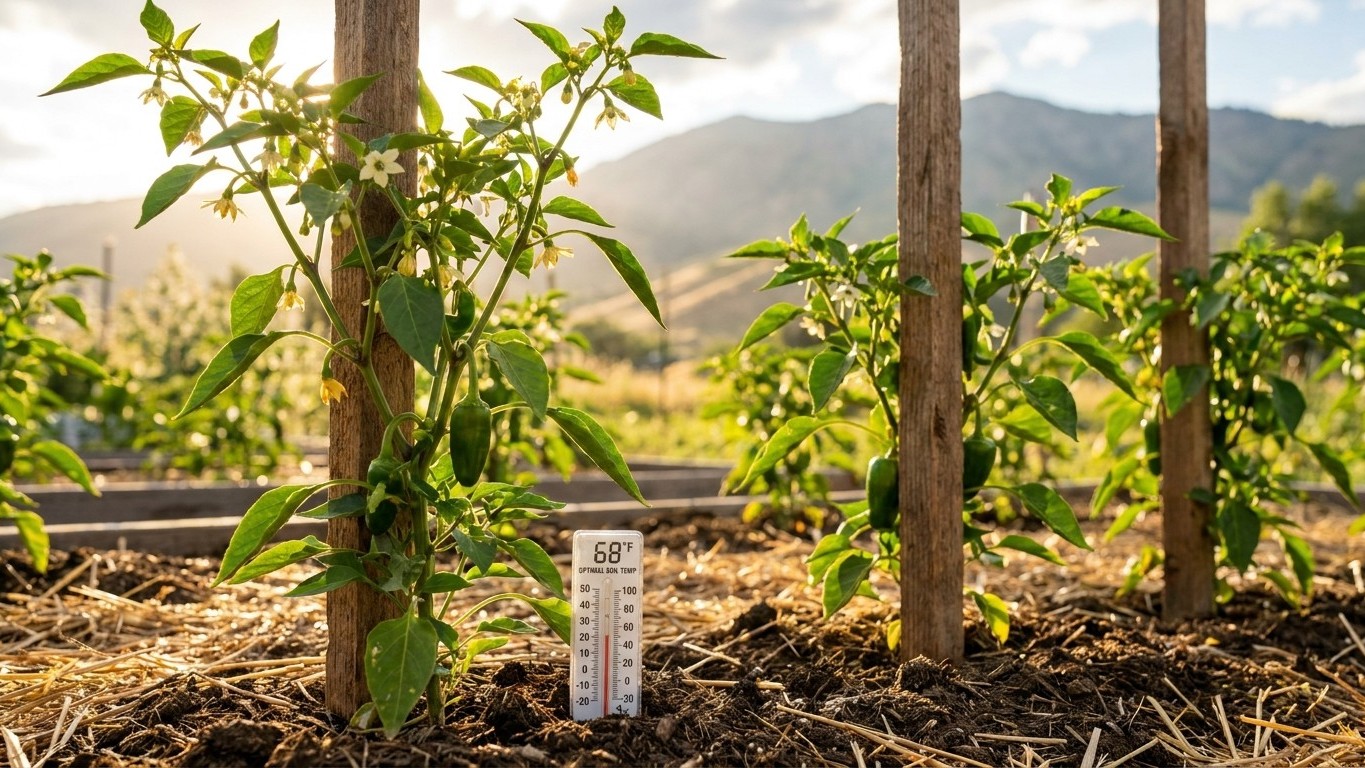

Alberta’s climate rarely pushes peppers into heat stress, but it just as often stalls them from the cold side. Success here comes down to picking quick-maturing types, starting seed early indoors, and tracking soil and night temperatures rather than the calendar alone. The province’s short, cool-leaning season rewards preparation more than variety choice.
The short answer

The reference station at Calgary averages 0.0 days a year at or above 90 F, according to Environment and Climate Change Canada’s 1981-2010 climate normals. That figure is the measure of summer heat load, the kind of stress that causes water demand spikes and blossom drop in warm-climate crops. For pepper growers, it means one half of the fruit-set problem barely exists in Alberta. Utah State University Extension notes that pepper fruit set fails once daytime temperatures climb above that 90 F line, blossoms simply fall instead of setting fruit, and Alberta’s near-zero count of such days means that failure mode is rare across a typical season here.
The other half of the equation runs the opposite direction, and it is the one Alberta gardeners actually need to watch. The same Utah State University Extension guidance is clear that pepper fruit set also fails when nights drop below 55 F. Cool nights are common in Alberta, especially early and late in the season, and in low-lying or exposed sites they can show up even at the height of summer. This site does not carry summer night minimum data for any territory, so there is no published figure here to hand you a safe number. That means the responsibility falls on the grower to watch their own nights directly, with a min-max thermometer in the actual garden bed, rather than assuming anything from the province’s latitude or from how cold the coldest month tends to run. Latitude tells you almost nothing about a specific night in July.
Put those two facts together and the shape of an Alberta pepper season becomes clear. Heat-driven blossom drop is a minor risk most years, given the 0.0 days-above-90 F average. Cold-driven blossom drop is the more realistic threat, and it is one this site cannot quantify for you because the night-minimum data simply is not tracked at that resolution here. Treat every cool snap, even a mild one relative to daytime highs, as a possible fruit-set interruption until your own thermometer readings say otherwise.
When to start seed here
Utah State University Extension recommends transplanting peppers only after two conditions are met: the danger of frost has passed, and the soil has warmed to 60 F. Working backward from those two checkpoints, and counting the recommended 8 to 10 weeks of indoor growing time, gives a usable seed-starting window for any Alberta county. Here is the arithmetic laid out step by step so it can be redone with local dates.
- Start with the mean last spring frost date. For the Calgary International Airport station, Environment and Climate Change Canada’s 1981-2010 normals put that date at May 21. This is a mean, not a guarantee: in one year out of two, frost arrives later than May 21. Treat it as the midpoint of a window, not a date to circle and trust.
- Check it against soil temperature, not just the calendar. Utah State University Extension ties transplanting to a 60 F soil reading, which in a cool spring can lag well behind the frost-free date. Whichever condition, frost safety or soil warmth, arrives later is the one that actually sets the transplant date. A probe thermometer pushed a few inches into the bed gives a real answer; guessing from air temperature does not.
- Count back 8 to 10 weeks from that transplant date. If a grower is aiming for a transplant date around the mean frost date of May 21, counting back 8 weeks lands on roughly March 26, and counting back 10 weeks lands on roughly March 12. That gives an indoor seed-starting window in mid to late March for a target transplant near the provincial mean date.
- Push the whole window later for colder districts. The Calgary station is one reference point, not a stand-in for the entire province. Northern Alberta and higher-elevation districts routinely run behind Calgary’s dates, so a grower in one of those areas should shift both the transplant target and the seed-start window later by whatever margin their own local frost history and soil readings suggest.
What goes wrong here
- Blossom drop from a hot spell. Rare in a province averaging 0.0 days above 90 F, but not impossible in a sheltered spot, against a south-facing wall, or inside an unventilated hoop house where trapped heat can spike well past outdoor readings. The remedy is airflow: prop open covered structures during a hot afternoon and avoid planting against reflective, heat-trapping surfaces.
- Blossom drop from a cool night. This is the more likely failure in Alberta, since Utah State University Extension puts the cool-end threshold at nights below 55 F, and this site does not track night minima to tell you how often that happens locally. Log your own overnight lows with a thermometer in the bed itself, and be ready to cover plants with row fabric or move containers under shelter on nights that read borderline.
- Sunscald. Strong, unfiltered prairie sun can scald exposed fruit once a plant has been pruned back or has thin foliage cover. Leaving enough leaf canopy over developing peppers, or adding light shade cloth on the hottest exposure, keeps direct sun off the fruit skin.
- Blossom-end rot. This shows up as a sunken, leathery patch on the fruit’s blossom end and traces back to uneven watering interrupting calcium uptake, not to a soil deficiency alone. Consistent soil moisture, helped by a layer of mulch, is the practical fix.
Common questions
Can I trust May 21 as my safe planting date? No. It is a mean last frost date from Environment and Climate Change Canada’s 1981-2010 normals for the Calgary International Airport station, meaning frost falls later than that in about half of all years. Use it as the middle of a planning window, and confirm with local forecasts before moving transplants outside.
Do I need to worry about heat stress on peppers in Alberta? Based on the 0.0 days-above-90 F average at the Calgary reference station, heat-driven blossom drop is a minor concern across most of the province in most years. Sheltered microclimates and unventilated covered structures are the exceptions worth watching.
How do I know if my nights are too cold for fruit set? Utah State University Extension sets the threshold at below 55 F. This site does not publish summer night minimum data for any territory, so there is no substitute for placing a thermometer in your own garden and checking it directly, rather than estimating from latitude or from winter cold.
Why does soil temperature matter as much as the frost date? Utah State University Extension recommends waiting until soil reaches 60 F before transplanting, regardless of whether the air is frost-free. Cold soil slows root growth and can stunt young pepper plants even when no frost risk remains, so the later of the two conditions, frost safety or 60 F soil, should always set the actual transplant date.