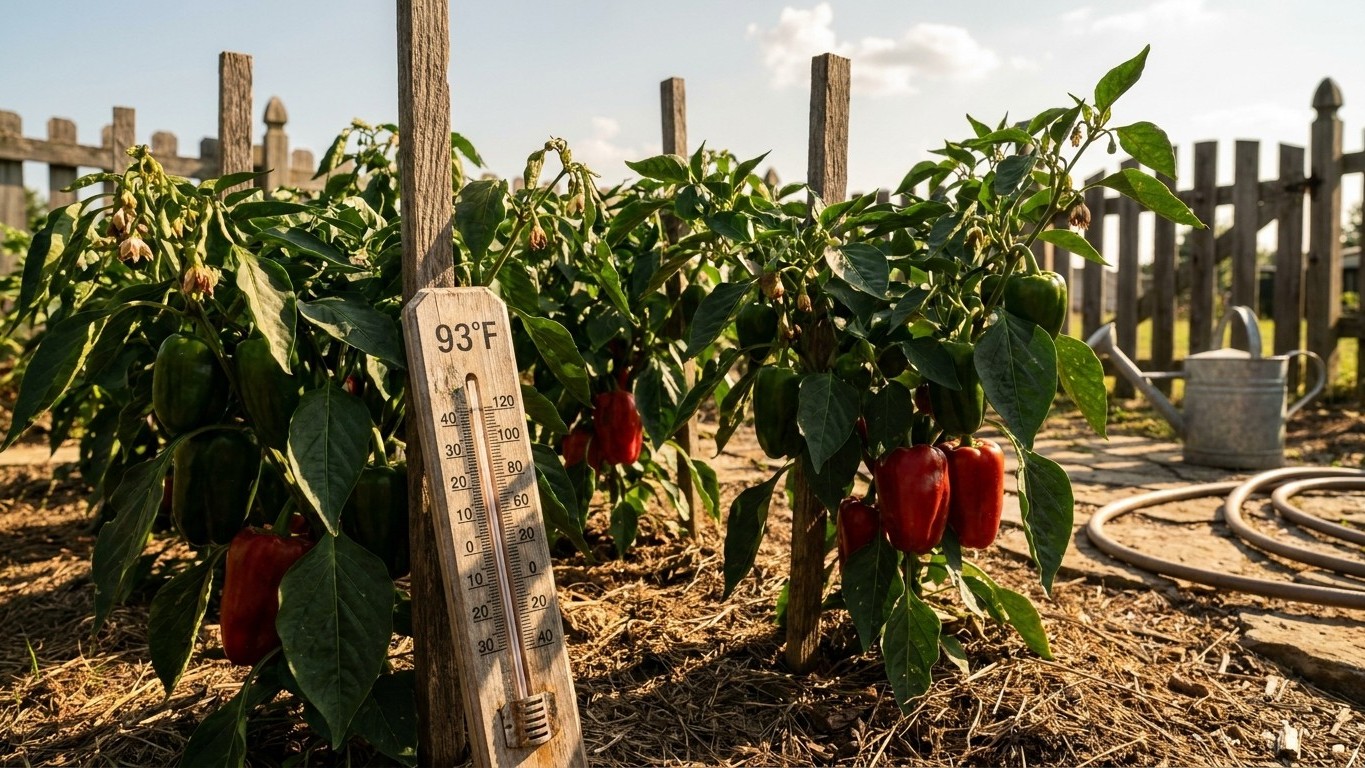

Kentucky pepper plants face two real risks: hot days that abort blossoms and cool nights that do the same thing from the other direction. The reference station at Louisville averages 37.2 days a year at or above 90 F, enough to interrupt fruit set for real stretches during peak summer. The cold end matters just as much, but this site doesn’t track summer night minimums for Kentucky, so growers need to watch their own thermometer. Timing transplants around the last spring frost, roughly March 24 to April 4, and starting seed 8 to 10 weeks earlier keeps plants ahead of both extremes, a schedule laid out in more detail in When to Start Pepper Seed in Kentucky. Choosing from Pepper Varieties That Ripen in a Kentucky Season can also help growers stack the odds in their favor from the start.
The short answer

Thirty-seven days a year at 90 F or hotter isn’t a rare event in Kentucky. It’s the Louisville-area norm, averaged over three decades of NOAA climate data. Spread across a typical June-through-September pepper season, that works out to roughly one day in three during the hottest stretch running at or above that mark. Pepper flowers don’t need the whole plant to cook to drop; the bloom itself can abort when daytime highs push past 90 F, especially if the heat holds for several days running. A single hot afternoon rarely does much damage. A heat wave that camps out for a week is a different story, and it’s exactly the kind of stretch this state’s climate produces most summers.
That’s the half of the fruit-set problem this site can actually measure. The other half runs in the opposite direction, and it’s just as real: nights that drop below 55 F cause the same blossom drop as the heat does, just through a different mechanism. Cool nights slow pollen viability and can stall flower development even when the days are perfectly comfortable. Kentucky springs and early falls can absolutely dip into that range, particularly in the weeks right after the last frost and again as autumn closes in, which is part of why understanding Why Peppers Fail to Set Fruit in Kentucky means watching both ends of the temperature scale, not just the heat.
Here’s the gap worth being honest about: this site carries the state’s days-above-90 count, but it does not carry summer night minimum temperatures for Kentucky. That’s not a small omission. Night lows vary by valley, by elevation, by how close a garden sits to a river or a paved lot that holds heat. A garden in a low-lying hollow can run several degrees cooler at 3 a.m. than one on a nearby ridge, and no statewide average captures that difference. There’s no shortcut here. Guessing at night lows from where the county sits on a map, or from how cold January gets, doesn’t hold up, because winter cold and summer night behavior aren’t the same signal. A minimum thermometer set at plant height, checked over a few nights during bloom, tells you more than any regional figure could.
Put the two together and the practical takeaway is this: Kentucky peppers face real pressure on fruit set from both directions, heat that’s documented and reasonably predictable, and cool nights that are local and need to be watched directly. Planning around the documented heat is only half the job.
When to start seed here
Utah State University Extension’s guidance on peppers gives the framework that applies here too: start seed 8 to 10 weeks before transplanting, and don’t move plants outside until after the last frost and until soil has warmed to 60 F. Kentucky’s last spring frost, per NOAA’s 1991-2020 climate normals, falls in the March 24 to April 4 window, based on the 30-70% probability band for a 32 F freeze. That gives a starting point for counting backward.
- Fix the frost date. Use the March 24 to April 4 range as the earliest safe outdoor date. NWS Louisville has noted that this reference station tends to run later in spring than surrounding rural Jefferson County, so a garden further out from the city should expect its own window to sit a bit differently, not automatically earlier or later, just its own.
- Check soil, not just the calendar. Frost passing doesn’t mean the ground is ready. Soil needs to reach 60 F before pepper transplants go in, and cold, wet Kentucky soils in early spring can lag behind air temperature by days or weeks. A simple soil thermometer pushed a few inches down beats guessing from the date alone.
- Count back 8 to 10 weeks from whichever date comes later, frost or soil warm-up. If the plan is to transplant in early April, seed should already be started by early to mid-February. If cold, slow soil pushes the real transplant date into late April, seed starting slides back to match, landing in late February or even into March.
- Build in a buffer, not a fixed date. Because the frost window itself spans about ten days, and because soil warm-up varies by how wet and shaded a particular bed is, treat the 8 to 10 week count as a range to aim for rather than a single day to hit exactly.
None of this changes by variety. The seed-starting window is a function of the local frost date and soil temperature, not of which pepper is going in the ground.
What goes wrong here
- Blossom drop during a heat spell. When daytime highs push past 90 F for several days running, a stretch this state sees an average of 37.2 times a year, flowers can abort before they set fruit. There’s no way to stop the heat, but light afternoon shade cloth over the row during the worst stretches, and keeping soil moisture steady so the plant isn’t fighting drought stress on top of heat stress, gives blossoms a better shot at holding.
- Blossom drop from a cool night. The same failure, opposite cause: a night that dips below 55 F can stall pollen and cause flowers to drop, even mid-summer if a cold front moves through. Since this site doesn’t track night minimums for Kentucky, the only real defense is watching a thermometer at plant height during bloom and, if a cold snap is forecast, covering plants overnight the way you would for a late frost.
- Sunscald on exposed fruit. Kentucky’s summer sun is strong enough that fruit left uncovered by foliage, especially on plants that have dropped leaves to heat stress or been pruned too hard, can develop pale, papery patches where direct sun hits the skin. Keeping the plant’s natural leaf cover intact, rather than stripping foliage to “let more sun in,” is the simplest fix.
- Blossom-end rot. This shows up as a dark, sunken patch on the bottom of the fruit and traces back to inconsistent watering interrupting the plant’s calcium uptake, not a soil calcium shortage in most cases. Even, regular watering through hot spells, rather than long dry stretches followed by a heavy soak, keeps this in check far more reliably than any additive poured on afterward.
Checking this against your own county
Statewide numbers like the 37.2 days above 90 F and the March 24 to April 4 frost window are averages built from decades of data at reference stations. They’re useful for planning, but they’re not a substitute for what’s happening in a specific yard. NWS Louisville itself flags that its station runs later in spring and earlier in fall than the rural county around it, which is exactly the kind of local variation a statewide figure can’t capture.
The University of Kentucky Cooperative Extension Service, at extension.ca.uky.edu, is the named resource for county-level growing information in Kentucky. A local extension office can speak to soil warm-up patterns, frost behavior, and pest pressure specific to that county’s terrain, something no state average will ever fully replace.
Common questions
Do all pepper varieties fail the same way in heat?
Utah State University Extension names several pepper varieties but does not attach a heat tolerance rating, a days-to-maturity figure, or a size to any of them. There’s no published basis here for saying one variety handles Kentucky’s hot stretches better than another.
Can I transplant peppers before the last frost date if I cover them?
Covering can protect against a light frost event, but it doesn’t address the soil temperature requirement. Even covered, pepper roots sitting in soil below 60 F won’t grow well, so covering is a stopgap, not a reason to move the transplant date earlier.
How long after flowering should I expect fruit?
Utah State University Extension notes 35 to 45 days from flowering to harvest, not from sowing or transplanting. That count only starts once the plant is actually blooming, which itself depends on avoiding the heat and cold extremes covered above.
What if my night temperatures run colder than expected?
Since this site doesn’t carry Kentucky’s summer night minimums, the only reliable check is a thermometer at plant height during bloom. If nights are consistently landing below 55 F, that’s a local microclimate issue worth raising with the county extension office rather than something a statewide figure would have predicted.