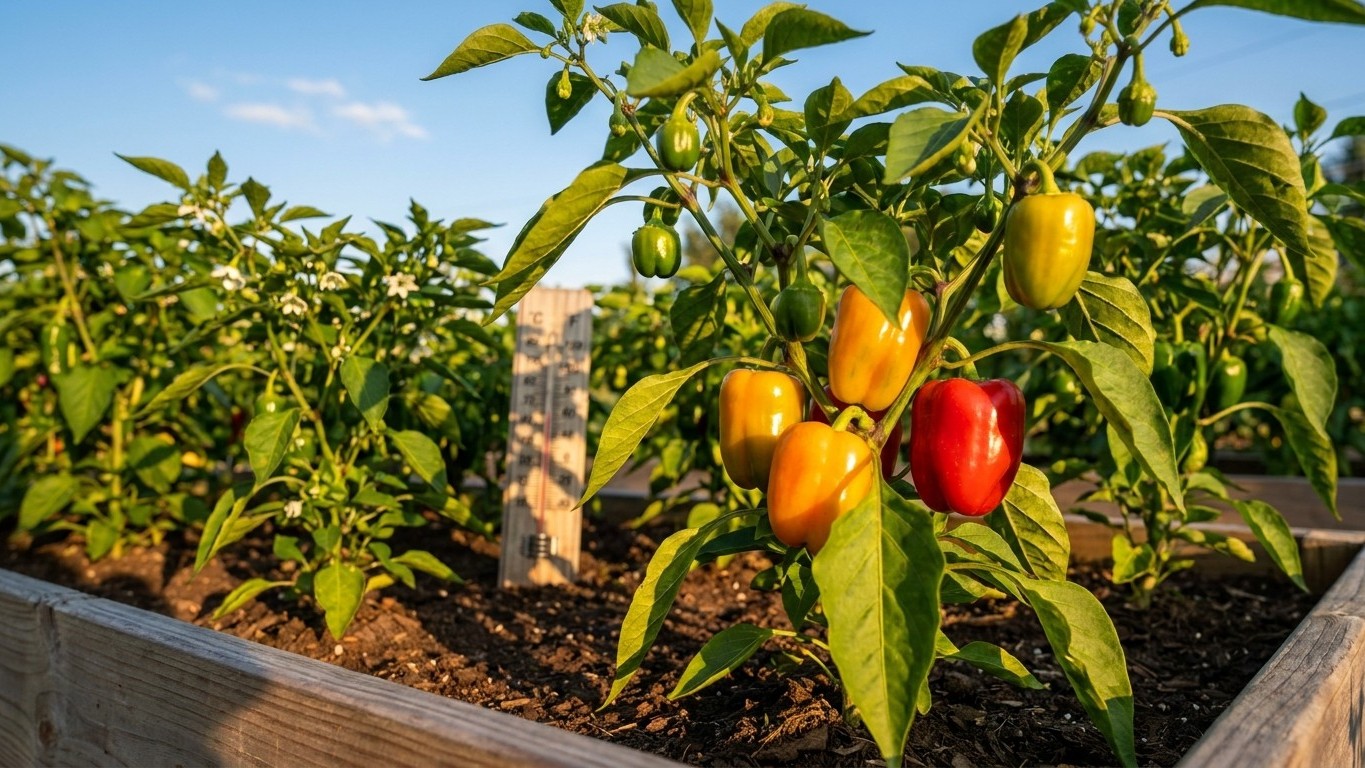

Ohio growers get a fairly forgiving heat load compared to the Deep South, but pepper fruit set is a two-sided problem here, not a one-sided one. The state’s warm season rarely punishes plants with long heat stretches, yet a cool night in late spring or early fall can shut down flowering just as fast as a 95-degree afternoon. Getting peppers to actually set fruit in Ohio comes down to timing the transplant and watching both ends of the thermometer, not just the hot one, which starts with knowing When to Start Pepper Seed in Ohio.
The short answer

Columbus averages 15.3 days a year at or above 90 F, based on NOAA NCEI Climate Normals covering 1991 to 2020. That’s a modest number. It means most Ohio summers give pepper plants only a couple of scattered hot stretches rather than weeks of sustained heat stress. Fifteen days spread across June, July and August is rarely enough to knock a healthy pepper plant out of production for the whole season, though a run of several of those days back to back, especially paired with dry soil, can stall flowering for a stretch.
That’s the hot end. Pepper fruit set fails there when daytime highs push past 90 F, because the flowers abort rather than pollinate and hold. With 15.3 days a year at that mark, Ohio’s exposure is real but limited, and it tends to cluster in July.
The other failure point sits at the cool end, and it’s the one gardeners underestimate. Pepper flowers also drop when nighttime lows fall below 55 F, and this is where a heat-day count can’t help you. This site tracks days at or above 90 F for Ohio, but it does not carry summer night minima for the state. Ohio Extension guidance on peppers, along with the Utah State University Extension guide on pepper fruit set, makes clear that both thresholds matter equally, and no latitude-based guess or coldest-month average can substitute for watching your own overnight lows through late spring and early summer. For a deeper look at both ends of this problem, see Why Peppers Fail to Set Fruit in Ohio. A backyard low of 52 F in a river valley or a low-lying yard can suppress fruit set even when the daytime high looked perfectly normal.
The practical takeaway is that Ohio’s pepper problem is rarely one long heat wave. It’s more often a scattering of hot afternoons in midsummer combined with the risk of a chilly night slipping in during a cool spell in May, June or even a surprise dip in September before the season ends. Choosing among Pepper Varieties That Ripen in a Ohio Season can help offset both of these risks by giving fruit a head start before either threshold becomes a problem.
When to start seed here
The math behind pepper timing in Ohio is simple once you have the pieces, and it works the same way whether you garden near Cleveland, Cincinnati or a rural county in between. Ohio State University Extension’s Ohio Gardening Calendar places the last spring frost between May 5 and May 15 for zone 6a, which covers a large share of the state. Work backward from that date and you get a transplant window that also respects soil temperature.
- Start with your last frost date. For zone 6a Ohio, Ohio State University Extension puts that window at May 5 to May 15. If you don’t know your zone, your county’s frost date may differ by a week or more in either direction, especially in the hillier southeastern counties or the colder northeastern counties near Lake Erie.
- Add the soil temperature check. Pepper transplants need soil that has warmed to 60 F, per Utah State University Extension. Frost date and soil temperature don’t always land on the same day. A frost-free date in early May can still sit on top of soil that’s stuck in the low 50s, especially after a wet spring, so check the soil with a simple probe thermometer rather than trusting the calendar alone.
- Set your transplant date as whichever comes later: the frost-free date or the day soil hits 60 F. That’s your actual “safe to plant peppers outside” day.
- Count back 8 to 10 weeks from that transplant date to find your indoor seed-starting day. If your transplant date lands around May 10, 8 to 10 weeks back puts seed-starting somewhere in the first half of March.
- Adjust for your own county’s frost record if it differs from the zone 6a window. A county with a later average frost date pushes both the transplant date and the seed-starting date later by the same number of days.
Redo this arithmetic with your own county’s numbers rather than borrowing Columbus figures wholesale. Frost dates shift enough across Ohio’s regions that a gardener near the Ohio River can safely transplant a week or more before someone near Lake Erie, and starting seed on the wrong end of that gap either wastes weeks of indoor growing space or risks a frost-killed transplant.
What goes wrong here
- Blossom drop from a hot spell or a cool night. Ohio’s roughly 15 days a year above 90 F can each trigger a wave of dropped flowers, and so can any night that slips below 55 F during a cool front in late spring or a chilly stretch in early fall. The remedy is to track your own daily highs and nightly lows through the growing season rather than assuming a “normal” week will stay in range, and to keep plants well watered before a forecasted hot day, since drought stress makes heat-driven drop worse.
- Sunscald where the sun is strong. A pepper plant that loses leaf cover, whether from wind damage, disease, or aggressive pruning, exposes its fruit directly to summer sun on those hotter afternoons. The fruit develops a pale, blistered patch that often turns to rot. The fix is straightforward: avoid heavy pruning during the hottest stretch of summer and let the plant keep enough foliage to shade its own fruit.
- Blossom-end rot. This shows up as a dark, sunken patch on the bottom of the fruit and it’s tied to inconsistent watering and calcium uptake, not to heat alone. Uneven watering, a heavy rain after a dry week, or letting containers dry out between waterings all raise the risk. Keeping soil moisture steady, especially during any run of hot days when the plant is pulling more water, is the most reliable remedy.
Checking this against your own county
The numbers above describe Ohio in general terms, but frost dates, soil warm-up, and even the frequency of hot afternoons vary by county and even by microclimate within a county. A garden tucked in a valley can run several degrees cooler on a summer night than a garden on a nearby hilltop, and that gap can decide whether your peppers hold flowers or drop them.
Ohio State University Extension (extension.osu.edu) is the named resource for county-level frost dates, soil temperature guidance, and pepper variety advice specific to your part of the state. Contacting your local county Extension office is the direct way to confirm whether the zone 6a window applies to you or whether your county runs on a different schedule.
Common questions
Can I plant peppers earlier than the frost date if I use row cover?
Row cover raises air temperature around the plant but doesn’t reliably warm the soil to the 60 F mark that Utah State University Extension identifies as necessary for transplants. Even under cover, soil that’s still cold will stall root growth and delay fruit set, so checking soil temperature directly remains the more reliable method than relying on frost protection alone.
Do all pepper varieties fail fruit set at the same night and day thresholds?
Utah State University Extension names several pepper varieties suited to home gardens but does not publish a heat rating, days-to-maturity figure, or size for any of them, and no such figures are published here. The 55 F night threshold and 90 F day threshold for fruit set failure apply generally to peppers rather than to one specific variety.
How many days after flowering should I expect fruit?
That figure is not published in the facts available for this article, and general ranges are commonly cited elsewhere for the interval from flowering to harvest, but attributing a specific number here without a named source would be guesswork. Check with Ohio State University Extension or the seed source for variety-specific timing.
What should I do if a hot spell is forecast right as my peppers start flowering?
Keep soil moisture consistent in the days leading into the hot spell, since drought stress compounds heat-driven blossom drop. There’s no way to prevent the temporary drop entirely, but plants generally resume flowering once temperatures fall back under 90 F, so a short hot stretch usually costs a wave of blossoms rather than the whole season’s crop.