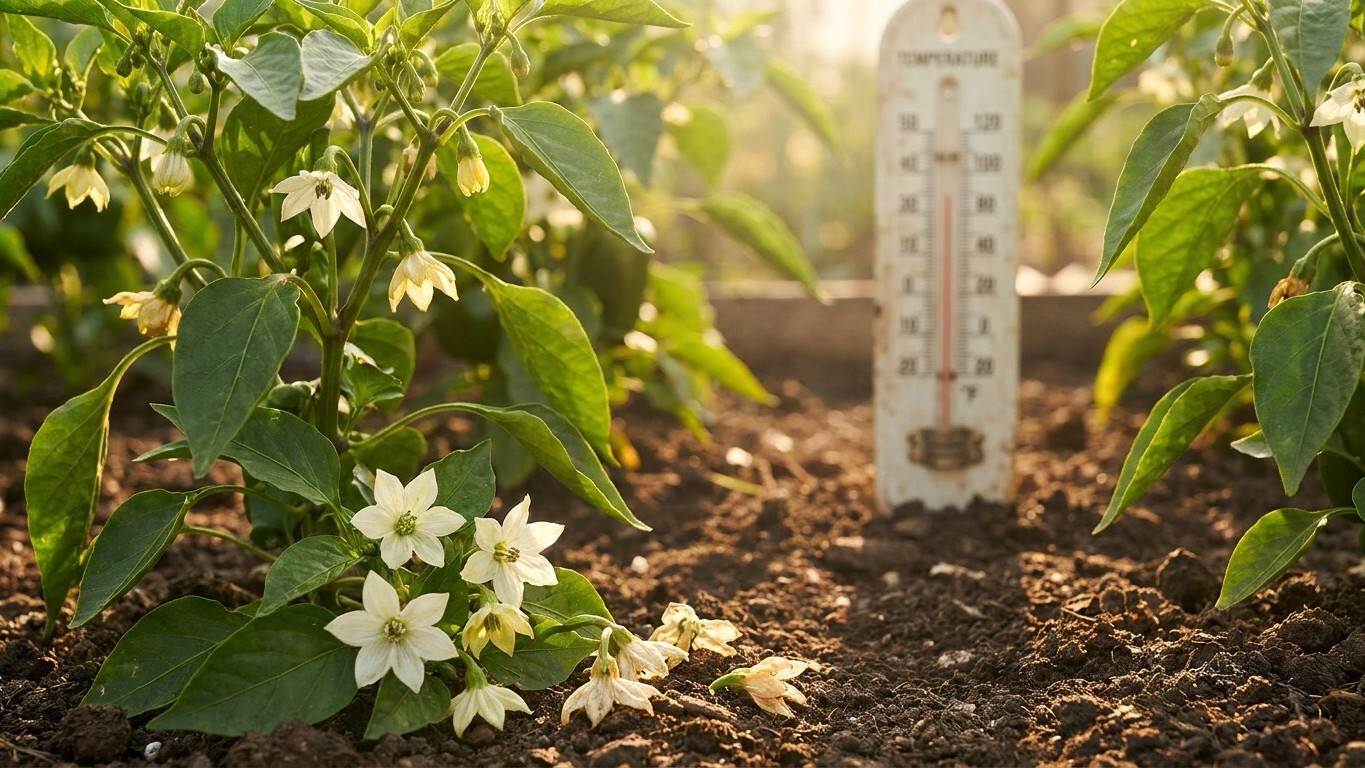

Oklahoma City averages 70.7 days a year at 90 F or hotter, and that heat load is the single biggest reason pepper flowers drop before they ever become fruit. The fix isn’t a variety switch, it’s timing: match transplanting to soil temperature, count backward from your last frost (see When to Start Pepper Seed in Oklahoma for exact dates), and track your own overnight lows since heat isn’t the only threshold that matters.
The short answer

That 70.7-day figure from NOAA’s 1991-2020 Climate Normals, measured at the Oklahoma City reference station, isn’t an average summer temperature. It’s a count of individual days that crossed 90 F, and it’s the number that tells you how much of the growing season sits inside pepper stress territory. Pepper plants can survive well above that mark, but fruit set is a different story. When daytime highs push past roughly 90 F for a stretch, especially paired with warm nights that don’t let the plant recover, flowers abort. The bloom opens, looks fine for a day or two, then drops off the stem with no pepper behind it. Multiply that by 70-plus days scattered across a typical Oklahoma summer, and it’s easy to see why gardeners here often get a strong flush of peppers in June, then watch production stall through the hottest weeks of July and August before it picks back up as temperatures ease in September.
The other end of the range gets less attention but causes the same result. Nights that drop below 55 F interfere with pollen viability just as surely as extreme heat does, which matters most at the edges of the season, in early spring after a late transplant or in fall as the first cool snaps arrive. This site tracks the heat side of that equation for Oklahoma because daytime highs are recorded reliably at fixed stations and published in NOAA’s Climate Normals. Summer overnight lows are not part of that same dataset here, and there’s no reliable way to estimate them from latitude, elevation guesses, or the coldest month of the year. A river bottom and a hilltop three miles apart can differ by several degrees on a calm, clear night. That means the cool-end threshold is one every gardener has to watch personally, with a thermometer on the porch or a basic outdoor sensor, rather than assume from a regional average — see Why Peppers Fail to Set Fruit in Oklahoma for a fuller breakdown of both thresholds.
| Fruit-set failure point | Threshold | Data for Oklahoma |
|---|---|---|
| Heat end | Days at or above 90 F | 70.7 days/year average (Oklahoma City station) |
| Cool end | Nights below 55 F | Not published on this site; track locally |
Put together, the practical takeaway is that Oklahoma pepper growers are managing a season with a wide window of good conditions in the middle and two separate failure zones bracketing it. Planning around both, rather than relying on variety choice alone, is easier once you know which Pepper Varieties That Ripen in a Oklahoma Season fit inside that window, than just the obvious heat, is what separates a garden that produces steadily from one that produces only in short bursts.
When to start seed here
Working out a start date is just arithmetic once you know your reference points. Utah State University Extension recommends starting pepper seed 8 to 10 weeks before transplanting, and transplanting only after two conditions are both met: frost danger has passed and the soil has warmed to 60 F. Here’s how that plays out using Oklahoma City’s own frost data.
- Find your last frost window. NOAA’s 1991-2020 Climate Normals put the 32 F freeze probability window for the Oklahoma City airport station between March 28 and April 10. That’s a station reading, not a neighborhood guarantee, and suburban or rural gardens around the state commonly see their last frost run one to two weeks later than the airport figure, more at higher elevation.
- Wait for 60 F soil, not just frost-free air. Air temperature can clear the frost mark while the soil is still cold several inches down. A soil thermometer pushed to about 4 inches deep, checked over a few mornings, tells you when the ground itself is ready. Pepper roots stall in cold soil even if the leaves look fine.
- Count back 8 to 10 weeks from your realistic transplant date. If your own frost history and soil checks point to a mid-April transplant, count backward: 8 weeks lands seed-starting in mid-February, 10 weeks pushes it to early February. Splitting the difference and starting around the first week of February gives most Oklahoma gardeners a cushion without forcing overly leggy transplants that sit indoors too long.
- Adjust for your own microclimate. A garden that historically runs a week or two behind the Oklahoma City average should shift the whole timeline later by the same margin, rather than starting seed on a fixed calendar date every year.
What goes wrong here
- Blossom drop during a hot spell. Flowers open, then fall off within a day or two, with no pepper forming, once daytime highs run near or above 90 F for several days in a row. This is the direct expression of the 70.7-day heat load described above. There’s no way to fully prevent it during a genuine heat spell, but afternoon shade cloth over the row, consistent deep watering rather than shallow daily sips, and mulch to keep root-zone temperatures steadier all reduce the severity and shorten how long production stalls.
- Blossom drop during a cool night. The same failure, opposite cause: a stretch of nights below 55 F, most likely at the start or tail end of the season, interferes with pollen and knocks flowers off before fruit sets. Since this site doesn’t track summer night minima for Oklahoma, the only real defense is watching your own outdoor thermometer through spring and early fall and expecting a slow week whenever a cool snap moves through.
- Sunscald on exposed fruit. Oklahoma’s strong summer sun can scorch peppers that lose their leaf cover, leaving a pale, papery, sunken patch on the side facing the sun. It usually follows aggressive pruning or a plant that’s lost foliage to wind or disease. Leaving a fuller canopy, and avoiding heavy leaf removal during the hottest stretch of summer, keeps fruit shaded by the plant’s own growth.
- Blossom-end rot. A flat, leathery, dark patch forms on the bottom of the fruit, not from a soil nutrient shortage in most cases but from inconsistent watering that disrupts calcium uptake even when calcium is present in the soil. Even, regular watering, with mulch to buffer swings between soaking rain and dry heat, is the most reliable fix.
Checking this against your own county
Everything above comes from station-level and regional data, useful for planning but not a substitute for what’s actually happening in your yard. Oklahoma State University Extension, at extension.okstate.edu, maintains county offices across the state that track local frost patterns, soil conditions, and variety performance specific to your area. If your county sits at a different elevation than Oklahoma City, borders a lake, or has a documented history of running warmer or cooler than the state averages, a call or visit to your local extension office will give you numbers closer to your actual garden than any statewide reference can. That’s especially worth doing before locking in a seed-starting date for the first time in a new location.
Common questions
Can I speed up fruit set by moving transplants outdoors earlier?
Transplanting before the soil reaches 60 F usually backfires. Cold soil stalls root growth and stresses the plant even if the air feels warm enough, often delaying fruit set more than an earlier start would have gained.
Do all pepper varieties fail at the same heat and cold thresholds?
Utah State University Extension names several pepper varieties suited to home gardens but doesn’t attach a heat rating, days-to-maturity figure, or size to any of them, so there’s no published basis here for saying one variety tolerates Oklahoma’s heat load better than another.
How long after flowering should I expect fruit?
Once a flower successfully sets, expect roughly 35 to 45 days before the pepper matures, counted from the flowering stage itself, not from sowing or transplanting. A plant that flowers early but faces a heat spell can end up producing later than one that flowers a bit later during milder weather.
What should I do if nights stay warm all summer and don’t drop below 55 F?
That’s the more common Oklahoma scenario during peak summer, and it means the cool-end threshold isn’t the immediate concern, the heat end is. Focus on afternoon shade, deep watering, and mulch during the hottest stretch, then watch nighttime lows again as fall approaches.