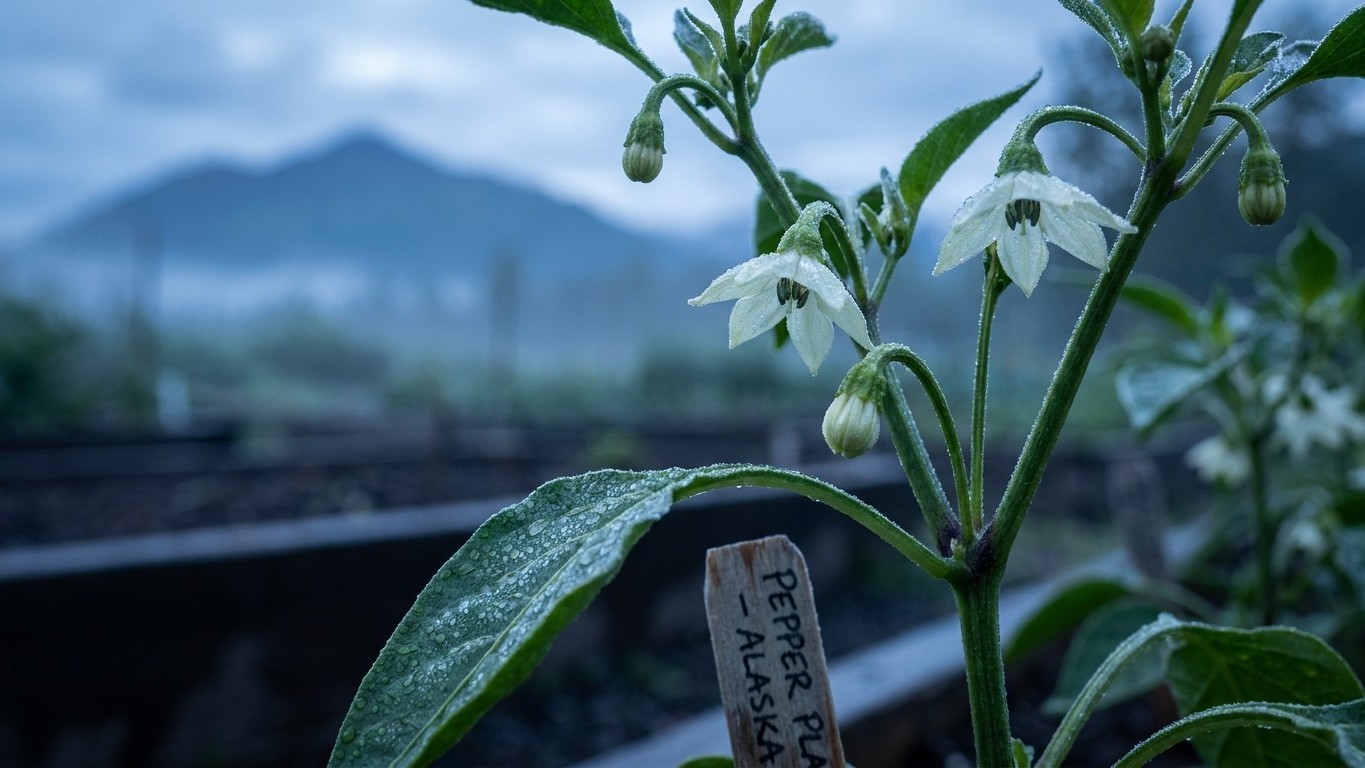

In Anchorage, the reference station for this state’s climate data shows essentially zero days a year at or above 90 F, so heat-driven blossom drop isn’t the threat it is farther south. The real risk runs the other way: cool nights below 55 F, which this site doesn’t track for summer minima. Add a frost-free season of roughly 143 days, and timing becomes the deciding factor for whether peppers set fruit at all here, which is why knowing When to Start Pepper Seed in Alaska matters just as much as choosing from the right Pepper Varieties That Ripen in a Alaska Season.
The short answer

Zero. That’s the mean number of days a year reaching 90 F or more at the Anchorage reference station, based on NOAA NCEI Climate Normals for 1991-2020. For pepper growers, that number matters because heat above 90 F is one of the two ways pepper flowers abort without setting fruit. If your garden never sees that kind of heat, you can cross that failure mode off the list. Anchorage growers aren’t fighting the sun scorching blossoms off the plant the way a grower in Phoenix or Wichita might.
But zero days above 90 F doesn’t mean pepper growing here is simple, and it definitely doesn’t mean the crop is easy money. Fruit set fails at both ends of the temperature range: hot days above 90 F on one side, and cool nights below 55 F on the other. A pepper plant sitting in a garden bed on a 62-degree Anchorage evening in July may be perfectly happy through the day and still fail to set fruit if the nighttime low keeps dropping into the low 50s or high 40s. That’s the threshold that actually governs whether flowers hold and swell into peppers in this climate, not the daytime high.
This is also the point where growers get themselves in trouble by guessing. It’s tempting to assume that because Anchorage sits at a northern latitude, or because winters here are long and cold, summer nights must automatically be too cool for peppers. That assumption skips a step. Latitude tells you about day length and season length, not about a specific night’s low. The coldest month of the year tells you nothing about a July or August night. Night temperature in summer depends on local factors, elevation, distance from Cook Inlet, cloud cover, whether the garden sits in a low spot that pools cold air, that this site simply doesn’t carry data for. For a deeper look at the mechanics behind these failures, see Why Peppers Fail to Set Fruit in Alaska. There’s no shortcut around a thermometer.
What that means in practice: track your own nights with a min-max thermometer placed at plant height in the actual bed, not a reading pulled from a regional forecast. Do it for at least a couple of weeks during the warmest stretch of summer. If those readings consistently sit below 55 F, that’s the constraint you’re designing around, whether the season is unusually cool or not. If they hold above 55 F most nights, peppers have a real shot at setting fruit here, heat load is not the problem, and the calendar becomes the main thing to manage.
When to start seed here
Pepper timing in Alaska is really a piece of backward arithmetic, and it starts from the frost date, not from a seed packet’s guess at a planting week. Here’s how to work it for your own garden.
- Find your last spring frost window. For the Anchorage reference station (USW00026451), NOAA NCEI’s 1991-2020 Climate Normals put the 32 F freeze probability window between May 3 and May 12. That’s not a guarantee, it’s a probability band, so treat the later end as the safer target if you can’t monitor conditions closely.
- Wait for soil, not just air, to clear 60 F. Utah State University Extension is specific on this: peppers should go into the ground only after frost has passed and the soil itself has warmed to 60 F. Soil in a maritime climate like Anchorage’s typically lags behind air temperature, sometimes by a couple of weeks, because the same cool water and cloud cover that moderate the air also slow soil warming. Check soil temperature directly with a probe thermometer at planting depth rather than assuming it tracks the frost date.
- Set your transplant date once soil hits 60 F. This is the actual anchor point for everything that follows, not the frost date itself. Two gardens a few miles apart, one in a sun-exposed raised bed and one in shaded native soil, can hit 60 F a week or more apart.
- Count back 8 to 10 weeks from that transplant date to find your seed-starting date. If your soil reliably reaches 60 F in early June, for instance, you’d count back 8 to 10 weeks from early June, landing seed-starting somewhere in late March to early April. Adjust the exact week based on your own soil readings from past seasons, not a fixed calendar date.
- Build in a hardening-off period before transplant. The 8 to 10 week indoor window already assumes seedlings go through a week to ten days of gradual outdoor exposure before they go into the ground for good, so don’t tack that time on separately, plan for it inside the same window.
Given Anchorage’s roughly 143 frost-free days, and given that peppers are already among the slower vegetables to reach harvest, this arithmetic isn’t optional. Start too late indoors and the plants transplant out as small, stressed seedlings with too little season left to recover, flower, and hold fruit before fall cold returns.
What goes wrong here
- Blossom drop from cool nights. This is the dominant failure mode in this climate, given that days above 90 F essentially don’t occur at the reference station. If your own nighttime readings run below 55 F, flowers form and then fall off without setting fruit, even though the plant otherwise looks healthy. The remedy is season extension at night: row cover pulled over hoops after sunset, water-filled plant protectors (sometimes sold as season extenders or plant teepees) placed around individual plants, or growing under a high tunnel or greenhouse where nighttime air stays a few degrees warmer than open garden beds.
- Sunscald on exposed fruit. Alaska’s long summer daylight means peppers can get many more hours of direct light exposure per day than a plant at a lower latitude, even without extreme heat. Fruit that’s suddenly exposed after a pruning session, or fruit on a plant with sparse foliage, can develop pale, papery patches where the skin has effectively burned. Keep enough leaf cover over developing fruit, and avoid heavy pruning during the sunniest stretch of summer when daylight runs close to 19 hours in the Anchorage area.
- Blossom-end rot. This shows up as a dark, sunken, leathery patch at the bottom of the fruit, and it’s driven by inconsistent water delivery to the plant rather than by a specific temperature threshold. Containers and raised beds, which many Alaska gardeners rely on to warm soil faster in spring, dry out quickly and are especially prone to this. Water on a steady schedule rather than letting the soil swing between soaked and bone-dry, and keep a consistent layer of mulch over the root zone to buffer moisture swings.
Checking this against your own county
Everything above is built from station-level data for the Anchorage reference point, and Anchorage is one of the mildest inhabited parts of Alaska. The Interior and the northern part of the state run on a much shorter, harsher clock, with later last frosts, earlier first frosts, and a narrower window for soil to reach 60 F, even with the long summer daylight helping growth along once conditions are met. Before you commit a season’s worth of seed-starting effort to a date pulled from this article, check it against local numbers.
The University of Alaska Fairbanks Cooperative Extension Service is the land-grant extension office for the state, and it can confirm frost dates, soil temperature trends, and variety performance specific to your borough or census area. Their office is reachable through uaf.edu/ces.
Common questions
Do I need to worry about heat stress on peppers in Alaska?
Based on the Anchorage reference station’s 1991-2020 Climate Normals, essentially no. Days at or above 90 F average zero per year there, so the hot-end failure threshold for pepper fruit set rarely comes into play in this state’s growing regions.
What temperature actually stops peppers from setting fruit here?
The cool end matters more in Alaska: nights below 55 F. This site doesn’t carry summer night minima for specific counties, so track your own garden’s nighttime lows with a thermometer rather than assuming a figure from regional averages or from how cold winter gets.
How many frost-free days does Anchorage get?
Roughly 143, based on NOAA NCEI’s 1991-2020 Climate Normals for freeze probability at station USW00026451. That’s on the generous end for Alaska; the Interior and northern parts of the state run considerably shorter.
When should I start pepper seeds indoors for an Alaska garden?
Count back 8 to 10 weeks from your expected transplant date, and set that transplant date only once soil has reached 60 F after your last frost, which the Anchorage reference station places between May 3 and May 12. Confirm your own county’s timing with UAF Cooperative Extension before locking in a date.