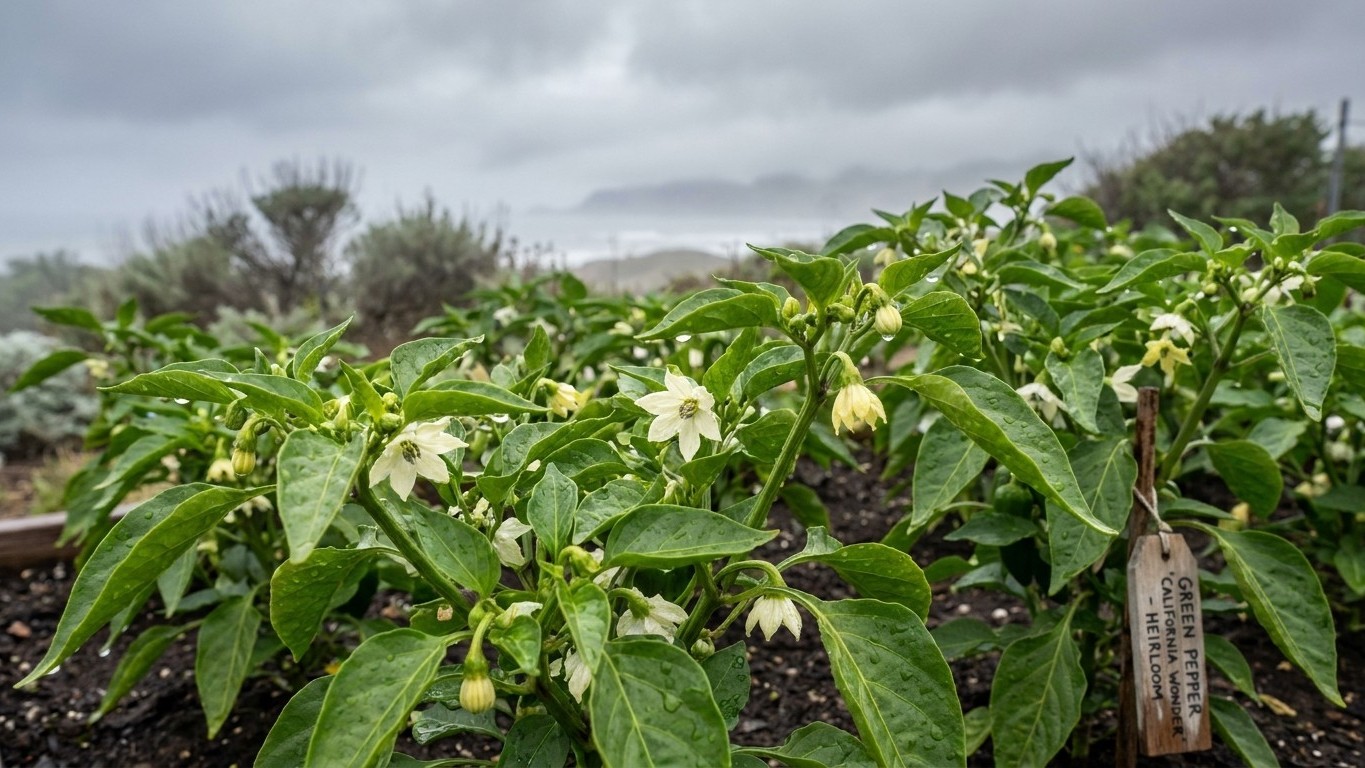

In Newfoundland and Labrador, the pepper problem isn’t heat, it’s the opposite. St. John’s averages zero days a year at or above 90 F, so the classic “too hot to set fruit” failure barely applies here. The real threat is cool nights stalling pollination, paired with a short window between a late, unreliable frost and the first real cold of fall.
The short answer

Start with the number that matters most for heat: at the reference station in St. John’s, the Canadian Climate Normals for 1981-2010 put the average count of days at or above 90 F at 0.0 per year. That’s not a typo and not a rounding trick. It means the upper threshold that shuts down pepper fruit set, the point at which flowers abort because the plant is under heat stress, essentially never gets triggered by the regional climate here. Growers in much of the continental United States spend July and August watching for heat waves that blast blossoms off pepper plants. That’s not the fight in Newfoundland and Labrador.
But fruit set doesn’t only fail on the hot side. Utah State University Extension is clear that pepper flowers also drop when nights fall below 55 F, and that threshold is the one that actually matters in this province. Why Peppers Fail to Set Fruit in Newfoundland and Labrador comes down largely to this cold-night mechanism: a pepper plant can look healthy, hold plenty of flowers, and still refuse to set fruit if the nighttime temperature keeps dipping into the low 50s or below. In a maritime, often foggy climate like Newfoundland’s, cool nights aren’t a rare event, they’re a recurring risk straight through the growing season, including in what’s supposed to be the warmest stretch of summer.
This is where the record has a real gap, and it’s worth being honest about it. This site tracks days at or above 90 F by territory, because that figure is published and consistent across stations. It does not carry summer night minimum temperatures, and no reliable substitute exists on this page. You can’t estimate how cold your nights run by looking at how far north you are, and you can’t borrow the coldest month of the year as a stand-in for a July or August night reading. Latitude tells you almost nothing about a specific night’s low, and winter cold has no fixed relationship to summer cold. The only way to know whether your peppers are getting shut out by cool nights is to track your own overnight temperatures through the season, ideally with a simple min-max thermometer placed where the plants actually grow, not on a porch or near a wall that holds heat.
So the short version: heat-driven fruit drop is not a realistic worry in this province based on the recorded normal. Cold-driven fruit drop is the real risk, and it’s one you have to monitor yourself, because the published data doesn’t cover it for you. That makes timing your planting even more important, so check When to Start Pepper Seed in Newfoundland and Labrador before choosing from the Pepper Varieties That Ripen in a Newfoundland and Labrador Season can help stack the odds in your favor before you even worry about nightly temperature swings.
When to start seed here
Getting the sowing date right means working backward from the transplant date, and the transplant date itself depends on two separate conditions that don’t always arrive together.
- Set your transplant target around two conditions, not one. Utah State University Extension recommends transplanting peppers outdoors after the danger of frost has passed and once the soil has warmed to 60 F. Frost-free doesn’t mean the soil is warm enough, and warm soil in a sheltered spot doesn’t mean frost risk is over. Both have to be true.
- Check the frost side against the local normal, but don’t treat it as a guarantee. At the ST JOHN’S A station, Environment and Climate Change Canada’s 1981-2010 Climate Normals put the average last spring frost at May 30. That’s a mean date, not a safe cutoff. Because it’s an average, roughly one year in two sees frost land later than May 30, sometimes well into June. Treat that date as the middle of a window, not the end of one.
- Check the soil side yourself, since it isn’t part of any published normal on this page. A basic soil thermometer, pushed a few inches into the bed where you’ll actually plant, tells you when the ground has caught up to 60 F. In a cool maritime climate, soil often lags well behind the air, so don’t assume that a mild, frost-free week means the ground underneath is ready.
- Count back 8 to 10 weeks from your realistic transplant date to land on a seed-starting date. If your working transplant target, after allowing for the fact that frost can run later than the May 30 average, falls in early June, counting back 8 to 10 weeks puts seed-starting somewhere in the last days of March into early April.
- Push the whole schedule later in colder districts within the province. The May 30 figure comes from a single station in St. John’s. Northern areas and higher-elevation or inland districts in Newfoundland and Labrador routinely run behind that coastal reading, sometimes by weeks. If you garden away from St. John’s, shift your transplant target later and your seed-starting date later to match, rather than using the capital’s normal as if it applied everywhere.
What goes wrong here
- Blossom drop from a cool night. This is the dominant failure mode in this climate. Once nighttime temperatures fall below 55 F, flowers abort even on otherwise healthy plants. Track your own nightly lows with a min-max thermometer near the plants, and if a cold stretch is forecast, cover plants overnight with a floating row cover or move container-grown peppers into a garage or greenhouse until temperatures recover.
- Blossom drop from an unusual hot spell. Even though the recorded normal for days at or above 90 F sits at 0.0 for this territory, that’s an average, not a promise that no single hot day will ever occur, and heat can also build up fast inside a closed greenhouse or high tunnel even on a moderate outdoor day. Ventilate covered growing spaces on warm afternoons and use shade cloth if a heat spell arrives, to keep flowers from aborting on the hot side too.
- Sunscald on fruit. Peppers exposed to strong direct sun, especially after aggressive pruning or on plants with sparse leaf cover, can develop pale, papery patches on the fruit’s sun-facing side. Leave enough foliage on the plant to shade developing peppers, and avoid stripping leaves for the sake of tidiness.
- Blossom-end rot. This shows up as a dark, sunken patch on the bottom of the fruit and traces back to inconsistent watering interfering with calcium uptake, not to a lack of calcium in the soil itself. Water on a steady schedule rather than letting the bed dry out and then soaking it, and mulch around the base of the plants to even out soil moisture between waterings.
Checking this against your own county
Every figure here comes from a single reference station or a provincial average, and Newfoundland and Labrador covers coastal, inland, and upland ground that behaves quite differently from one another. Before you commit to a sowing date or a transplant week, check it against local guidance from the Newfoundland and Labrador Department of Fisheries, Forestry and Agriculture, at gov.nl.ca/ffa. Their staff can speak to conditions in your specific district in a way a single station reading never can, particularly if you’re gardening away from the coast or at higher elevation, where frost and soil warming both run later than the St. John’s normal suggests.
Common questions
Do peppers ever struggle with heat in Newfoundland and Labrador?
Based on the recorded normal of 0.0 days a year at or above 90 F at the St. John’s reference station, heat-driven fruit drop isn’t a realistic concern for outdoor peppers in this province. The exception is heat trapped inside an unventilated greenhouse or high tunnel, which can still get hot enough on a mild day to stress flowers.
What’s the biggest risk to pepper fruit set here?
Cool nights. Utah State University Extension notes that pepper flowers drop when nights fall below 55 F, and that threshold is far more likely to be crossed in this maritime climate than the 90 F heat threshold ever is.
Can I use the May 30 frost date as a firm planting cutoff?
No. It’s a mean date from Environment and Climate Change Canada’s 1981-2010 Climate Normals for the ST JOHN’S A station, which means frost lands later than May 30 in roughly half of all years. Treat it as the middle of a range, and confirm soil temperature separately before transplanting.
Where can I get planting advice specific to my district?
Contact the Newfoundland and Labrador Department of Fisheries, Forestry and Agriculture at gov.nl.ca/ffa. They can account for local differences in frost timing and soil warm-up that a single provincial or station-level figure can’t capture.