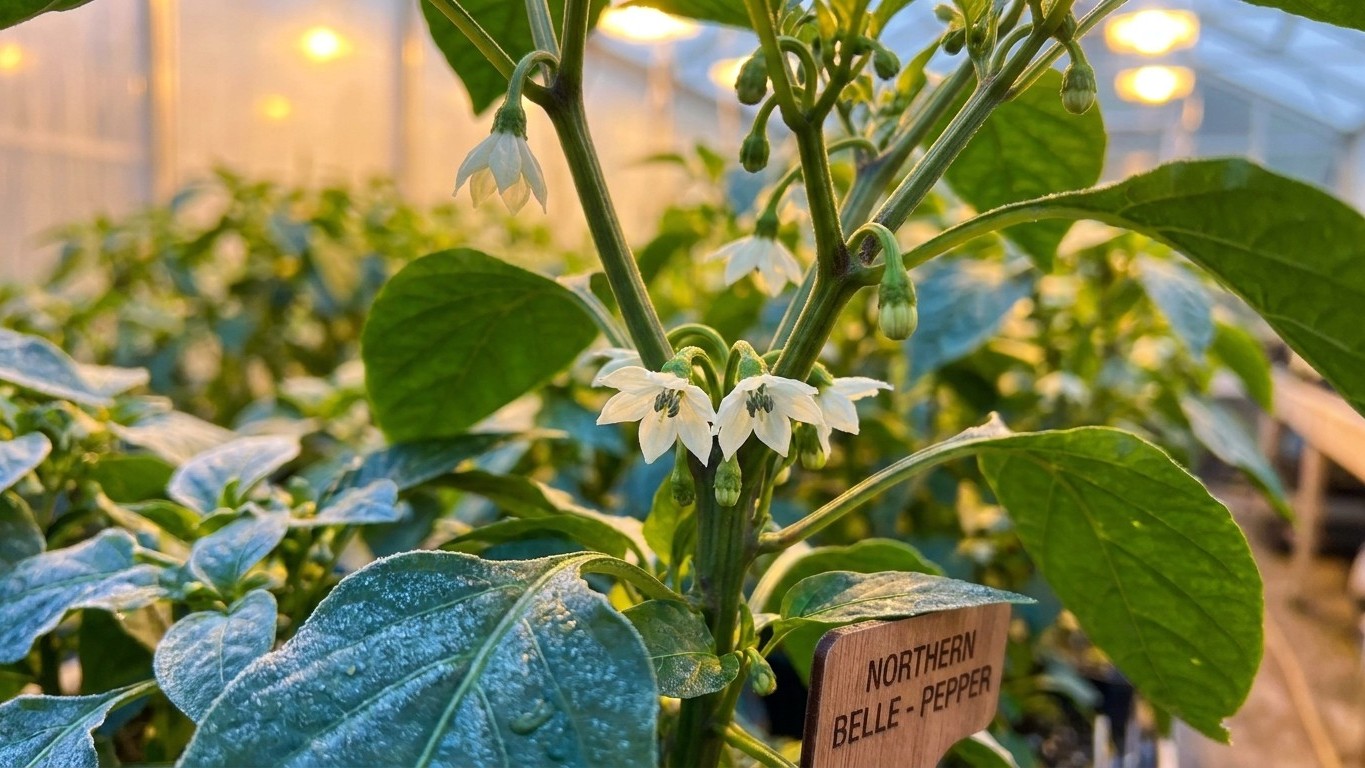

Peppers need warmth to set fruit, and Nunavut’s climate barely offers a season, let alone the sustained heat peppers evolved to expect. The territory logs an average of 0.0 days a year at or above 90 F, so scorching afternoons are not the threat. The threat is the other end: cold nights during flowering, a compressed frost-free window, and soil that takes its time warming up. Growing peppers here is possible, but only with real season-extension work and a careful eye toward Pepper Varieties That Ripen in a Nunavut Season.
The short answer

Start with the number that matters most for fruit set on the hot side: at the reference station in Rankin Inlet, the average count of days reaching 90 F or higher is 0.0 a year, based on the 1981-2010 Canadian Climate Normals. That figure describes summer heat load, not the average summer temperature, and for Nunavut it tells you plainly that heat stress on pepper flowers is not going to happen outdoors. Pollen does not cook off in Nunavut summers. Fruit set failing because the plant got too hot is, for practical purposes, off the table here.
That is the easy half of the story. Pepper fruit set fails at both ends of the thermometer, and the cold end is where a northern grower needs to pay attention, a topic covered in depth in Why Peppers Fail to Set Fruit in Nunavut. When nights drop below 55 F during flowering, flowers abort and drop before they ever become peppers, regardless of how warm the days get. This site tracks days at or above 90 F for every territory and state, but it does not carry summer night minima, and that gap matters more in Nunavut than almost anywhere else in the cooperative. Nobody should guess at overnight lows from latitude or from how cold the coldest month runs. A place can sit far north and still have a warm microclimate near open water, a building, or a south-facing slope, and the reverse is just as true.
What that means in practice: a grower here has to put an actual thermometer, ideally a min-max model, near the plants during the flowering stretch and read it every morning. If overnight lows are dipping under 55 F while buds are opening, that is the signal to add row cover, move containers into a greenhouse or cold frame overnight, or accept that outdoor fruit set will be patchy at best. The heat threshold is a non-issue in this climate. The cold threshold is the whole ballgame, and it is a local reading, not a number anyone can hand you from a normals table.
When to start seed here
Working backward from the calendar is the only reliable way to time pepper seed indoors in a climate this short, and When to Start Pepper Seed in Nunavut lays out that arithmetic in detail. The arithmetic is simple once you have the pieces, and every piece needs a local check rather than a guess.
- Start with the average last spring frost. For the Rankin Inlet A station, the mean date of last spring frost is June 19, drawn from the 1981-2010 Canadian Climate Normals. That is a mean, not a guarantee: in one year out of two, frost arrives later than June 19. Treat it as the midpoint of a window, not a safe planting date.
- Add the soil-temperature condition. Utah State University Extension is clear that pepper transplants should go into the ground only after frost has passed and once soil temperature has reached 60 F. Soil warms more slowly than air, and in a climate where June still carries a real frost risk, soil is likely to lag well behind the air, which pushes the realistic transplant date later than June 19 in most years.
- Count back 8 to 10 weeks indoors from that realistic transplant date. If soil in a given spot does not hit 60 F until early July, for example, seed needs to go into trays indoors roughly 8 to 10 weeks earlier, which lands in late April to early May. Nobody can hand you the exact week without a soil thermometer of your own, because soil warm-up varies with drainage, sun exposure, and whether the ground is shaded by snow cover longer than the surrounding area.
- Recheck against your own site every season. Because the June 19 figure is a long-term mean and soil behavior is local, redo this count each year using a soil thermometer pushed 4 inches deep, rather than relying on the calendar alone.
The takeaway for anyone gardening in Nunavut is that seed starting has to begin earlier indoors than almost anywhere else covered in this series, precisely because the outdoor window opens so late and closes so fast once fall arrives.
What goes wrong here
- Blossom drop from a cool night. This is the dominant risk in this climate. When overnight temperatures fall below 55 F while the plant is flowering, blossoms drop before fruit forms. Since this site does not track summer night lows, watch your own thermometer through the flowering stage, and be ready to cover plants or bring containers under shelter on cold nights.
- Blossom drop from a hot spell. Outdoors in Nunavut this is essentially a non-event, given the 0.0 average days a year at or above 90 F. The one place it can still show up is inside an unventilated greenhouse or hoop house on a bright, still day, where trapped heat can spike well past outdoor conditions. The remedy is the same anywhere: vent the structure and avoid letting daytime heat build past what the flowers can tolerate.
- Sunscald. Even without extreme heat, the long daylight hours of an Arctic summer mean fruit can be exposed to strong, sustained light for many more hours a day than a plant further south would see. Fruit left uncovered by foliage, especially after aggressive pruning, can scald. Keep the plant’s leaf canopy intact rather than stripping it back, so fruit stays shaded.
- Blossom-end rot. This shows up as a dark, sunken patch on the bottom of the fruit and traces back to uneven water supply interfering with calcium uptake, not to a soil calcium shortage on its own. In a climate with a short, intense growing window, irregular watering is easy to fall into. Keep soil moisture even through the fruiting period, particularly in containers, which dry out faster than garden beds.
Checking this against your own county
Every figure here comes from a single reference station and a national dataset, and Nunavut is too large and too varied for one station to speak for every community’s growing conditions. Before committing seed trays and greenhouse space to peppers, check current guidance with Agriculture and Agri-Food Canada, the federal department responsible for agricultural extension work, at agriculture.canada.ca/en. They can help you find frost data and growing advice specific to your community rather than a single southern-Kivalliq reference point. A local agricultural or horticultural contact can also tell you whether other growers nearby have had luck with peppers under cover, which is worth more than any normals table.
Common questions
Can peppers actually mature outdoors in Nunavut without a greenhouse?
It is a hard ask. With the frost-free window opening late (the average last frost at Rankin Inlet A is June 19, and that is only the midpoint of the range) and closing early, most pepper varieties will struggle to reach full fruit maturity outdoors without some form of season extension like a cold frame, row cover, or hoop house.
Does the 0.0 days-above-90 F figure mean heat is never a problem here?
Outdoors, yes, effectively. That figure describes the reference station’s average heat load, and it tells you fruit set will not fail from excess outdoor heat. The exception is an enclosed, unventilated greenhouse, where trapped heat can climb well past ambient temperature on a sunny day.
How do I know if my nights are too cold for fruit set?
Use a min-max thermometer placed near the plants and check it every morning during flowering. Since summer night minima are not tracked here by territory, this is a reading you have to take yourself rather than infer from any published average.
Why does the seed-starting count use 8 to 10 weeks instead of a fixed date?
Because the two things that set the transplant date, frost timing and soil temperature, both vary by site and by year. Utah State University Extension frames the timing as weeks before transplant rather than a calendar date precisely so growers can adjust it to their own soil readings instead of a one-size answer.