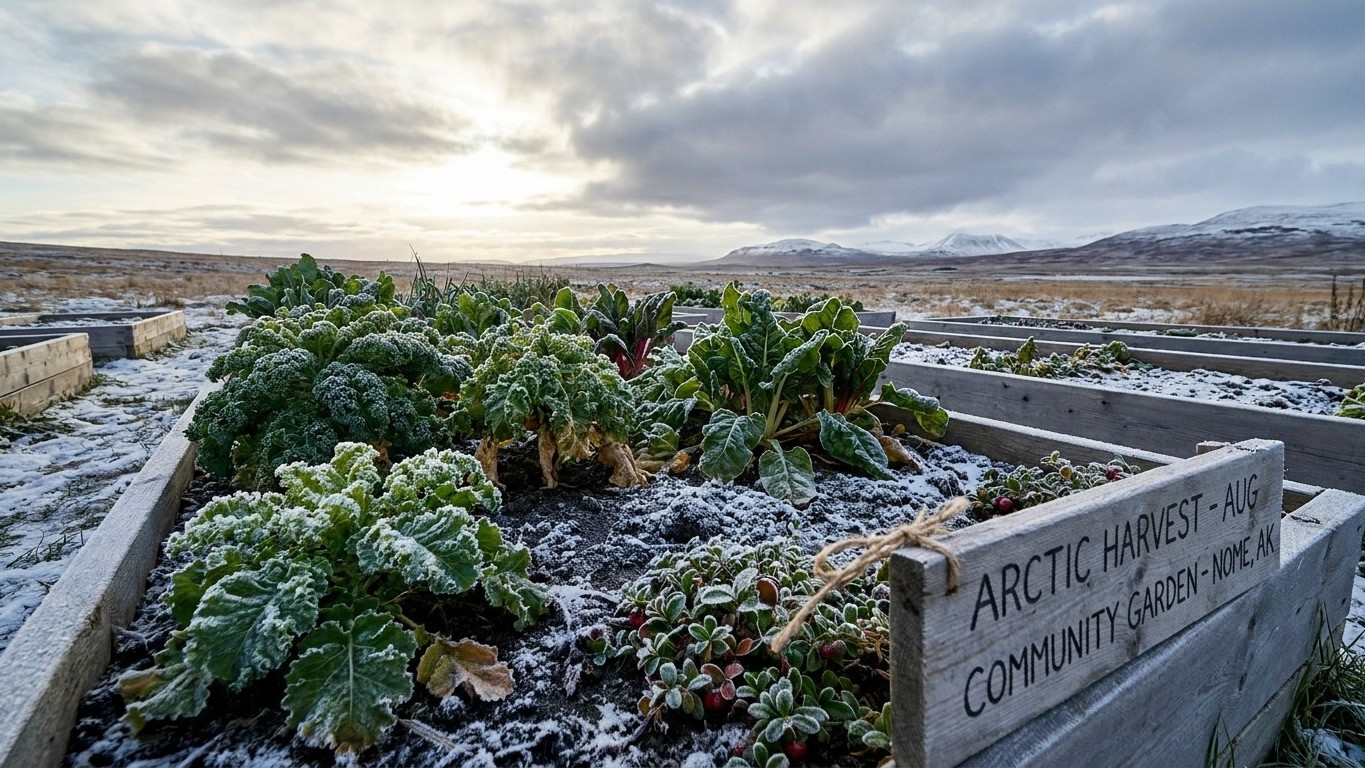

Gardening in Nunavut works on a frost-free window of roughly 86 days, bracketed by a hardiness zone so cold it barely registers on most garden references. There’s no midsummer heat problem here, no bolting lettuce in July. The limit is the cold itself, on both ends of the calendar, and it decides almost everything a gardener can realistically grow.
How long your season really is

Three numbers define what’s possible in a Nunavut garden, and they’re worth putting side by side before anything else.
| Measure | Value |
|---|---|
| Hardiness zone (Canadian system) | 0a |
| Average last spring frost | June 19 |
| Average first fall frost | September 13 |
That zone rating comes from Natural Resources Canada’s Plant Hardiness Site, and it’s worth pausing on the label: 0a is a Canadian zone, not a USDA zone, and the two systems don’t translate. The Canadian model factors in seven climate variables, the USDA model just one, and NRCan itself notes that a single Canadian zone can span nine different USDA zones. So treat 0a as its own scale entirely. It also describes the reference city behind this data, not every corner of the territory, since Nunavut stretches across enough latitude to make one climate label almost meaningless at its edges — a challenge covered in detail in Growing Pumpkins in Nunavut.
Subtract June 19 from September 13 and you get about 86 days, call it twelve weeks, of frost-free growing. That’s the entire operating window. It rules out anything that needs a long, warm run to mature outdoors: full-season tomatoes, sweet corn, pumpkins, most melons — the near-impossibility of the first of those is laid out in Growing Sweet Corn in Nunavut. Those crops need three to four months of warmth just to set and ripen fruit, and this window doesn’t offer that even in a good year — see When to Carve a Pumpkin in Nunavut for just how far off a fully mature pumpkin patch really is here, while shorter-season, heat-loving crops like peppers face their own hurdles, as covered in Growing Peppers in Nunavut. Hardier, cold-tolerant options fare much better within this window, as Growing Potatoes in Nunavut demonstrates, and root vegetables tend to do well too, a point explored in Growing Parsnips in Nunavut.
Hardier, cold-tolerant options fare much better within this window, as Growing Potatoes in Nunavut demonstrates, and root vegetables tend to do well too, a point explored in Growing Parsnips in Nunavut, while leafy greens that tolerate the cold have their own advantages, as Growing Spinach in Nunavut shows.
And “good year” is the catch. Both dates are averages pulled from Environment and Climate Change Canada’s 1981-2010 climate normals for the Rankin Inlet A station, not guarantees. An average last frost date means exactly that: in half of the years on record, frost has arrived after June 19. The other half, it’s arrived before. Treat these two dates as the midpoint of a range, not a schedule you can plant against, and build in a buffer on both ends if you’re starting anything outdoors.
What the summer does to a garden here
Zero. That’s the average number of days per year that reach 90°F at the reference station, based on the same 1981-2010 climate normals. For a lot of the country, summer heat is the thing that shuts a garden down in July: tomatoes drop their blossoms above roughly 90°F, lettuce bolts, spinach turns bitter. None of that applies here. There is no heat-driven dead zone in the middle of a Nunavut summer, because there’s essentially no heat to speak of.
That changes the shape of the whole growing year. Instead of two productive shoulder seasons bookending a scorching, unproductive midsummer, a Nunavut garden gets one short, uniformly cool stretch. Whatever gets planted has to tolerate cool soil and cool air for its entire life cycle, not just at the start and finish. Crops that actually thrive on mild temperatures, things bred for short, cool seasons, are working with the climate instead of against it.
The other number that matters is the coldest one: an average daily minimum of -29.8°F during the coldest month, again from the same station data. That’s not a record low, it’s the typical low for the hardest weeks of winter, and it tells you plainly that nothing lives outdoors unprotected here between growing seasons. Perennials, shrubs, anything meant to overwinter in open ground, needs either serious protection or a container that comes inside. The growing season is short and cool. The dormant season is long and brutally cold. There isn’t much middle ground.
Where to check before you plant
Everything above comes from one reference station, and Nunavut is too large and too varied for one station to speak for the whole territory. A single climate label can be accurate for the community it was measured in and meaningfully off for a hamlet a few hundred miles away, especially given the range of latitude involved.
Before committing to dates or crop choices, check with Agriculture and Agri-Food Canada, the federal department whose site is agriculture.canada.ca/en. It’s the federal source rather than the territorial one because the territorial agriculture site currently blocks automated verification, and a working link beats one that can’t be confirmed. From there, look for guidance specific to your own community, since local knowledge, whether through a community greenhouse project, a hamlet office, or a territorial extension contact, will always beat a general figure pulled from one weather station.
The gap between a territory-wide average and a specific community’s reality can run to weeks on either end of the season. A frost date that holds for one location may be three weeks early or late somewhere else in Nunavut, and in a growing window already this tight, three weeks is the difference between a harvest and a frozen bed.
Three Crops Worth Trying
Once you accept what the calendar and the thermometer are telling you, a handful of specific crops stop looking impossible and start looking like reasonable projects. Garlic is the clearest case: it wants a hard winter, and Rankin Inlet’s cold isn’t something to work around but something to plant into, as laid out in a guide to growing garlic in Nunavut, which walks through planting dates and varieties suited to that cold. If your ambitions run to a patch of green around the house rather than a vegetable bed, a look at Nunavut lawn care explains why warm-season turf is off the table before you’ve even chosen a variety, and what to plant and feed instead given zero days a year above 90°F. And if you’re after something more ambitious than either, a guide to growing tomatoes in Nunavut covers how to get fruit to ripen before frost, starting indoors and moving out under a season-extending structure. Each page works from the same Rankin Inlet climate normals, applied to a different crop’s actual needs.