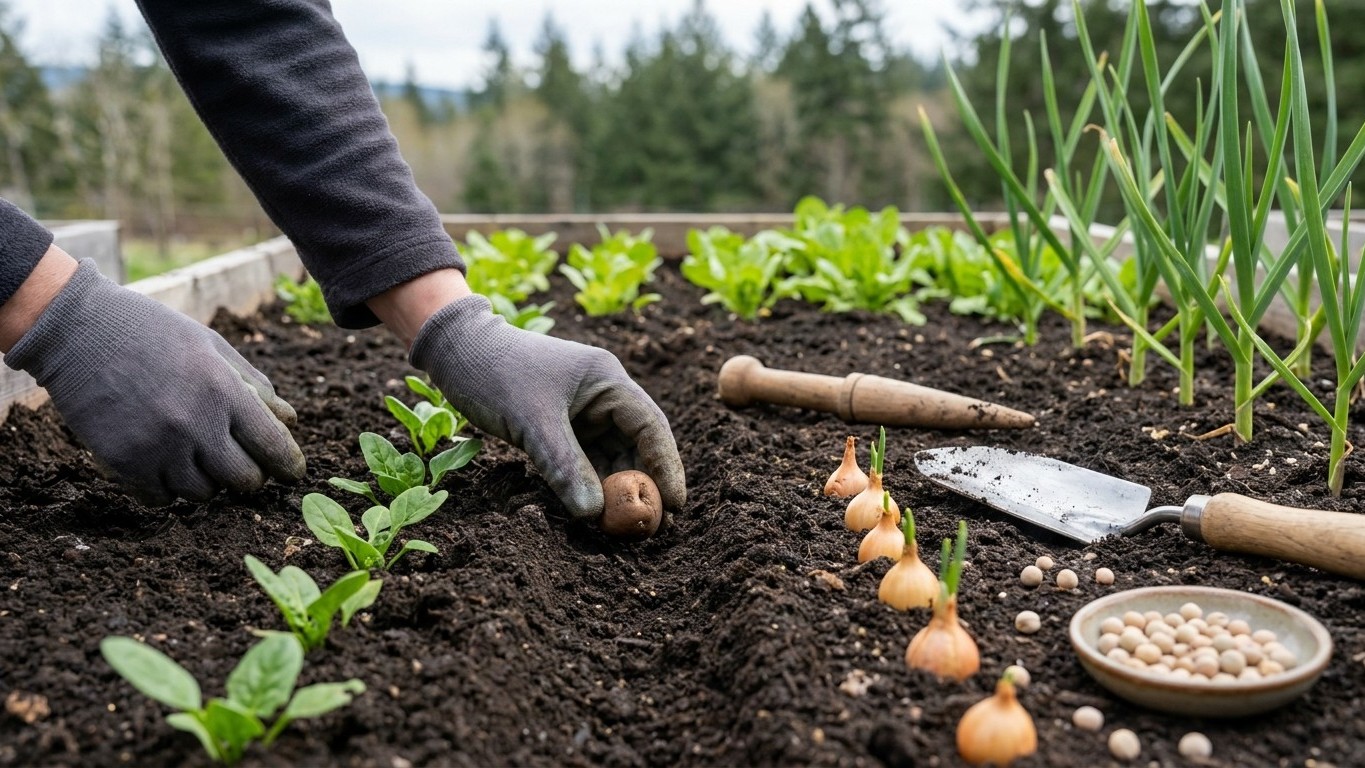

Coastal British Columbia sits well past its average last frost by the time April arrives, which makes this one of the busiest direct-sowing months of the year. Peas, hardy greens, alliums and seed potatoes can go into the ground, while tomatoes, peppers and other tender crops still need to wait their turn indoors.
What goes in the ground in April

The calendar says spring, but the decision to plant should come from the soil, not the date on a page. Environment and Climate Change Canada’s 1981-2010 normals put the average last spring frost at the Vancouver Int’l A station at March 18, which means April opens with the mean frost date already behind it. That sounds reassuring, and for the Lower Mainland and much of the coast it largely is. But a mean is not a guarantee: in one year out of two, frost arrives after that date, so the first week or two of April can still deliver a cold snap that catches tender growth off guard.
What this means practically is that the hardy crops have a clear runway. Peas and fava beans can be sown directly once the soil crumbles rather than clumps in your hand. Spinach, lettuce, arugula and other salad greens go in the same way, and they shrug off a light frost that would flatten a bean seedling. Onion sets, shallots and seed potatoes are also fair game, with potatoes best held until the back half of the month when soil has warmed and drained enough that the seed pieces won’t simply rot.
Garlic planted the previous fall is already up and growing through this stretch and needs nothing more than weeding and a side-dressing later on. Brassica transplants, cabbage, broccoli, kale started earlier under cover, can go out once hardened off, ideally with a row cover or cloche on hand for any night that turns sharply cold.
| Crop group | April status | Notes |
|---|---|---|
| Hardy greens & alliums | Direct-sow now | Tolerate a light frost without damage |
| Peas & fava beans | Direct-sow now | Germinate fine in cool, moist soil |
| Seed potatoes | Plant mid-to-late month | Wait for soil that’s workable, not soggy |
| Brassica transplants | Transplant hardened-off starts | Keep cover handy for cold nights |
| Warm-season crops | Hold off | Cold soil stunts or kills tomatoes, peppers, squash, beans |
The gap between those two ends of the table is the whole story of April gardening on this coast: half the garden is ready to go, and half is still a month or more away.
What to start under cover
This is the month to work backward from your own frost window rather than forward from a seed packet’s suggested date. Tomatoes typically need six to eight weeks of indoor growth before they’re sturdy enough to transplant, and peppers and eggplant often want closer to eight to ten. Since the average last frost sits around mid-March here, but real frost risk can stretch weeks beyond that mean, most gardeners plan to move these crops outside sometime after mid-May, once nights have settled and the soil itself feels warm to the touch, not just the air.
Counting back from a mid-to-late May transplant date puts tomato sowing in late March through early April, and peppers slightly earlier than that. If you missed that window, starting now still gives you usable transplants, just smaller ones at planting time, which is far from a disaster.
Squash, cucumbers and melons move faster and only need three to four weeks under cover, so those get started later in April or even into May for a June transplant. Basil follows a similar timeline to squash and appreciates the extra warmth of an indoor start.
The two ways this goes wrong are mirror images of each other. Start tomatoes too early, say back in January, and by transplant time they’re leggy, rootbound and stressed before they ever touch garden soil. Start them too late and they’re still small seedlings when the short days of fall arrive, with too little season left to ripen a real harvest. April sits in the sweet spot for a lot of these crops precisely because it splits the difference.
What is ready to pick
Overwintered crops carry the harvest basket through this stretch. Kale and chard that rode out winter under a bit of mulch put out fresh, sweet growth once the days lengthen, and sprouting broccoli, if you planted it the previous summer, sends up its small tender spears right around now, often before the main crop broccoli heads even form. Leeks left in the ground all winter are still perfectly good to pull, and rhubarb crowns push up their first stalks, ready to harvest once they’re a foot or so tall and the leaves have unfurled.
Asparagus beds three years old or older start throwing spears this month as soil temperatures climb, and the trick is picking them at six to eight inches before the tips loosen and start to open, since asparagus left too long turns woody fast.
Cold frames and low tunnels, if you’ve been running them, are usually still producing salad greens and maybe a few overwintered carrots, sweeter now than they were in fall because cold exposure converts their starches to sugar.
It’s also worth a walk through the root cellar or pantry. Stored potatoes, winter squash and onions can turn on you fast once temperatures inside a garage or basement climb even slightly with the season. Check for soft spots, sprouting eyes on potatoes, and squash that’s gone soft near the stem end, and use those up first rather than let them go to waste.
The jobs that matter this month
Soil preparation earns its keep more in April than almost any other month, because everything planted from here forward depends on it. Working compost or aged manure into beds before the main planting push gives roots something to grow into, and it’s far easier to do this before beds fill with seedlings than after.
Mulching comes right behind it. A layer around already-planted alliums and brassicas holds moisture as the weather warms and keeps weed pressure down before it gets ahead of you. Staking and support structures for peas and any early climbing crops should go in now too, while plants are still small, rather than after they’ve sprawled across the bed and tangled themselves.
Watering rhythm shifts this month as well. Spring rain is often generous on the coast, but a dry week can catch a bed of freshly sown seed and stop germination cold, so checking soil moisture by hand, not by guessing from the sky, matters more than it did in winter.
Succession sowing starts paying off from here forward too. Rather than planting a full row of lettuce or spinach at once, splitting it into smaller sowings every couple of weeks keeps a steady harvest coming instead of one big flush that bolts all at the same time.
Pest scouting deserves a walk through the garden every few days. Slugs are especially active in the damp, mild conditions typical of coastal April, and they can strip a bed of young lettuce or bean seedlings overnight. Catching them early with hand-picking, barriers or bait is far more effective than dealing with an established population later.
Finish any dormant pruning on fruit trees and cane berries before buds break fully open, since pruning cuts made after leaf-out heal more slowly and invite disease. And if seed orders haven’t gone in yet, the popular varieties for warm-season crops often sell out by now, so that’s a task with a real deadline attached.
What not to do in April
The classic mistake this month is trusting a warm afternoon over a soil thermometer. Air temperature climbs fast on a sunny April day, tempting gardeners to set out tomatoes or peppers, but the soil several inches down warms far more slowly, and a tender transplant dropped into cold, wet ground often just sits there stunted, or rots outright, even if it doesn’t die from actual frost.
A related error is pulling covers and mulch off too early after a mild stretch. A week of gentle weather can feel like spring has arrived for good, but since the mean last frost date carries real spread around it, a cold night can still follow, and plants that were hardening nicely under cover get knocked back hard when exposed too soon.
Nitrogen timing trips people up too. Heavy feeding right at planting, before roots have had a chance to establish, tends to push soft, leafy growth that’s more vulnerable to both cold and pests. It’s better to work compost into the soil ahead of planting and save direct feeding for once plants are actively growing and have roots to use it.
Finally, resist planting warm-season crops directly outdoors just because the calendar reads April. The safer bet almost everywhere in coastal BC is to keep them under cover a while longer and let the soil, not the wall calendar, make that call.
Checking this against your own county
Everything above is anchored to a single weather station near Vancouver, and British Columbia is anything but one climate. Elevation shifts frost timing by weeks even a short drive from the coast, the Okanagan and other interior valleys run on a very different schedule than the Lower Mainland, and northern districts lag both by a wide margin. The province’s Canadian hardiness zone of 9a, drawn from Vancouver-area data, describes that reference city, not the whole of BC.
Before committing a full bed to any of the above, check current conditions and regional guidance through the BC Ministry of Agriculture and Food, which tracks conditions specific to the province’s growing regions.
Common questions
Can I plant tomatoes outside in April in British Columbia?
Not yet in most areas. Tomatoes are killed by frost and stunted by cold soil, and since real frost risk can extend well past the mean last frost date of March 18, most gardeners keep tomatoes under cover through April and transplant once nights have reliably warmed, typically in May.
What vegetables can I direct-sow in April on the BC coast?
Peas, fava beans, spinach, lettuce, other salad greens, onion sets and seed potatoes (later in the month) are all reasonable direct-sow choices, since these crops tolerate the occasional light frost that can still occur this early in spring.
Is BC’s hardiness zone the same as a USDA zone?
No. British Columbia’s zone 9a, near Vancouver, comes from the Canadian system, which factors in seven climate variables rather than the single minimum-temperature measure the USDA system uses. The two scales don’t convert directly, so a Canadian zone number should never be read as its USDA equivalent.
When does the growing season end on the BC coast?
The average first fall frost at the Vancouver-area station is November 10, giving the coast a long growing season compared to inland BC. As with the spring date, treat this as a midpoint rather than a guaranteed cutoff.