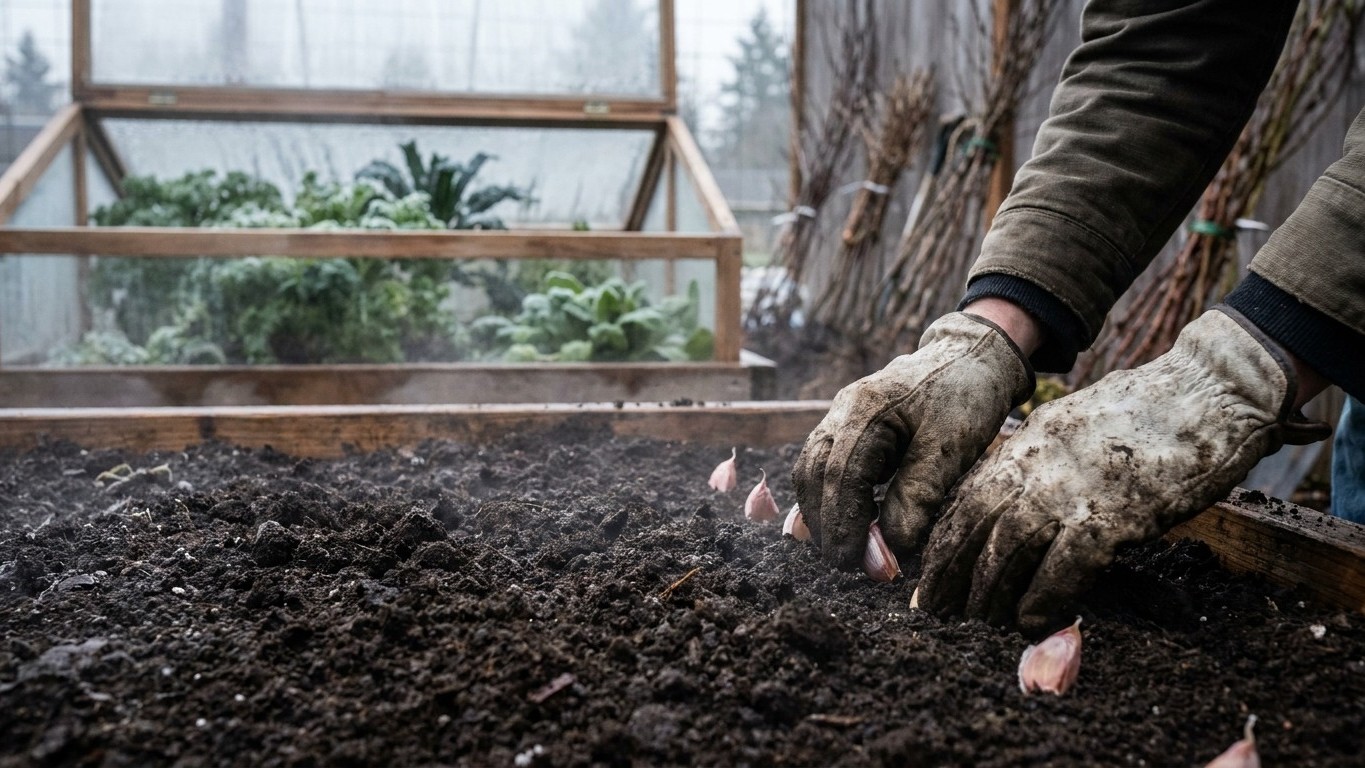

Garlic and shallots can still go into workable soil on the coast, bare-root fruit trees and canes go in while they’re dormant, and cold frames keep hardy greens alive through the cold snaps. Almost nothing else goes into open ground this month across British Columbia. The average last spring frost at Vancouver Int’l A sits around March 18, and that’s a mean, not a guarantee: in half of all years, frost arrives later than that.
What goes in the ground in January

The calendar says January. The soil doesn’t care what the calendar says. What decides whether anything can go into open ground is soil temperature and how far you sit from that average last-frost date of March 18 at Vancouver Int’l A, a figure from Environment and Climate Change Canada’s 1981-2010 climate normals. That date is a midpoint, not a finish line. Half the years on record ran later. So this month sits roughly ten weeks ahead of an average frost-free date that itself carries no promise, and on Vancouver Island or the Lower Mainland the ground is often too wet to work anyway, let alone warm enough to sprout a seed.
For most of the province, the honest answer is that direct-sown crops have no business in the open ground right now. But that’s not the same as an empty month. A few things are still worth doing outdoors where beds aren’t waterlogged:
- Garlic and shallots, ideally planted in fall but still viable in early January on the milder coast if the ground hasn’t frozen or turned to soup
- Bare-root fruit trees, cane fruit, and roses, planted while fully dormant, which is exactly what this month offers
- Cold frames and low tunnels holding hardy greens like mache, spinach, and claytonia that were sown in fall
- Peas can go in as a very early, cautious sow on the coast toward the tail end of the month, but only in free-draining soil, and they’ll sit doing nothing until the ground warms
Everywhere else, especially inland and in the north of the province where snow cover and hard freezes are routine, none of this applies. Wait for a genuine thaw and a soil test with your fingers, not a mild afternoon.
What to start under cover
Seed starting works backward, not forward. You pick your crop’s weeks-to-transplant, count back from the average frost-free date, and land on a start date. That average, again, is March 18 at the reference station, a mean that half the time undersells the real risk.
Onions and leeks grown from seed need roughly 10 to 12 weeks of indoor growth before they’re ready to go out, which lands their start date right around the first half of January. That makes this the actual window for onion and leek starts, not a random early move. Peppers, needing around 8 to 10 weeks, can also begin now or in the next few weeks depending on variety, since they tolerate a slightly later transplant date better than they tolerate being rushed. Early brassicas for spring transplant, cabbage and broccoli started indoors, fall into a similar 8-week count.
The two ways to get this wrong are mirror images of each other. Start too early, ten or twelve weeks before you have anywhere to put the plant, and you end up with rootbound, leggy seedlings straining against their pots on a windowsill. Start too late, and slow growers like onions never bulk up before the season’s heat arrives. Given that March 18 is a mean and not a safe date, err toward the earlier side of any range for slow crops, but keep pots sized up and lights close so growth stays stocky rather than stretched.
What is ready to pick
Little to nothing comes out of open ground in most of British Columbia this month. That’s a fact of the season, not a failure of planning. What still feeds a household comes from crops planted months ago and from storage, not from anything freshly harvested.
On the milder coast, overwintered kale, leeks, and winter cabbage can still be picked leaf by leaf or head by head, especially where a cold frame or a thick mulch kept the worst of the wet cold off the crowns. Brussels sprouts, if they made it through fall without rot, often taste better after cold exposure, since the plant converts starches to sugars in response to chill. Cold-frame greens, mache and spinach in particular, keep producing small pickings through the coldest stretch as long as the frame stays closed on the hardest nights.
Indoors, sprouts and microgreens are the easiest fresh green a gardener can produce this month, ready in one to two weeks with no soil and no daylight requirement beyond a sunny sill. And this is the month to walk the storage shelves. Check squash for soft spots near the stem, potatoes for green shoulders or sprouting eyes, onions for any that have gone soft at the neck. One rotting squash near good ones spreads faster than most gardeners expect, so pull it the moment you see it.
The jobs that matter this month
This is the busiest quiet month on the calendar. Nothing is growing fast, so the work that matters is the work that sets up everything that will grow later.
Dormant pruning tops the list. Apple, pear, and stone fruit trees, along with raspberry and blackberry canes, are cut back while they’re fully asleep and the structure of the plant is easy to see without leaves in the way. Pruning now, before sap starts moving, reduces stress on the plant and lets you make cleaner cuts. Fruit tree wood cut in January also roots reasonably well if you want to try grafting or cuttings later.
Seed ordering belongs here too, and it’s easy to underrate. Popular varieties, particularly of onions, leeks, and anything a seed company markets as a limited release, sell out well before spring planting season arrives. Ordering now means the seed is in hand when the counting-back schedule from the last section says to start it.
Beyond that, this month covers the groundwork that never shows up in a harvest photo:
- Testing and amending soil pH and organic matter while beds are empty and workable
- Turning compost piles to keep decomposition moving through the cold
- Cleaning and sharpening pruners, loppers, and shovels before the spring rush
- Repairing raised beds, trellises, and fencing while nothing is in the way
- Planning crop rotation on paper before seed orders lock in the layout
None of this is filler work. Skip the pruning window and you’re cutting into active growth later, with more stress on the tree and a longer recovery. Skip the seed order and you’re planting whatever’s left on the shelf.
What not to do in January
The most common mistake this month has nothing to do with cold. It’s working wet soil. Coastal British Columbia clay, when squeezed and worked while saturated, compacts into something closer to brick than garden bed, and that compaction can take a full season to reverse. If a handful of soil forms a slick ribbon rather than crumbling, leave the bed alone.
The second mistake is trusting a mild stretch of weather. A few days in the mid-50s on the coast can feel like an invitation to pull the cover off a cold frame or push a marginal seedling outside early. But a single warm spell doesn’t move the average last-frost date, and that date, remember, already undersells the real risk since frost falls later than March 18 in half the years on record. Uncovering hardy crops during a mild snap only to have them hit by the next cold night undoes weeks of protection in one evening.
The third mistake is feeding nitrogen at the wrong moment. Dormant trees and perennials aren’t pulling nutrients from the soil right now, and a dose of high-nitrogen fertilizer this month either washes away in winter rain or, worse, sits ready to push soft, frost-tender growth the moment temperatures tick up, growth that a late cold snap will burn back. Save the feeding for when roots are actively growing, closer to the point where soil temperature, not air temperature, has genuinely turned the corner.
Checking this against your own county
Every figure in this article traces back to one weather station, Vancouver Int’l A, and one hardiness zone rating for a single reference city. British Columbia is not one climate. Coastal valleys, the dry interior, mountain elevations, and the north each run on their own schedule, sometimes weeks apart from the coastal average, and the province’s Canadian hardiness zone of 9a applies to that reference city alone, not to the whole province, and doesn’t convert to a USDA zone at all since the two systems are built differently.
Treat everything here as a starting point. For a reading tuned to your own elevation and district, check the BC Ministry of Agriculture and Food’s extension resources before locking in a planting date.
Common questions
Can you plant garlic in January in British Columbia?
Yes, on the milder coast, if the ground hasn’t frozen and isn’t waterlogged. Fall planting gives better results, but an early January planting still has time to establish before spring growth starts.
What is the hardiness zone for coastal British Columbia?
The reference city sits in Canadian hardiness zone 9a, based on Natural Resources Canada’s 1991-2020 data. This is the Canadian system, built on seven climate variables, and it does not translate to a USDA zone number.
When does the last frost typically hit British Columbia?
At the Vancouver Int’l A station, the average last spring frost falls around March 18, based on Environment and Climate Change Canada’s 1981-2010 climate normals. That’s a mean date, so frost arrives later than that in roughly half of all years.
What should I start indoors in January for a British Columbia garden?
Onions and leeks from seed, since they need 10 to 12 weeks before transplant, along with peppers and early brassicas at 8 to 10 weeks. Counting back from the average frost date puts all of these squarely in this month’s window.