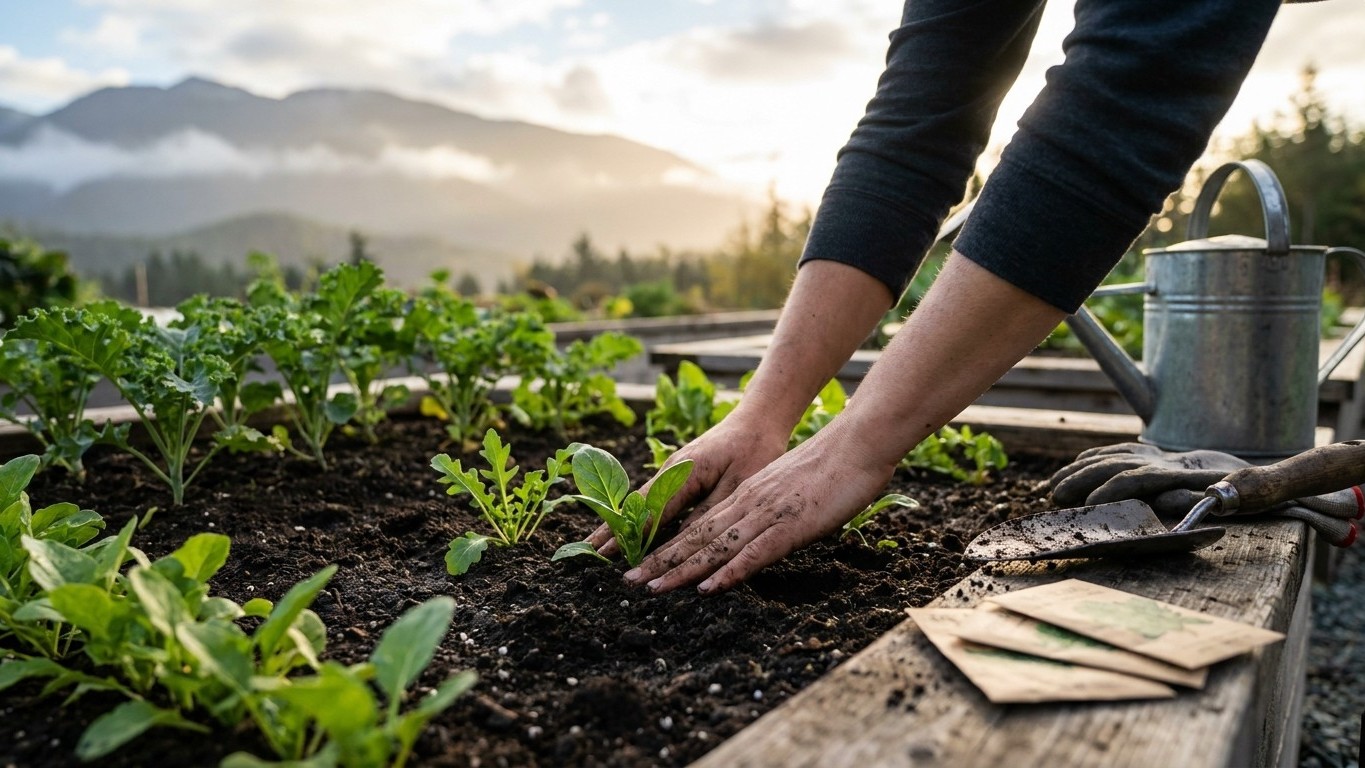

September in coastal British Columbia sits in the last stretch of open-ground gardening before fall rains and shortening days take over. Around Vancouver, the average first fall frost lands November 10, so there are still roughly ten weeks of frost-free growing left when the month opens. That’s enough time for a full round of fast greens, a start on overwintering crops, and the last harvest push for anything still ripening from summer.
What goes in the ground in September

Soil temperature, not the calendar, decides what will actually size up before the light fades. Coastal BC soils are still warm from summer sun in early September, which is exactly why this is a workable planting window rather than a dead zone. The average first fall frost at Vancouver Int’l A is November 10, but that’s a mean date from a thirty-year record, not a promise. In one year out of two, frost arrives earlier. Treat the countdown as generous, not fixed.
Direct-sown crops that handle this timeline well include spinach, mâche (corn salad), arugula, radishes, turnips, and mesclun mixes built for cool weather. These germinate fast and tolerate the first light chills without complaint. Fava beans meant to overwinter can go in from mid to late September in milder coastal pockets, though colder interior valleys should hold off until conditions there confirm it’s safe.
Transplants make more sense than seed for anything that needs a head start. Overwintering onion sets and transplants, along with kale, collards, and other brassica starts grown earlier in summer, can go into the ground now to establish roots before growth slows. Garlic is the classic exception: on the coast it’s typically planted later, into October or November, once soil cools further, though colder interior districts sometimes start earlier. Cover crops like fall rye or crimson clover are a smart use of any bed that’s emptied out, protecting soil structure through the wet months ahead.
Remember that Vancouver’s Canadian hardiness zone is 9a, a rating built on seven climate variables and not comparable to the single-variable USDA scale used elsewhere. It describes the coastal reference station, not the whole province.
What to start under cover
Working backward from the frost window is more reliable than working forward from today’s date. If the average first fall frost falls around November 10, and a given lettuce variety needs about eight weeks to reach usable size, seed started under cover in early September should be well established by the time cold really bites, with a buffer built in for the mean-date uncertainty already mentioned. Push that same sowing another two or three weeks later and the plant may still be small and vulnerable when the cold arrives.
Cold frames and unheated tunnels extend this math further. Hardy lettuce, spinach, and pak choi sown in trays now and moved under cover once true leaves appear can keep producing well past what open ground allows, because the cover buys several degrees of protection and slows the drop in soil temperature.
Two mistakes show up every year. The first is starting too early, when late-summer heat is still around: seedlings stretch, get leggy, and become rootbound before there’s anywhere cool enough to plant them out. The second is starting too late, when the shortening daylight of autumn (sometimes called the low-light period) means growth nearly stops regardless of temperature. Splitting the difference by seeding in early-to-mid September, then transplanting as soon as seedlings have a couple of true leaves, avoids both traps.
What is ready to pick
September is a genuine harvest month on the coast, not a transition to bare beds. Tomatoes, peppers, and summer squash are typically still producing early in the month, especially in sheltered gardens, and it’s worth picking them consistently since a single mean frost date doesn’t tell you exactly when growth will stop. Corn and pole beans are usually finishing up. Tree fruit, including apples, pears, and plums, often peaks now depending on variety, and the simplest ripeness check is a gentle twist: fruit that’s ready separates from the branch with almost no resistance.
Winter squash and pumpkins should be left on the vine until the skin resists a fingernail scratch, then cut with a few inches of stem attached and cured in a warm, dry spot for a week or two before storage. Potatoes grown for storage are commonly dug once the foliage has died back, then left to dry out of direct sun for a day before being moved somewhere cool and dark.
Anything already in storage from midsummer, cured onions, garlic braids, early potatoes, deserves a check this month too. Soft spots, sprouting, or a sweet fermented smell mean that item needs to be used immediately or composted, not left to spoil the rest of the batch.
The jobs that matter this month
A few tasks done now save real trouble later, and several have hard deadlines tied to the season, not to preference.
Bed preparation for garlic and overwintering alliums should start well before actual planting, since compost and amendments need time to settle into the soil before roots go down. Mulching around anything left in the ground, whether that’s a fall crop of carrots or perennial herbs, helps buffer the first cold snaps and holds moisture as rainfall patterns shift. Staking tall fall brassicas before wind and rain arrive prevents the kind of toppling that snaps stems.
Watering rhythm needs adjusting rather than abandoning. Coastal BC often sees a dry stretch in early September before fall rains set in, so beds shouldn’t be left to dry out just because summer is winding down. Succession sowing of quick greens like radish and mâche can continue every couple of weeks as long as there’s daylight to support germination.
Pest scouting matters more than gardeners expect this time of year. Cabbage moth and aphid pressure on fall brassicas often spikes in early fall, and catching an infestation while it’s small is far easier than fighting it once populations establish.
Beyond the beds themselves, September is a practical moment for dormant-season prep even though it isn’t dormant yet: order garlic and overwintering onion sets before good varieties sell out, start planning next season’s crop rotation, and get compost turned while there’s still warmth to speed the process along. Tools used hard all summer are worth cleaning and sharpening now, before they sit unused through winter.
What not to do in September
The most common misstep is treating a warm September stretch as an excuse to sow heat-loving crops like beans or squash outdoors again. Warm air doesn’t mean warm enough soil for germination, and even if seeds sprout, there usually isn’t enough remaining season to bring them to harvest before growth slows for the year.
Another frequent error is uncovering cold frames or row covers too early after a mild spell, assuming the cool weather has passed. It hasn’t, not reliably, since the November 10 average frost date is a midpoint, and colder snaps can and do arrive well before it in roughly half of all years. Keep protective covers ready to go back on rather than storing them away.
Feeding nitrogen-heavy fertilizer late in the growing season is also a mistake gardeners repeat. It pushes soft, leafy growth that hasn’t had time to harden off before cooler nights arrive, making that new growth more vulnerable to cold damage than if the plant had been left to slow down naturally. If a fall feeding is needed at all, a balanced or lower-nitrogen option supports root and overall plant health without forcing tender new shoots.
Leaving winter squash in the field past the point of a light frost is another avoidable loss. A touch of cold can damage the skin enough to shorten storage life significantly, so it pays to harvest ahead of any forecast cold snap rather than after one.
Checking this against your own county
Every date and zone figure here comes from a single coastal station, Vancouver Int’l A, and British Columbia is not one climate. Elevation changes things fast: interior valleys, the Okanagan, the Cariboo, and mountain districts can run weeks behind the coast in both spring warm-up and fall frost arrival. Coastal fog and lake effect near larger water bodies shift local timing further still.
Treat everything above as a starting point, then confirm it against local conditions through the BC Ministry of Agriculture and Food’s extension resources, which cover regional growing conditions across the province in more detail than a single provincial average ever could.
Common questions
Is it too late to plant vegetables in September in BC?
Not on the coast. With an average first fall frost around November 10, there’s usually enough season left for fast greens, radishes, and overwintering transplants, though warm-season crops like beans or squash are no longer worth starting from seed.
Can I still plant garlic in September?
Coastal gardeners typically wait until October or November when soil has cooled further, though some interior growers plant earlier depending on local conditions. Late September is usually reserved for bed preparation rather than planting the cloves themselves.
What’s the difference between the Canadian hardiness zone and the USDA zone?
The Canadian system, which rates Vancouver at 9a, is built from seven climate variables including wind and snow cover, while the USDA system uses only winter minimum temperature. Natural Resources Canada is explicit that the two scales don’t convert directly, so a Canadian zone number should never be treated as equivalent to a USDA one.
How reliable is the November 10 frost date for planning?
It’s a thirty-year average, not a guarantee. Because it’s a mean date, frost arrives later than November 10 in about half of all years and earlier in the other half, so it works best as a planning midpoint rather than a safe cutoff for tender crops.