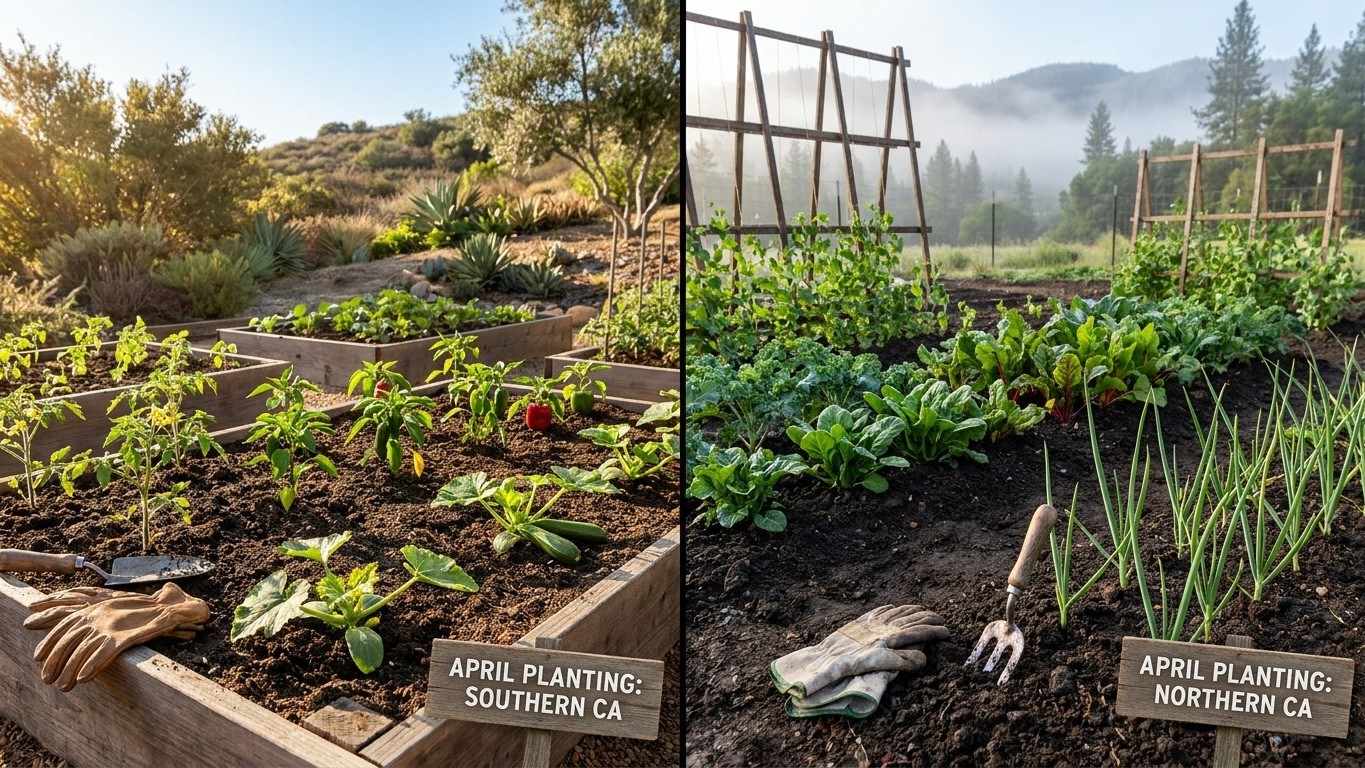

April is the month California splits in two. Along the coast and through Southern California, where frost simply doesn’t happen, this is prime time to set out tomatoes, peppers, squash, beans and melons, while cool-season crops race to finish before the heat arrives. In the Central Valley, Sierra foothills and interior Northern California, frost risk can still linger, so hardy greens, alliums and peas go in first while tender transplants wait for the soil to catch up.
What goes in the ground in April

The state’s climate diversity means “plant in April” answers two different questions depending on where you garden. NOAA climate normals for the coastal and Southern California reference station show zero days at or below 32°F across three decades of record, with a frost-free season listed at 365 days. That’s not an exaggeration, it’s the measured normal. In these zones, frost isn’t the limiting factor for April planting. Heat and water are. By this point in spring, soil has typically warmed enough to set out tomatoes, peppers, eggplant, summer squash, cucumbers, beans and melons directly or as transplants, and corn can go in as direct-sown seed once the ground is no longer cold to the touch.
That same freedom doesn’t extend to the Central Valley, the Sierra foothills, or the interior valleys of Northern California, which sit in a very different part of the USDA hardiness range for this state (the map spans 5a to 11a, and that spread is the whole story). These areas still experience real frost events into spring, and the published data for this page doesn’t include a computable freeze date for those inland zones. That’s not an oversight, it means local variation is too wide to compress into one statewide number. Gardeners in those regions should treat April as a transition month rather than a green light: hardy crops go in now, tender ones wait for confirmed local conditions.
What’s safe almost everywhere in the state this month is the hardy tier: onions, garlic, shallots and leeks where soil is workable, along with peas, spinach, lettuce, and the cole crops (broccoli, cabbage, cauliflower) as transplants. These tolerate the occasional cool night far better than a squash seedling does, and they give inland gardeners something productive to do while they wait out the last frost risk.
What to start under cover
Seed-starting math works backward from your local frost window, not from a date on a calendar. For gardeners in frost-free coastal and Southern California zones, that backward count is less about survival and more about beating the heat: tomatoes, peppers and eggplant started under cover roughly six to eight weeks before you intend to transplant will be sturdy enough to handle outdoor conditions without stalling in a cold snap that, statistically, isn’t going to happen anyway.
In the Central Valley, Sierra foothills and interior Northern California, that same six-to-eight-week count matters for a different reason: it determines whether tender transplants are ready right as the soil and air finally warm, instead of sitting rootbound in trays for weeks past their prime. This page doesn’t carry a specific last-frost date for those inland zones, so the right move is pulling the local frost data from your county extension office and counting backward from there rather than guessing.
Two mistakes show up every spring. Start too early, and warm-season seedlings outgrow their containers before it’s safe or warm enough to plant them out, turning into leggy, stressed plants that never fully recover once transplanted. Start too late, particularly in the warmer interior valleys, and seedlings meant for a mild spring transition instead get slammed by a heat spike before they’ve built real root systems, which especially punishes lettuce, spinach and other cool-season starts that bolt fast once temperatures climb.
Melons, winter squash and pumpkins benefit from an indoor head start almost everywhere in the state, since their long season means every week of early growth under cover translates into an earlier, more reliable harvest later.
What is ready to pick
April harvests in California lean heavily on what was planted through fall and winter. Overwintered lettuce, spinach, kale and other greens are usually at their sweetest right now, before rising temperatures push them toward bolting. Peas planted earlier in spring or through mild winter stretches are typically starting to fill their pods, and the tell is simple: pods that feel firm and rounded, not flat or papery, are ready.
Coastal and Southern California gardeners are often finishing up citrus this month. Late-season navel oranges are winding down their harvest window, and the fruit is ready when it separates easily from the branch with a gentle twist rather than a hard pull. Artichokes, a coastal California specialty crop for home gardens as much as commercial ones, are typically approaching their peak, with buds harvested while still tight and before the scales begin to loosen.
Strawberries planted the previous fall in mild-winter zones are often starting to ripen, and color is the only reliable test, since a berry that looks red but hasn’t fully colored at the shoulders usually hasn’t developed full sweetness yet. In cooler inland zones where the growing season lags behind the coast, April harvests are lighter, limited mostly to the same overwintered greens and any stored alliums, potatoes or winter squash from the previous season. Check stored crops now for soft spots or sprouting, since anything starting to turn should be used first rather than left to spoil the rest of the batch.
The jobs that matter this month
Irrigation setup earns top billing this month in a state where water, not frost, is the defining constraint on gardening. Drip lines and soaker hoses installed or checked now, before the heat ramps up, save far more water over the season than any amount of careful hand-watering later. This is also the moment to mulch beds heavily, since a two-to-three-inch layer applied before the soil dries out traps moisture that would otherwise evaporate straight through the warming months ahead.
Staking and caging go in now for tomatoes, peppers and vining crops, before plants sprawl and root systems get disturbed by late support installation. Waiting until a tomato plant has flopped over means untangling stems that have already taken root where they touch soil, which sets the plant back more than the staking itself would have.
Succession sowing of lettuce, spinach and other quick cool-season crops should happen in overlapping batches through this month rather than all at once, since a single planting will all bolt together the moment a heat spike arrives. Sowing a new short row every couple of weeks keeps a harvest coming instead of an all-or-nothing crop.
Pest scouting matters more in April than almost any other month, because aphid populations can explode on tender new growth faster than most gardeners expect. Checking the undersides of leaves on brassicas, peas and new transplants now, before populations build, means a quick blast of water or insecticidal soap handles the problem instead of a full-blown infestation later. Citrus growers should also watch new flush growth for leafminer damage and treat early rather than after leaves are already scarred.
What not to do in April
The most common mistake in California’s colder interior is trusting a warm afternoon over the actual soil temperature. A string of 75-degree days in the Central Valley or Sierra foothills feels like summer, but if the ground hasn’t caught up, tomatoes and peppers set out too early simply sit and sulk, sometimes for weeks, instead of growing. Checking soil temperature with a simple thermometer before transplanting beats guessing from air temperature every time.
In frost-free coastal and Southern California zones, the opposite mistake shows up: gardeners assume there’s no risk at all and overwater tender new transplants during a state where water restrictions are a real, recurring constraint. Deep, less-frequent watering builds stronger root systems than frequent shallow watering, and it uses less water overall, which matters in a state where drought conditions return often enough to plan around.
Nitrogen timing trips up plenty of tomato growers statewide. A heavy dose of high-nitrogen fertilizer early in the season pushes lush green foliage at the expense of flowering and fruit set, meaning a gorgeous-looking plant that produces disappointingly little. Balanced or phosphorus-leaning fertilizer at planting time, with nitrogen added later once fruit is setting, produces a better harvest than front-loading nitrogen out of habit.
Uncovering cold frames or row covers too early after a mild stretch is a real risk in the inland zones, where a warm week can be followed by a cold snap that catches exposed seedlings off guard. Keeping covers handy and checking forecasts before fully removing protection costs nothing and prevents losing weeks of growth to a single bad night.
Checking this against your own county
A statewide planting month is a starting point, not an instruction, and California proves that better than almost any other state. Elevation alone can shift planting windows by weeks between a Sierra foothill garden and a valley floor a few miles away, and the difference between coastal fog belts, inland heat, and the frost-free south versus the freezing north is enormous. The USDA Plant Hardiness Zone Map puts the state’s range at 5a to 11a, which is nearly the full range the system covers nationwide packed into one state’s borders.
The most reliable next step is checking conditions against your specific county rather than the state as a whole. The University of California Agriculture and Natural Resources extension service maintains local planting guidance suited to California’s fractured microclimates.
Common questions
Is April too late to plant tomatoes in California?
Not in frost-free coastal and Southern California zones, where April is often prime transplanting time. In the Central Valley and Sierra foothills, it depends on whether the soil has warmed and local frost risk has passed, which varies enough that county-level extension guidance is more useful than a statewide date.
Does California really not get frost?
Coastal and Southern California, where NOAA climate data shows a 365-day frost-free season at the reference station, genuinely doesn’t get frost in an average year. But the Central Valley, Sierra foothills and interior Northern California absolutely do freeze, and treating the whole state as frost-free is a common and costly mistake.
What can I direct-sow outdoors in April in cooler parts of the state?
Hardy crops handle the uncertainty best: peas, spinach, lettuce, onions, garlic and the cole crops as transplants. Warm-season crops like beans, squash and corn should wait until soil temperature and local frost risk clearly support them.
Why is water management more important than frost protection in April?
Because for most of California’s population centers, drought and water restrictions are the recurring seasonal constraint, not cold. Setting up efficient irrigation and mulching now matters more for most gardeners than worrying about a frost event that, in frost-free zones, isn’t statistically expected to happen.